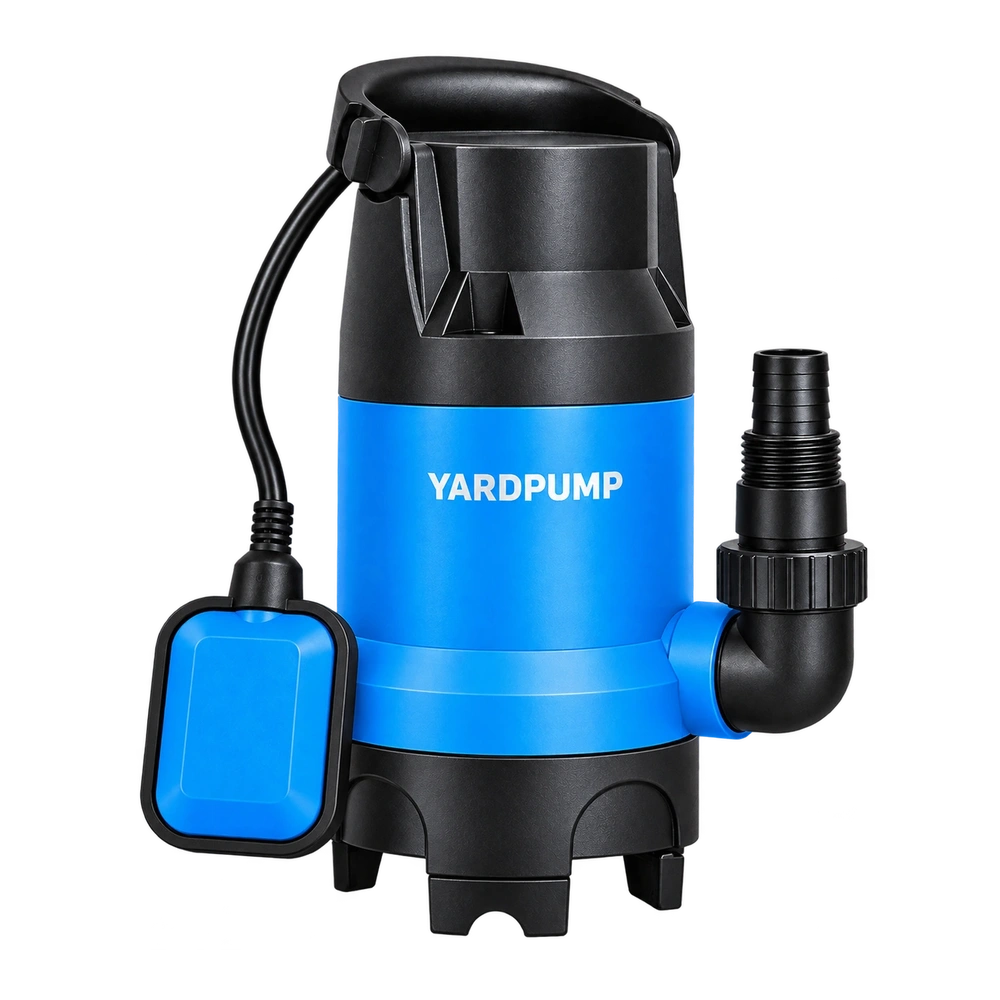
YARDPUMP application expert
“I just need a submersible pump. Why are there clean-water, dirty-water, sewage, low-level and sump versions if they all sit under water?”
This is the first confusion many buyers have. Product pages group pumps by power or appearance, while real applications are separated by liquid, solids, residual-water target, control method and hydraulic duty. Two compact pumps can look similar and still belong to different jobs.
“Submersible” is only the installation concept. The useful selection starts with the liquid and duty, then checks the hydraulic path, motor, sealing, control and complete construction for that job.
Think of it like this
“Submersible pump” is a category like “vehicle,” not a complete specification
Calling something a vehicle tells you it moves people or goods, but it does not tell you whether you need a bicycle, van, excavator or ambulance. “Submersible” works the same way: it tells you the pump and motor are designed to operate with the pump submerged, but it does not define the liquid, solids or hydraulic duty.
A clean-water utility pump, a dirty-water drainage pump, a low-level pump and a sewage pump can all be submersible. Their inlet geometry, impeller, passage size, controls, materials and intended operating envelope can be very different.
Once you treat “submersible” as the top-level family rather than the final buying label, pump selection becomes much easier.
What is actually inside
Every submersible pump is a five-part engineering system
The motor supplies torque. The hydraulic end converts that torque into flow and head. The sealing system keeps liquid out of the motor. The controls decide when the pump should run. The installation—hose, outlet, submergence and surrounding space—decides how the whole unit behaves in reality.
A product can be strong in one area and still be wrong for the application. A high-flow hydraulic design does not compensate for a float that cannot move in a narrow pit. A corrosion-resistant housing does not make a clean-water impeller suitable for stringy sewage. A strong motor does not erase an undersized discharge hose.
Good engineering is the alignment of these systems around one duty, not the presence of one impressive component.
A composite buyer story
The pump that was “too small” was really the wrong family
Imagine a user emptying a rain pit that collects leaves and gritty sediment. The first pump is a compact clean-water model chosen because its wattage and maximum flow look sufficient. It moves water well when the pit is clean, then repeatedly clogs or wears as storm debris accumulates.
The instinct is to buy a larger version of the same pump. But the problem is not necessarily size. The liquid category has changed the job. The useful questions are now debris type, solids passage, abrasion exposure and whether low-level cleanup still matters.
Moving to the correct pump family can solve more than doubling wattage because the hydraulic path now matches the water.
Map the main jobs
The water tells you which family to investigate first
Relatively clean drainage and transfer favor designs optimized for clean water and efficient flow. Dirty-water drainage adds soft solids and debris tolerance. Low-level utility work prioritizes how little water can remain. Sump applications add automatic control, basin geometry and cycling behavior. Sewage and true solids-handling duties require purpose-built passages and application limits.
Groundwater and pressure applications can use very different multistage submersible architectures from compact household drainage pumps. This is another reason not to generalize from one submersible category to all others.
Manufacturer literature reflects this separation: liquid characteristics, duty points, controls and application requirements are treated as primary selection inputs.
What good engineering looks like
A better pump is not simply the one with more watts or more metal
Good engineering means the pump can produce the required flow at the actual working head while staying inside its intended liquid, temperature, control and cooling limits. It also means the materials and sealing system fit the exposure and the design can be manufactured consistently.
Headline values such as Qmax, Hmax and input power are useful descriptors, but they are not a quality score. Reliability can be damaged by operating far from the intended duty, by excessive starts, by insufficient cooling, by chemical incompatibility or by abrasive solids.
For buyers, this shifts the question from “Which specification is biggest?” to “Which complete construction has margin against the failure modes in my application?”
One map, different decisions
Homeowners, distributors and OEM buyers use the same framework at different depth
A homeowner may only need four answers: what is in the water, how high and far it must move, how dry the area must finish and whether automatic control is needed. A distributor needs those same answers translated into clear product categories and honest application boundaries.
An OEM buyer goes deeper into voltage/frequency, cable, materials, seal arrangement, control, validation and documentation. The decision tree is still the same; only the level of detail changes.
That is why a useful pump guide should create a mental map first, then let the reader zoom in.
Where general guides stop
The final answer always belongs to the exact model data
General pump families help narrow the field, but the model datasheet decides the actual limits. Solids size, pH/material range, temperature, submergence, cable, control behavior, residual-water level and performance curve should be checked for the exact configuration.
If the liquid is chemically aggressive, highly abrasive, viscous, explosive, sewage-heavy or otherwise unusual, a general household submersible-pump guide is not enough.
YARDPUMP expert takeaway
Do not choose “a submersible pump.” Choose a pump family for a defined liquid and job. Once the water, duty and control are clear, power, materials and price become meaningful comparisons instead of shortcuts.