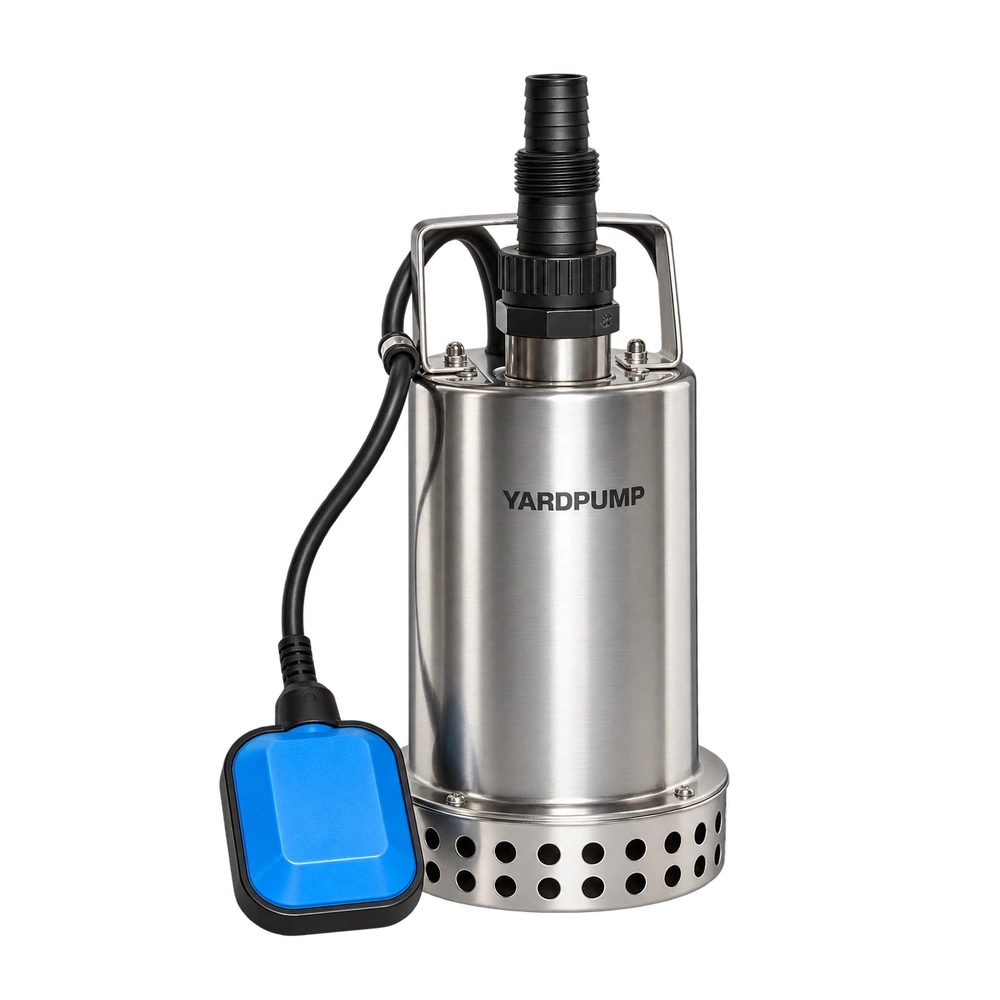
YARDPUMP engineering explainer
“If I upgrade the seal or choose more metal, can I make the pump last longer?”
Warranty discussions often search for one guilty component: the seal leaked, the motor overheated, the impeller wore, the cable entry failed. Engineering guidance points in a different direction—operating point, cooling, starts, liquid chemistry, abrasion and component interfaces can combine into one failure chain.
Reliability comes from keeping several margins healthy at the same time. A premium component cannot compensate indefinitely for overheating, incompatible liquid, dry running, excessive cycling or an operating point the pump was not designed to sustain.
A composite failure chain
The seal leak may be the last event, not the first cause
Imagine an automatic pump in a small basin. Heavy inflow makes it start repeatedly. The installation allows only limited cooling around the motor, and the pump sometimes runs near minimum submergence. Months later, moisture appears in the motor area and the seal is blamed.
The seal may indeed be damaged, but the useful investigation asks what happened before the leak. Repeated starts create thermal cycles. High temperature changes elastomer behavior and lubricant condition. Shaft or bearing wear can change alignment. Abrasive particles can damage seal faces.
The final failure component is therefore not always the original root cause. Reliability analysis works backward through the chain.
Think of it like this
A submersible pump is more like a waterproof watch than a bucket with a motor
A waterproof watch survives because the case, gasket, crystal, crown and assembly tolerances all maintain one barrier. Installing an expensive gasket in a warped case does not create a reliable watch.
A submersible pump is similar. Seal faces, elastomers, shaft finish, alignment, oil or lubrication arrangement, cable entry and pressure/temperature conditions work together to keep water away from the motor.
This is why “double mechanical seal” or a named face material should be treated as part of a system, not as a universal reliability badge.
Heat
Motor temperature is created by electricity, load, cooling and cycling together
Motor overheating can come from electrical conditions such as under- or overvoltage, from mechanical load, from blocked hydraulics, from high-viscosity liquid or from too many starts. Submersible motors add another variable: the surrounding liquid may be part of the cooling path.
Manufacturer guidance specifically notes that inadequate fluid flow around some submersible motors can allow excessive heating. In open tanks or dry-installed arrangements, a cooling sleeve or jacket may be required to force liquid past the motor surface.
This means “the motor runs underwater” is not a complete cooling analysis. The installation determines how heat actually leaves the motor.
Seals
Seal life depends on faces, alignment, lubrication and temperature—not the material name alone
Mechanical seal faces need the correct contact, surface condition and lubrication environment. Dry running or loss of the intended liquid film can generate heat quickly. Misalignment or shaft movement can disturb the face relationship.
Elastomers in the sealing system also respond to temperature and chemistry. A seal arrangement suitable for ordinary clean water may not be suitable for a solvent, hot liquid or abrasive slurry.
For OEM work, the specification should therefore identify the validated arrangement and application limits rather than describing the seal with one material word.
Materials
Corrosion resistance and abrasion resistance solve different problems
A material can perform well in clean water and poorly in chloride-rich or chemically aggressive liquid. Another material can resist corrosion yet wear rapidly under hard abrasive particles. Temperature can change both chemical attack and elastomer life.
Hydraulic Institute material-selection guidance treats corrosive and erosive fluids as explicit pump-selection concerns. This is the correct mindset: identify the dominant mechanism before selecting the material upgrade.
A stainless-looking housing cannot guarantee compatibility if the shaft, fasteners, seal faces, elastomers or cable entry remain the limiting parts.
What “upgrade” should mean
The best reliability upgrade may be a control or installation change, not a more expensive component
If failures begin with short cycling, increasing the switching range may reduce thermal cycling more effectively than changing the seal. If the motor runs too hot because cooling flow is poor, fixing installation flow can matter more than changing winding material.
If sand is wearing hydraulics, a different pump family or abrasive-duty design may be more rational than hardening one isolated part. If chemistry attacks elastomers, changing only the housing does not solve the leak path.
Reliability engineering asks which intervention removes the root stress with the least new complexity.
Who should care
Failure chains connect service teams, OEM buyers and product engineers
A service technician needs the sequence of symptoms. A distributor needs to know whether the product was used outside its intended liquid or control range. An OEM buyer needs controlled BOM and application limits. A product engineer needs returned-product evidence that connects field conditions to the failed interface.
The strongest warranty database therefore records more than “seal leak” or “motor burned.” It records application, voltage, runtime, cycling, liquid, solids, submergence and the physical failure evidence.
Where this guide stops
Root-cause analysis needs the actual failed unit when consequences are high
General failure mechanisms can guide troubleshooting, but they cannot prove the cause of a specific returned pump without inspection, electrical tests and application evidence.
For safety-critical, chemical, sewage or high-duty service, use formal failure analysis and model-specific manufacturer instructions rather than inferring root cause from symptoms alone.
YARDPUMP expert takeaway
Do not ask only which part failed. Ask which stress started the chain. The longest-lived pump is usually the one whose motor, seal, materials, control and installation all have enough margin for the same real duty.