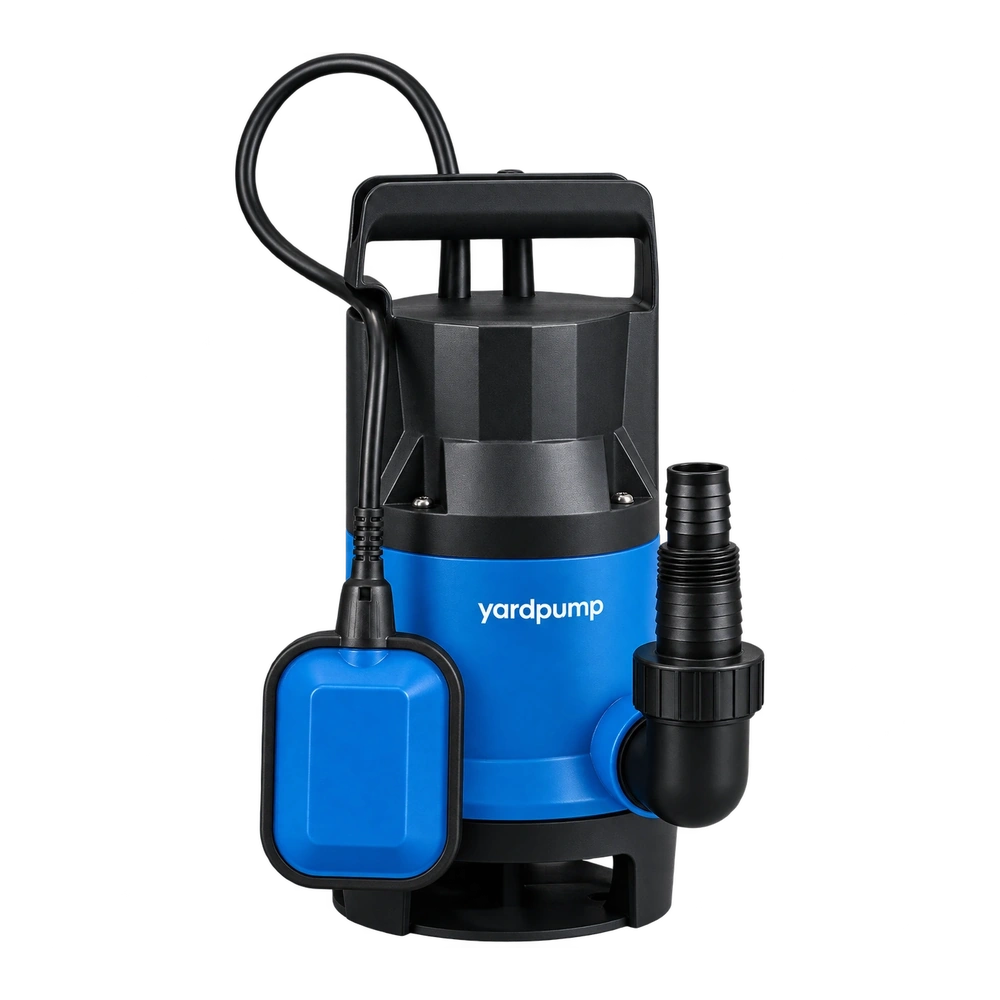
Two meters on a single-phase submersible pump agree on voltage and current but report different watts. One report used root-mean-square voltages and currents multiplied by the cosine of the fundamental phase angle. The other recorded averaged instantaneous power. If the waveform is distorted, those calculations are not generally equivalent. Ask for true active power at a defined boundary, along with the instrument settings and the operating point, before comparing pump efficiency.
Apparent power and active power answer different questions
Root-mean-square voltage and current describe the effective magnitudes of their respective waveforms. For a single-phase circuit their product is apparent power, in volt-amperes. Active power is the average of the instantaneous product of voltage and current over a representative interval. Their ratio is the true power factor. When both waveforms are sinusoidal at the same frequency, the cosine of their phase difference equals that ratio. With harmonic content, the displacement factor describes the fundamental frequency alone; it does not cover the whole waveform.
A non-sinusoidal current can make RMS current higher than the fundamental component alone would suggest. If voltage also contains harmonics, components of voltage and current at the same harmonic can contribute to the averaged active power, with their corresponding phase relation. Do not assign a fixed loss or correction to a given distortion number. Two loads with different harmonic phase angles can have the same RMS reading and a different active-power result.
This distinction is separate from channel phase error. Two instruments can apply the same active-power definition and still disagree if differences in range, transducer phase response, filter, bandwidth or timing affect what they sample. The first question is whether their reported quantities mean the same thing. The second is whether both instruments measure that quantity accurately in the application.
Compare the measurement boundary as well as the numbers
For a hypothetical example, 230 V RMS and 2.00 A RMS give 460 VA. A fundamental displacement factor of 0.90 would give 414 W if used as a shortcut. If a suitable analyzer measures 360 W of active power for the same hypothetical operating point, the true power factor is about 0.78. The 54 W difference is a difference between calculations under those assumptions. It is neither a measurement of heat loss nor evidence that a manufacturer overstated the pump rating.
Ask the lab to identify the point at which voltage and current are measured. Power at the wall can include a controller, converter or cord losses; a reading at a suitable motor supply boundary covers a different system. Keep the pump voltage and frequency at the stated conditions and record the device and settings where a converter is involved. Use a stable flow, head and water temperature for cross-lab comparison. A meter reading during starting or cycling cannot automatically be compared with a steady-duty result.
Qualified staff should document the meter and probe models, selected ranges, filter settings, synchronization and averaging interval. Request voltage, current, apparent power, active power and true power factor together, with displacement factor labelled separately if used. Waveforms or distortion measures can help explain differences when numbers disagree; they are useful only with a procedure that has suitable bandwidth and safe isolation. Do not ask end users to expose energized components near water.
Keep the efficiency definitions on the test sheet
Label the measured electrical input separately from shaft power and hydraulic output. Shaft power needs an approved mechanical or otherwise valid test method. Hydraulic output is based on the fluid, flow and net head at the same duty. An efficiency claim needs a stated numerator and denominator as well as identical conditions at both measurements. Compare the two meter reports first on the same setup and boundary; refer an unresolved difference to qualified measurement staff. Accept the watts only when the method supports what the buyer or lab intends to decide.
Frequently asked questions
Does a true RMS current clamp measure active watts?
Only if the instrument actually measures and combines voltage and current waveforms as required. Current alone is not sufficient.
Can active power be higher than apparent power?
For the same valid steady measurement and boundary, its magnitude is bounded by apparent power. Check units, channels and time windows if the report contradicts this.
Should I compare nameplate output with measured input directly?
No. First identify the rating definition and duty. Electrical input, shaft output and hydraulic output are separate quantities.