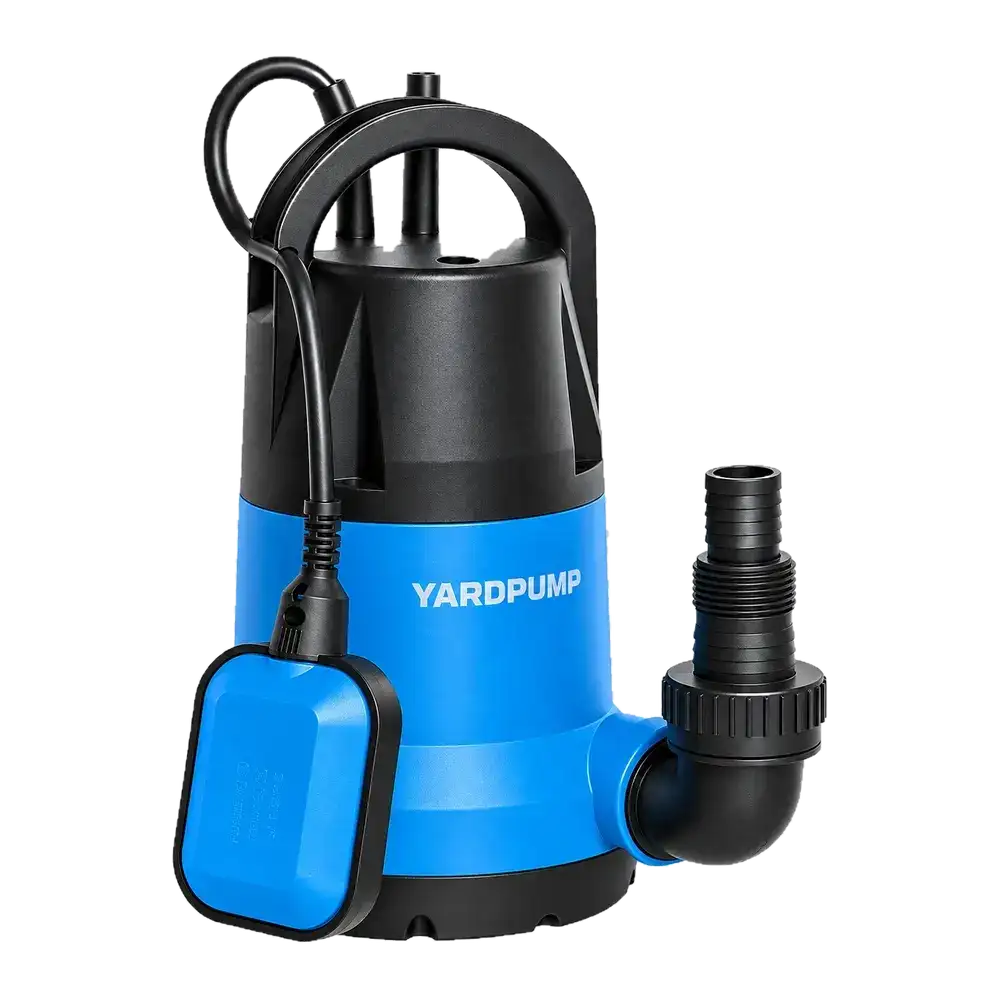
Suppose two submersible drainage or dirty-water pumps both list a maximum head of 8 metres. A dealer installs one as a replacement for the other, but the pit level falls more slowly and the usual emptying time is no longer achievable. Identical maximum head figures leave room for this outcome. Compare flow and head across the part of the curve that the system will use, then check where each pump will run on the actual discharge line.
A shared endpoint does not establish the whole curve
A pump's flow changes with head. Maximum head usually describes the shutoff end of the curve, where flow is near zero. Maximum flow is at the low-head end. The two catalogue values cannot be combined into a single duty point. Two wet-end designs can have similar shutoff heads while delivering noticeably different flows in the working range. Once a hose, bends, and a check valve are installed, the operating point depends on where the pump curve meets the head required by the system. Elevation is one part of that head. Losses along the discharge line change with flow.
Consider two hypothetical curves with the same 8 metre shutoff head. If a test bench holds total head at 5 metres for each pump, pump A delivers 32 litres per minute and pump B delivers 50. If the order specifies a minimum of 40 litres per minute at 5 metres, only B passes in this example. The two pumps need not both operate at exactly 5 metres when connected to the same hose in the field. Different flows produce different friction losses. These figures illustrate how to compare the curves. They are not a product rating or a prediction for an actual hose.
What to put in the request for quotation
Give the high and low levels on the supply side and the elevation and condition at the discharge. Say whether the pump discharges freely, feeds a pressurized line, or sees a changing receiving water level. Sketch the hose length, actual inside diameter, bends, and check valve, including places where the hose might flatten. Specify the minimum flow required at a stated total head. If the water level varies widely, add a second critical condition. This gives the supplier enough information to return the curve for the proposed configuration.
Ask for the frequency, voltage, impeller configuration, and test liquid, with readings around the expected operating range. Agree on a duty point and a second point that distinguishes the curves, plus tolerances and a way to decide acceptance. Record input power and test water temperature when useful. Check that the pump can operate throughout the expected range. If the duty includes solids, verify permitted liquids, passage and servicing separately. A clear-water curve does not establish solids handling.
Separate pump performance from piping changes
Match the discharge position, hose diameter and route, water level, and fittings before timing drawdown through the same repeatable level range. If estimating flow from the drop in a pit, account for ongoing inflow and use the actual change in volume over the test interval. A pit with a changing cross section cannot be treated as having one area over its full depth. Use an approved test method with suitable personnel. Do not close the outlet simply to reproduce a catalogue maximum. If piping conditions cannot be matched, characterize the installed system first before deciding to replace the pump, change the line, or correct the installation.
If water keeps entering under the worst expected condition, include that inflow and the required drawdown time in the acceptance conditions. Holding the level steady is different from lowering it within a set time.
Frequently asked questions
Do matching maximum flow figures make the curves equivalent?
No. The curves may have similar endpoints and still separate in the middle. Compare at the expected duty conditions and agree on how they will be verified.
If the outlet is 5 metres above the water, should I look up 5 metres on the curve?
Only if that figure represents total head. Allow for hose and fitting losses at the relevant flow, plus the receiving pressure if the outlet feeds a pressurized line.
Could wear widen the gap between the pumps?
It could. First hold the piping, conditions, and measurement method constant. If a difference persists, qualified service can assess the condition of the wet end.