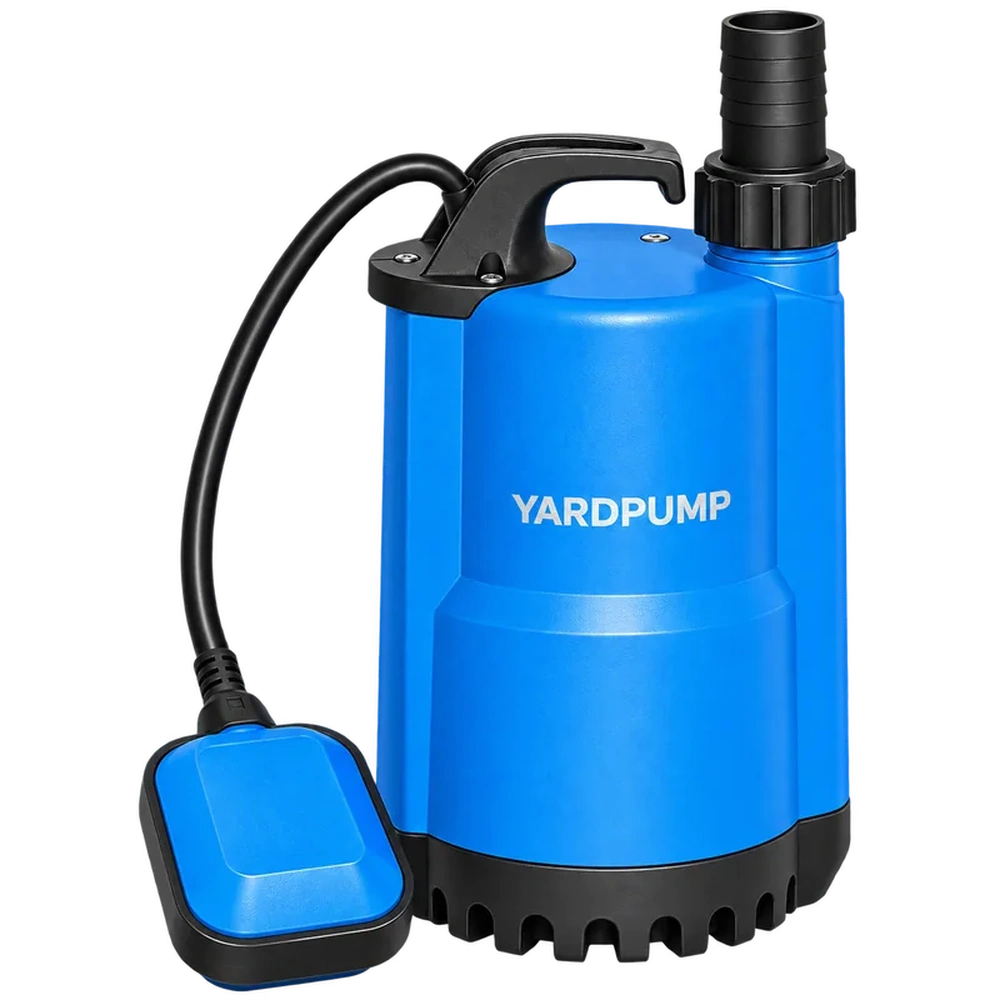
YARDPUMP application expert
“My pump works, but the float sticks, runs every few seconds or refuses to switch off. Do I need a new pump?”
Recent homeowner and plumbing discussions show the same geometry problem repeatedly: narrow pits, crowded pumps and cable floats that cannot move freely. In heavy rain, the same setup can turn into 15-second cycling or a float pressed against the basin wall.
Treat the float, pit and water-level range as one control system. A perfectly healthy pump can behave badly when the switch has too little travel, the working volume is too small or water falls back into the basin.
A field pattern that keeps repeating
A powerful pump cycling every 15 seconds may be a volume problem, not a pump problem
One homeowner described a narrow but deep pit during intense rain where the pump was starting roughly every 15 seconds for hours. The pump could remove water quickly, but the switching range used only a small part of the basin volume, so the water level returned almost immediately.
The natural fear was that the pump was too small or about to burn out. But a larger pump does not automatically solve short cycling. If it empties the same narrow level band even faster, it may simply create shorter runs followed by the same rapid restart.
The useful engineering quantity is working volume: how much water enters the basin between OFF and ON. That depends on pit area and switching range, not just pump power.
Think of it like this
A tethered float needs room the way a door needs swing clearance
A perfectly good door will not open if a cabinet blocks its arc. A tethered float has the same physical requirement. It must move through space, and that movement can be blocked by the basin wall, discharge pipe, power cable, second pump or debris.
This is why “the switch works when I lift it by hand” does not prove the installation is good. The question is whether it can complete the same motion reliably hundreds or thousands of times in the real pit.
Vertical floats and electronic level controls solve different geometry problems, but each introduces its own switching range, contamination and compatibility considerations.
Short cycling
The control range determines run time and starts per hour
Manufacturer guidance warns that frequent cycling can shorten switch life. Wider ON/OFF separation increases the amount of water removed per cycle, which can reduce starts when the basin volume allows it.
Float placement also has to keep the pump sufficiently submerged and avoid interference. In larger pump stations, manufacturers specify minimum spacing between floats precisely because control geometry changes reliability.
For a compact sump or drainage pit, the same principle applies on a smaller scale: measure the space first, then decide whether a tethered float, vertical float, integrated sensor or another validated control approach can physically achieve the required start and stop levels.
Do not ignore backflow
A perfect float can still cycle rapidly if the discharge line refills the pit
When the pump stops, water remaining in the discharge line may drain back if a check valve is missing, leaking, stuck or incorrectly installed. That returned volume can raise the water level enough to trigger another cycle.
This is why troubleshooting should separate inflow from backflow. If the pit refills even during dry weather, observe where the water is coming from rather than immediately adjusting the switch.
A check valve is not just a small plumbing detail in automatic operation; it can change the entire cycling pattern.
Another real-world clue
When heavy rain stops, the pump should not stay “confused”
A recent plumbing discussion described a relatively new sump pump that sometimes kept running after heavy rain until the user unplugged it. Other users immediately focused on the float: contamination, sidewall interference or a switch that was failing to return.
That is a useful diagnostic lesson. High inflow can expose marginal control geometry because the float operates repeatedly and may be pushed into cables, walls or debris. The pump motor can be completely healthy while the control mechanism becomes the failure point.
Before replacing the whole unit, verify whether the switch is serviceable or replaceable on that specific model and whether the pit layout is causing the same mechanical problem to recur.
Where this stops being a simple float problem
High inflow, backup capacity and power loss can turn a control issue into a flood-risk issue
If the basin regularly receives more water than one pump can remove, switch optimization is no longer the whole answer. Pump capacity at the real head, backup pumping, alarm strategy, power-loss planning and discharge capacity must be considered together.
Automatic control should reduce intervention, not hide an undersized drainage system.
YARDPUMP expert takeaway
When automatic pumping behaves badly, look at the space before the switch model number. Reliable control needs enough physical travel, enough working volume and a discharge system that does not simply pour the pumped water back.