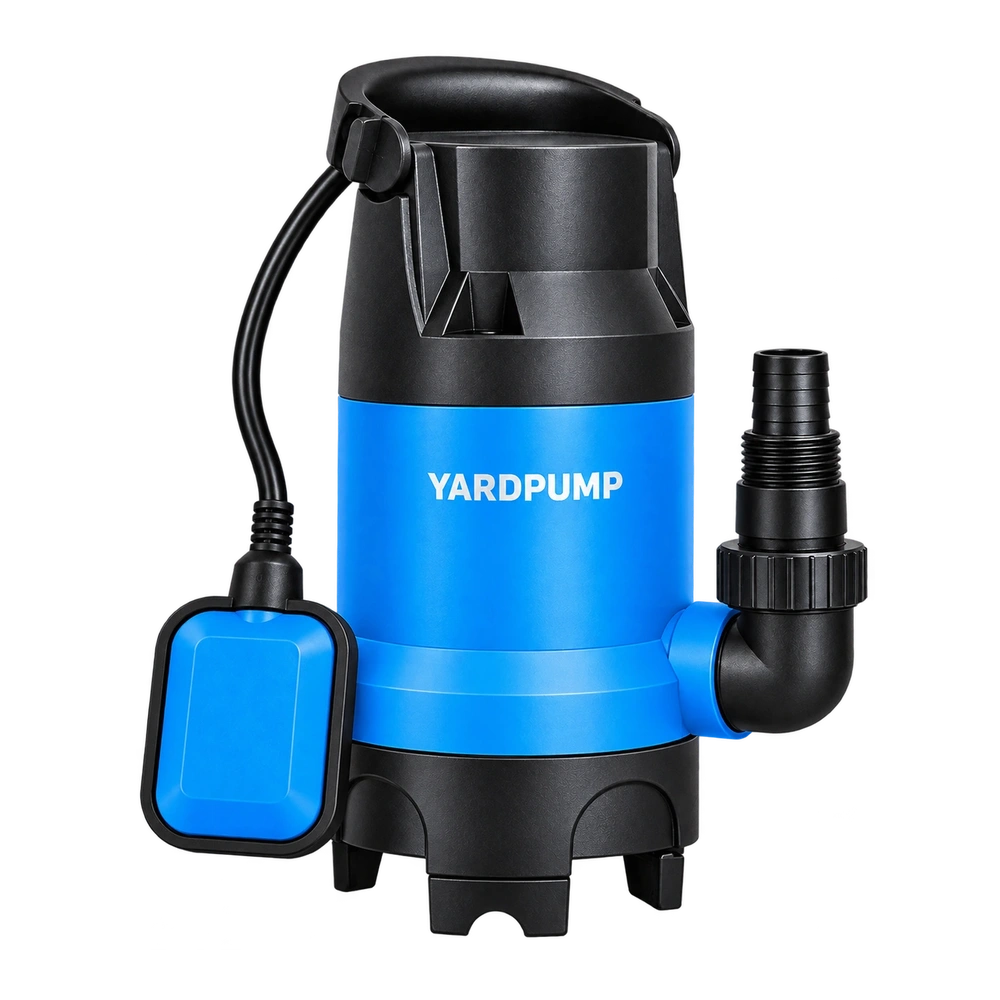
YARDPUMP application expert
“The label says the pump can move thousands of litres per hour. Why does the hose at my installation look like a fraction of that?”
The same complaint appears in irrigation systems, basement discharge lines, tanks and long garden-hose installations. Users often compare the measured flow against Qmax, even though Qmax is normally measured near very low head and their real system adds height and friction.
The pump is not operating at Qmax because your system is asking it to produce head at the same time. The real flow is the point where the pump curve meets the resistance of your installation.
The number that causes the confusion
Qmax tells you where the curve starts, not what every installation will deliver
Maximum flow is useful because it describes one end of a pump’s hydraulic capability. It becomes misleading only when it is treated as a guaranteed installed flow. The moment water has to climb, travel through a hose, turn through fittings or pass a reducer, the system demands head.
The pump responds by moving to another point on its Q–H curve. At that new point it produces more head and less flow. That is normal centrifugal-pump behavior, not automatically a sign of a worn impeller or weak motor.
This is why comparing two pumps only by Qmax can produce the wrong choice. The useful question is which pump can deliver the flow you need at the total working head created by your actual route.
A common installation story
The rainwater pump that “lost” most of its flow on the way to the garden
Picture a rainwater tank beside a house. The pump outlet is reasonably large, but the user connects a long garden hose, routes it uphill, adds a spray nozzle and expects something close to the headline flow. At the tank the pump sounds normal, yet at the far end the stream feels disappointing.
Nothing mysterious has happened. The elevation creates static head. The narrow hose and nozzle create friction and pressure demand. Every metre of small hose adds resistance, and that resistance rises rapidly as flow increases.
Before replacing the pump, changing the discharge path may produce the bigger improvement: larger hose, fewer restrictions, a shorter route or a duty point chosen from the curve instead of from Qmax.
Think of it like this
A narrow hose is not just a smaller doorway—it is a long traffic jam
If a thousand people must pass through a stadium gate, a slightly smaller gate slows the whole crowd. A long narrow hose behaves similarly, except the penalty compounds along its length. The water rubbing against the hose wall creates friction all the way to the outlet.
That is why reducing a pump outlet immediately into a long small hose can hurt far more than the visual size difference suggests. Diameter changes velocity, and higher velocity changes friction loss dramatically.
The lesson is practical: hose size belongs in pump selection, not in the accessories list after the pump has already been chosen.
Build the real duty point
Add static lift and friction before you judge the pump
Pump-selection guides from major manufacturers treat total head as the sum of static elevation and friction losses. Long-distance livestock watering, irrigation and dewatering systems make this especially obvious because line length can become a large part of the required head.
For a compact submersible-pump application, start with the vertical difference between the water surface and the discharge point. Then account for hose or pipe length, internal diameter, elbows, valves, reducers and any required outlet pressure.
You do not need a perfect hydraulic model to improve a bad buying decision. Even a conservative estimate of working head is more useful than comparing maximum flow numbers at zero or near-zero head.
Who should care
Different users make the same mistake for different reasons
Homeowners see a big litres-per-hour number and expect fast drainage. Irrigation users underestimate long hose friction. Contractors sometimes inherit undersized discharge lines. Distributors compare catalogue maxima because the duty point was never collected from the customer.
OEM buyers should go further: define at least one required flow-at-head point for the intended market. A pump curve or verified duty point protects both sides from arguments that begin with “the brochure said 8,000 L/h.”
Where this explanation stops
Low flow can also be a fault, so do not blame the hose automatically
If a system that previously performed well suddenly loses flow, check for blocked strainers, a clogged or damaged impeller, air lock, kinked hose, closed valves, voltage problems or other faults. System resistance explains a stable mismatch between headline flow and installed flow; it does not explain every sudden performance change.
Use the curve and the system first. If the measured result is still far below what that operating point should produce, then troubleshoot the pump and installation.
YARDPUMP expert takeaway
When real flow looks “too low,” do not begin with motor wattage. Begin with the route. Height, hose diameter, length and fittings decide where the pump actually operates on its curve.