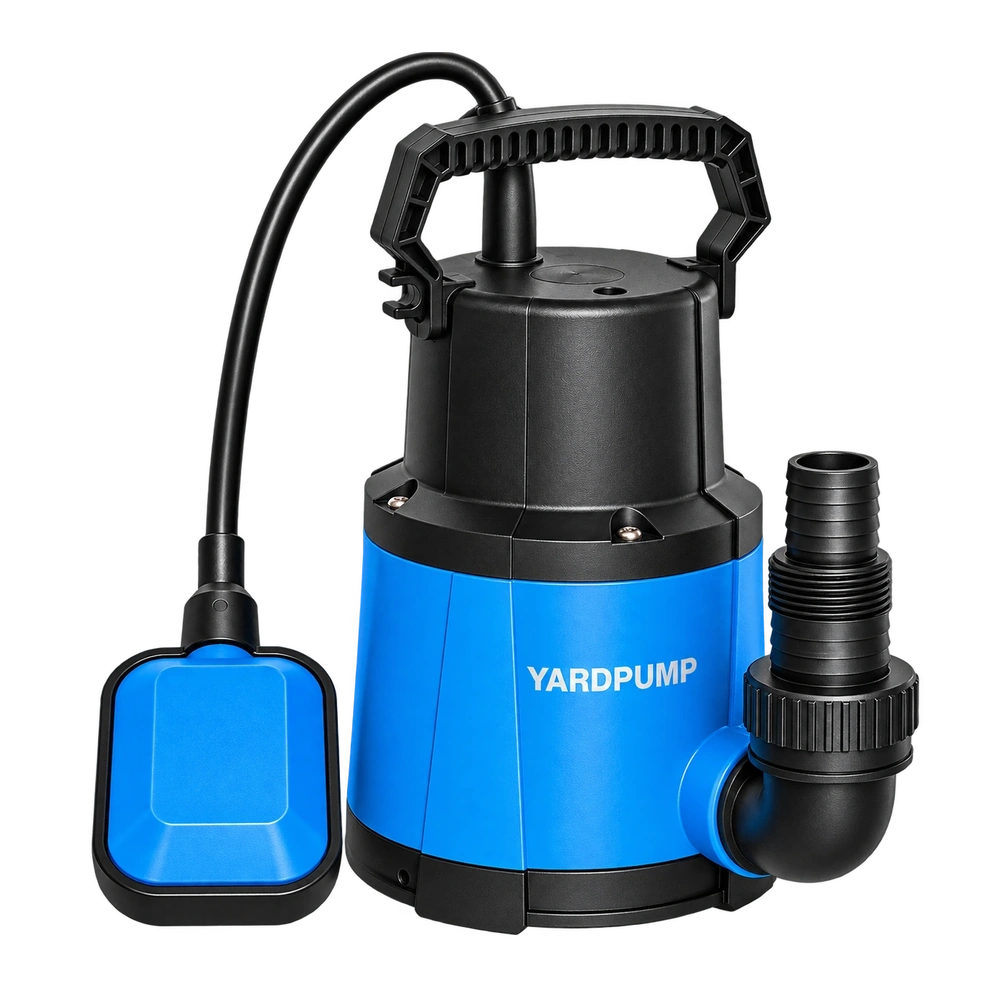
A buyer sees 750 watts on a submersible pump and only 250 watts on a plug-in meter. The difference deserves investigation, but first identify both quantities and the operating condition. Different power definitions or a lightly loaded measurement do not by themselves establish misrepresentation. A defensible conclusion compares the same specified quantity under the agreed conditions.
Three powers must remain distinct
Electrical input is the real power taken from the supply. Shaft output is the mechanical power delivered by the motor. Hydraulic output is the useful energy rate imparted to the liquid. These quantities are related through losses; they are not interchangeable. At one steady operating point, useful output cannot exceed total input without accounting for another energy source.
If 750 watts denotes rated shaft capability while 250 watts is input at a lightly loaded point, that reading does not prove the motor cannot deliver its rating. If a supplier claims an actual 750 watts of shaft output at the same point as 250 watts of total electrical input, the explanation conflicts with the energy balance and needs correction or remeasurement. Rated capability and current output are different questions.
Maximum head and flow are not one duty point
Maximum head is normally near the zero-flow end of the curve. Maximum flow occurs at comparatively low head. A label stating 10,000 litres per hour and ten metres of maximum head does not mean that both are achieved simultaneously.
Write the required duty directly, such as an agreed flow at six metres of total head. Identify pipe losses and measurement boundaries. A narrow hose, low voltage, inadequate intake conditions or an incorrect measuring point can all change the field result. Resolve those conditions before deciding whether the supplied curve or configuration is inaccurate.
Why labels can distort a price comparison
When purchasing uses nameplate watts as the main product grade without specifying curves, thermal performance and configuration, the label can become a substitute for measurable capability. Different power conventions, reused curves from another version, missing conditions and unsupported numbers can put unlike products into the same apparent price category.
This does not justify an invented claim that a particular share of the industry mislabels pumps. Nor does a low price prove misconduct. Motors, cable conductors, seals, housings, manufacturing, inspection and order terms can produce legitimate cost differences. Identify the actual variation instead of using an industry rumour as the explanation.
Build four connected records
Define power convention, voltage, frequency, duty and water temperature. Obtain a complete curve and target-point measurements showing flow, total head and real electrical input together. Retain the matching bill of materials, drawings and electrical configuration. Finally, link production inspection and traceability to the approved version.
Testing needs suitable personnel and instruments. Voltage multiplied by current is not automatically single-phase real input power, and a plug-in power meter does not directly measure shaft output. Agree the method and acceptance deviations in writing before using results for a commercial decision. An independent laboratory can provide additional verification where necessary.
Put deliverable capability into the purchase agreement
Specify the duty point, parameter definitions, approved sample revision, important materials, sampling and retest method, and treatment of discrepancies. Draw production samples using the agreed random selection process rather than relying only on a demonstration unit prepared separately by the supplier.
Performance and electrical safety remain separate acceptance requirements. Neither an impressive curve nor a plausible wattage reading proves every quality requirement. A lower-labelled pump that reliably performs the required task can offer more value than a larger unsupported number. The purchase should secure repeatable capability and the configuration supporting it.
Questions buyers ask
Does a 250-watt reading automatically mean failure? No. Establish the claimed quantity and test condition, then retest an actual discrepancy against the agreed requirement.
Is one maximum-flow test enough? No. Confirm flow at the required head and the corresponding input, with additional points where relevant.
Can a discount resolve inaccurate specifications? Price cannot replace correct claims, suitable configuration and the applicable verification.