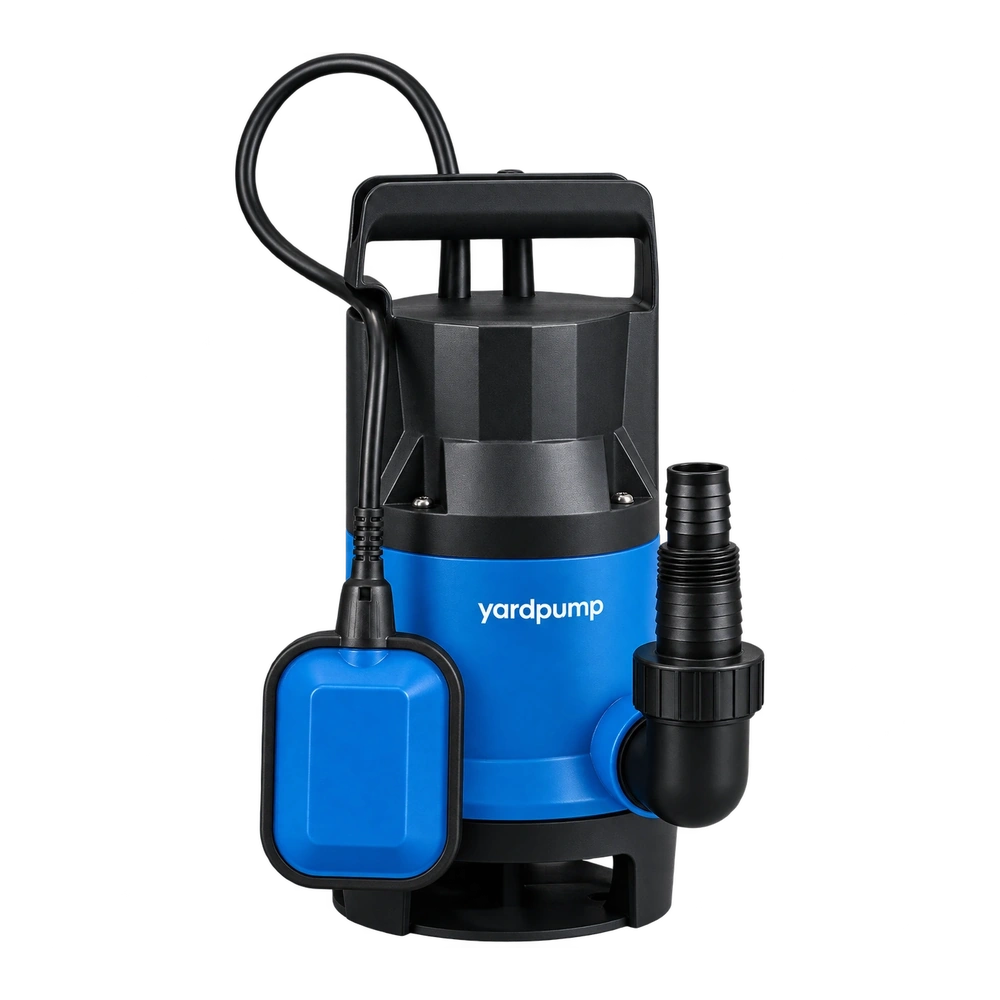
A surface pump works in a lowland garden but becomes difficult to prime at a mountain installation with apparently identical pipework and lift. One possible reason is lower atmospheric pressure. The available suction margin has changed even though the hose has not. Treating altitude as a simple motor-wattage correction misses this hydraulic constraint.
First assess the absolute pressure conditions between the source and the pump inlet. Separately confirm that the motor and other equipment are suitable for the installation environment.
Why atmospheric pressure matters at an open source
When a pump lowers its inlet pressure, atmospheric pressure acting on an open water surface helps move water into the suction line. At greater altitude, that atmospheric pressure is lower. Less pressure head remains to accommodate vertical suction lift, pipe losses and the water’s vapour pressure.
For an initial assessment of an open tank with negligible surface velocity, available net positive suction head can be expressed as atmospheric pressure head minus suction lift, suction losses and vapour pressure head. All terms must use the same liquid-head units. The pump’s required NPSH and an appropriate design margin must then be checked separately. A positive available value alone does not establish acceptable operation.
An illustrative pressure budget
Assume water near 20°C and compare atmospheric pressures of 101.3 kPa and 79.5 kPa. Using an approximate water density of 1,000 kg/m³ gives atmospheric heads of 10.33 metres and 8.10 metres. Assume also that the pump inlet is 3 metres above the lowest source level, suction losses are 0.8 metres and vapour pressure head is about 0.24 metres.
The resulting available NPSH is approximately 6.29 metres in the first environment and 4.06 metres in the second: a difference of about 2.23 metres. These are illustrative assumptions, not current weather readings or guaranteed suction lifts. If the required NPSH plus the agreed margin exceeds the second result, the arrangement needs changing.
In particular, the 8.10-metre atmospheric head is not an allowable suction lift. It has not yet had the other demands subtracted.
| Change | Consequence at the inlet | Information needed |
|---|---|---|
| Greater altitude | Lower atmospheric pressure budget | Local absolute pressure |
| Warmer water | Higher vapour pressure | Highest operating temperature |
| Falling source level | Greater vertical lift | Lowest working water surface |
| Dirty strainer | Higher suction loss | Maintenance condition and limits |
Improve the inlet conditions before increasing power
Compare lowering the pump, shortening the suction route, reducing unnecessary fittings and using an appropriate suction diameter. A lower location must still be protected against flooding and satisfy electrical and ventilation requirements. Increasing motor power does not necessarily improve inlet conditions. If it increases flow, suction losses and required NPSH may also rise.
An alternative submerged intake arrangement may be worth considering where the application permits it. Confirm the water quality, immersion requirements, electrical installation and service access before choosing that route. Difficulty with a surface pump does not establish that an arbitrary drainage pump is suitable for permanent well service or drinking-water supply.
Put the environmental boundary into the enquiry
Give the supplier the installation altitude or local pressure range, lowest water level, highest water temperature, pipe drawing and required duty. Ask for separate responses on suction feasibility and motor environmental suitability. This prevents a statement about motor cooling from being mistaken for a hydraulic suction approval.
Some small pumps do not have a published required-NPSH curve. In that situation, request a verified application boundary or an appropriate agreed test. Do not invent a curve from the advertised maximum suction lift. Site commissioning should cover the intended adverse combination of low water level and temperature, rather than relying on one successful start on a cool morning.
Use altitude for initial screening and actual local pressure where a closer assessment is needed. Weather can matter when the remaining margin is small. A single barely successful priming event does not establish adequate margin. The technical response should state the flow and temperature used, rather than a broad claim that the pump is suitable for mountain use.
Frequently asked questions
Can suction lift be reduced by a fixed amount for each thousand metres of altitude?
A fixed rule is too crude. Atmospheric pressure does not vary linearly with altitude and also changes with weather. Use local conditions.
Does a pressure gauge directly show absolute pressure?
A normal gauge usually reads relative to local atmospheric pressure. Distinguish gauge and absolute pressure before assessing vaporisation conditions.
Will a larger discharge pipe solve the problem?
It can change losses and the operating point, but it does not replace the inlet pressure budget. Reassess the suction side at the resulting flow.