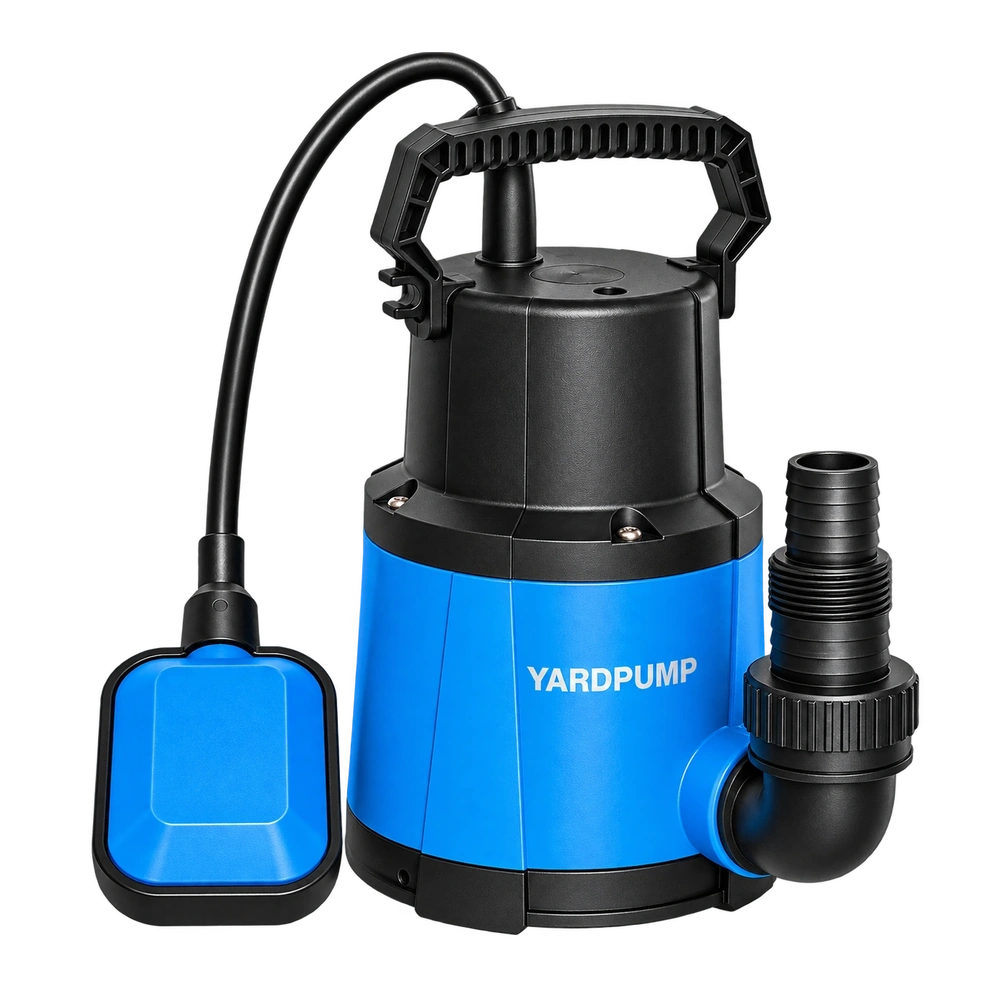
A rainwater tank looks clear near the surface, but the discharge turns cloudy as the level approaches the bottom. A pump that reaches a lower residual level may not be the best everyday watering choice. Removing more water and avoiding settled sediment are different objectives.
First decide whether the task is routine water supply or a tank-cleaning operation.
Identify what is settled at the bottom
Roof runoff can introduce dust, plant debris and other contaminants. Some settle during storage and can become suspended again when incoming water, local flow or equipment disturbs the bottom.
Australian government rainwater guidance addresses first-flush diversion and sediment management as parts of system maintenance. These upstream controls matter even when the upper layer of stored water appears clear.
A low-level inlet sits closer to the floor and can help remove shallow water within its specified liquid limits. It may also approach the sediment layer. A dirty-water particle-size statement does not independently establish long-term resistance to abrasive grains or suitability for pumping thick sludge.
Separate daily supply from periodic cleaning
Everyday garden supply generally benefits from relatively clean water that the pump, controller and irrigation outlets can handle reliably. An approved installation can keep the intake appropriately above settled material. A manufacturer-confirmed floating intake may be another option for a compatible system.
A floating intake still needs secure positioning, adequate immersion and protection against drawing air. It does not mean hanging an ordinary complete pump loosely at the surface.
Emptying and cleaning the tank is a different maintenance job. Identify whether the material is loose fine sand, organic sediment or cohesive sludge, then use suitable equipment and procedures. Repeatedly drawing from the bottom is not a validated cleaning method for an ordinary transfer pump.
Any raised installation must remain stable, leave the inlet unobstructed and preserve float movement. Recheck the minimum operating level and cooling requirements after changing the position. Avoid exchanging a sediment problem for a new low-water operating problem.
Calculate the effect on usable storage
Consider a simple geometric example, not a product test. A tank has an approximately flat one-square-metre bottom. Raising the effective stop level by eight centimetres leaves about eighty additional litres below the usable level.
A curved or sloping tank needs a calculation based on its actual shape. The effective stop level can also include control and immersion requirements, so it should not be confused with support height alone.
The retained volume should be considered alongside filter maintenance, wear, emitter blockage and cleaning frequency. If more usable water is essential, a larger tank or better sediment control may be preferable to forcing the intake against the floor.
There is no universal clearance suitable for every tank and pump. Sediment depth, incoming flow patterns, operating levels and equipment requirements all matter. A dimension used successfully elsewhere is not automatically an acceptance value for another installation.
Gather the facts before choosing the pump
Record the sediment depth and character, maximum and minimum water levels, intended supply duty, intake arrangement, control clearance and filter losses. Ask explicitly whether the owner wants routine irrigation supply or near-emptying during maintenance.
Those uses can lead to different equipment choices and different expectations. A low residual-water specification is useful when it serves the actual task, but it should not replace an assessment of liquid quality and operating conditions.
Flood contamination and work requiring entry into a tank introduce separate health, structural and confined-space issues. Follow the relevant professional guidance rather than treating pump selection advice as a tank-entry procedure. Flood-affected electrical equipment also needs appropriate assessment before reuse.
The intake arrangement should balance usable storage, water quality and the pump’s operating requirements. That gives the owner a repeatable way to use stored rainwater without asking the pump to serve as an unverified sludge-removal tool.
Questions buyers ask
Is placing a brick beneath the pump sufficient? Not by itself. Confirm stability, inlet access, minimum operating level and control clearance.
Can a finer screen replace sediment management? Not completely. It may block sooner or increase losses, so consider pretreatment and intake position together.
Can a low-level pump be used in a rainwater tank? It can be considered when its water, installation, control and duty requirements match the application. Low residual alone does not establish the best choice.