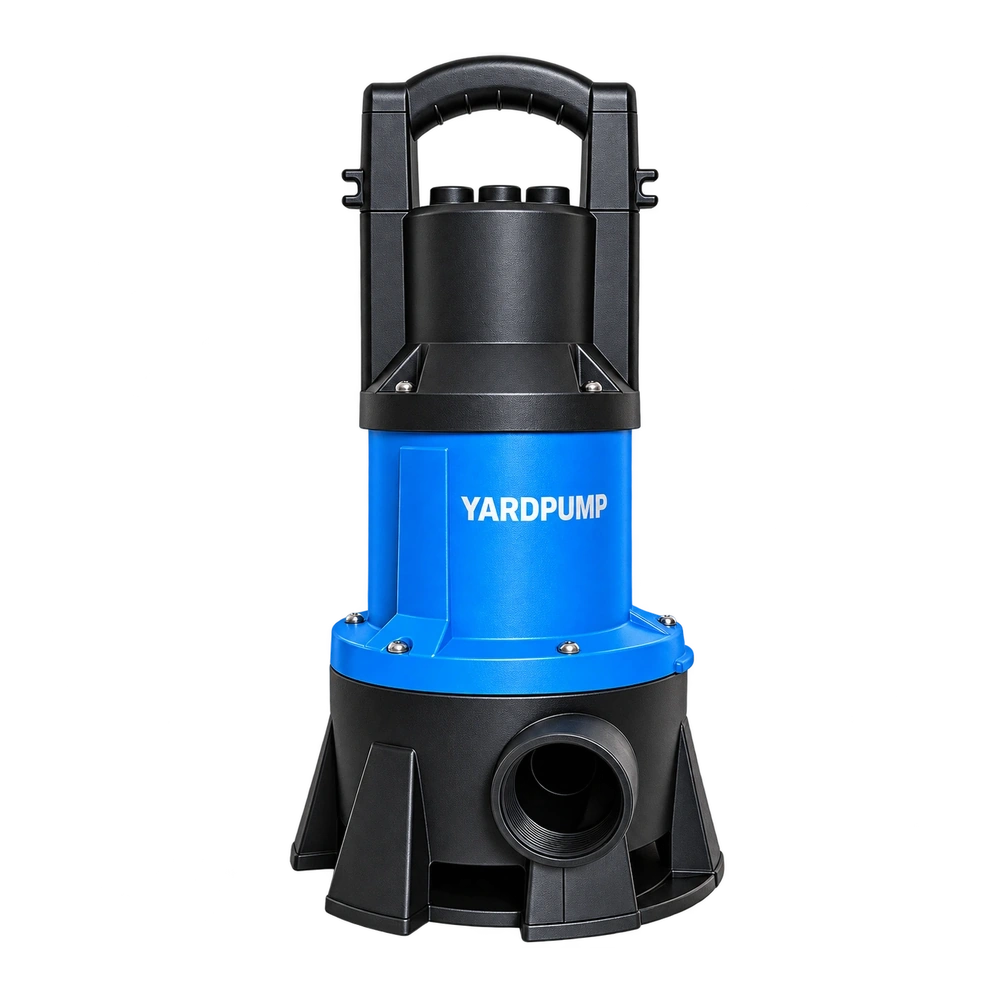
A small submersible pump moves water from a raised tote to ground level. The bucket fills fast enough to suggest a higher flow than the free delivery figure in the catalogue. That tells you something about how quickly the installation moves water. It does not, by itself, verify the catalogue figure. When the discharge is below the source surface, gravity can help drive the flow. The combined pump and piping can deliver more than the pump did at the specified zero head test point. Start by finding out whether the readings describe the same duty.
Locate the hydraulic endpoints before tracing the hose
For an open supply tank, record its water surface during the test. If the hose discharges freely into air, use the outlet centre as the elevation at that end. If it discharges below the water in a second open tank, use the receiving water surface for that end's static elevation. Subtract the source elevation from the receiving elevation. The highest point where the hose crosses the rim does not replace either endpoint. It can still affect initial filling, trapped air and whether the hose stays full. Record whether the line was full and whether air broke the flow.
For illustration, suppose the source surface is 1.4 m above the floor and the free outlet centre is 0.4 m above it. The static elevation term is −1.0 m. Water leaving the outlet still has velocity, and the hose, elbows and adapters still consume head. The pump's actual total head need not be negative, and that single number does not say how many extra litres will arrive per minute. With two large open tanks, the two surfaces still give the static term. Use the agreed boundaries when accounting for pipe and exit losses so that outlet energy is not counted twice.
Check which test conditions gave you the extra flow
Put the source surface, outlet elevation and outlet type from the actual trial beside the catalogue test conditions. Compare hose inside diameter, effective length, fittings and the flow measurement method. If a filling bucket submerges an outlet that began open to the air, write down the change; the discharge condition did not stay the same. When the source level falls rapidly, a long timing run averages across a range of water levels rather than measuring one head point.
If water already continues to leave the installation after a normal stop, record the stop command, water levels and flow change as clues about the system. There is no need to deliberately set up a siphon for this check or loosen a fitting without a safe place for the water to go. If flow stops with the pump, that also does not rule out gravity assistance while it was running: a check valve, admission of air or an emptying line can stop the flow.
Keep two different acceptance results where they answer different questions
If the practical question is how quickly a container empties, record time and flow in the real installation and label the elevation difference, water level range and hose setup. To verify a pump promise, use the agreed sample, supply and test circuit. Record flow and head together at the specified point on a controlled bench. If an order calls for a minimum flow at a specified head, state the tolerance and retest method. A best bucket result from a low outlet should not substitute for that point. Both records can be kept when the buyer needs to accept the pump and understand actual site performance.
Confirm the liquid, inlet submergence, installation and permitted duty range before running a test. A lower outlet is not a way to increase throughput if it sends the pump beyond the manufacturer's allowed operating range. Stop and isolate the supply before changing the pipe layout or moving the pump; trained personnel should restore the approved setup before another run.
Frequently asked questions
Will lifting the bucket to the source water level give a zero head test?
Not necessarily. Equal elevations remove the static elevation term, but the flowing line still has losses. Measure total pump head using the agreed test method.
Is the top of a hose loop the static discharge head?
For a continuous, full line, static elevation comes from the two endpoints. The high point matters for filling and trapped air but is not itself the receiving boundary.
Does maximum catalogue flow always mean zero head?
Check the curve, setup and wording for that model. If the supplier has not defined the maximum, agree on a paired flow and head for acceptance.