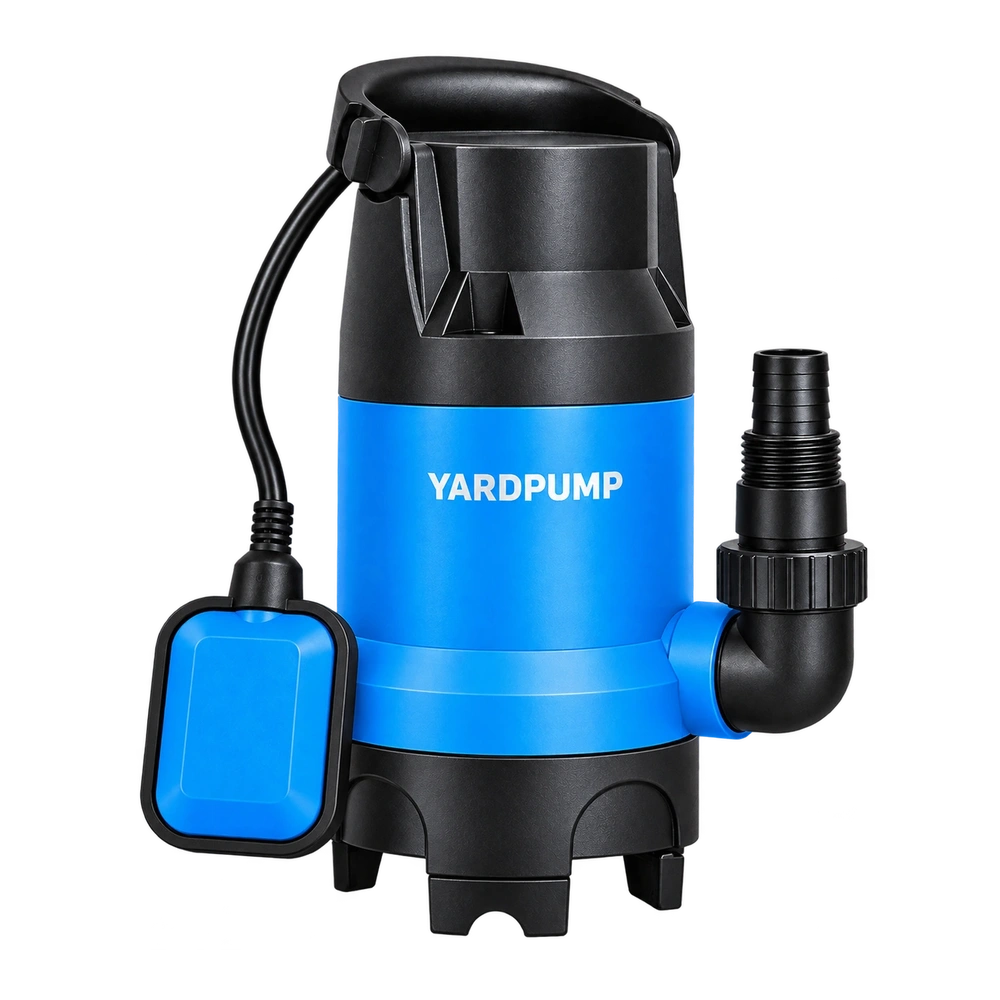
A pump struggles to start, and someone proposes a larger capacitor to give it more strength. Capacitor failure can cause starting problems, but more capacitance is not automatically better. In a single-phase motor, the capacitor is part of a matched phase-shifting system. Changing it can affect current, torque, vibration and temperature rise; it is not a control for increasing the rated motor output.
Its role depends on the winding design
In a common permanent-capacitor arrangement, the capacitor works with the auxiliary winding to establish the intended current phase relationship and rotating field. Successful starting and running depend on the main and auxiliary windings, capacitor, voltage, frequency and mechanical load together.
Two motors carrying the same wattage need not use the same capacitance. Different winding versions can also share an external appearance. The capacitor's physical size does not establish compatibility. Identify the approved capacitance, tolerance and associated requirements for the actual motor version.
Why increasing capacitance can increase heating
For a simplified capacitor supplied at fixed frequency and terminal voltage, current increases with capacitance. In an operating motor, capacitor voltage and winding impedance interact, so a fifty-percent increase in capacitance does not establish a fifty-percent increase in complete-motor current or torque.
Changing from eight to twelve microfarads is a fifty-percent numerical increase. That is an illustration, not a modification recommendation. Auxiliary-branch current, magnetic balance and losses can change. A brief successful start does not prove satisfactory extended operation. If the original problem is a jammed impeller, inadequate supply or damaged bearing, a larger capacitor may obscure the cause rather than resolve it.
Capacitance and voltage rating are different
Microfarads describe capacitance. The AC voltage rating describes a different operating requirement. A 220 or 230 volt supply does not automatically mean the capacitor needs only that same voltage rating: some motor connections can produce a capacitor terminal voltage above the supply voltage.
Replacement assessment also includes starting or running duty, frequency, temperature rating, life classification, safety features, dimensions and connections. A starting capacitor is not freely interchangeable with a continuously energised running capacitor. Even a higher voltage rating at the same capacitance requires confirmation of the remaining requirements and manufacturer approval.
Separate starting symptoms before choosing a remedy
Record whether the pump is silent, hums without rotation, fails to restart when warm, or causes a protective device to operate. Supply, switching, windings, mechanical resistance and capacitors can produce different combinations of those symptoms. A normal-looking capacitor can be faulty, while a visibly damaged capacitor does not prove the rest of the motor is sound.
Inspection involves isolation, stored charge and internal wiring, so it belongs with suitably qualified personnel. Customers should not touch energised components, short terminals with loose wire or repeatedly apply power in an attempt to force rotation. Assessment should follow the relevant component and motor methods and include actual starting and thermal behaviour.
Control the approved capacitor version
For OEM purchasing, identify the supplier and complete component designation, capacitance tolerance, AC voltage rating, temperature classification and duty. Review any alternative against the winding and intended supply, then complete the appropriate starting, running, temperature-rise and protection assessments.
A larger or more expensive component is not evidence of a successful upgrade. Production and service records should retain capacitor identity. Where a repair uses a different approved specification, document the reason and validation so a temporary sample intervention does not quietly become the production standard.
The objective is stable operation across the declared load range. Merely making the shaft turn once is not a complete acceptance criterion.
Questions buyers ask
Can lost capacitance be compensated by fitting the next larger size? Restore a suitable approved specification and investigate the failure rather than exceeding the design value.
Will a larger capacitor save electricity? Not necessarily. Input, branch current and thermal behaviour can change.
Can wattage alone identify the correct capacitor? No. Establish the model, winding version, supply and operating requirements.