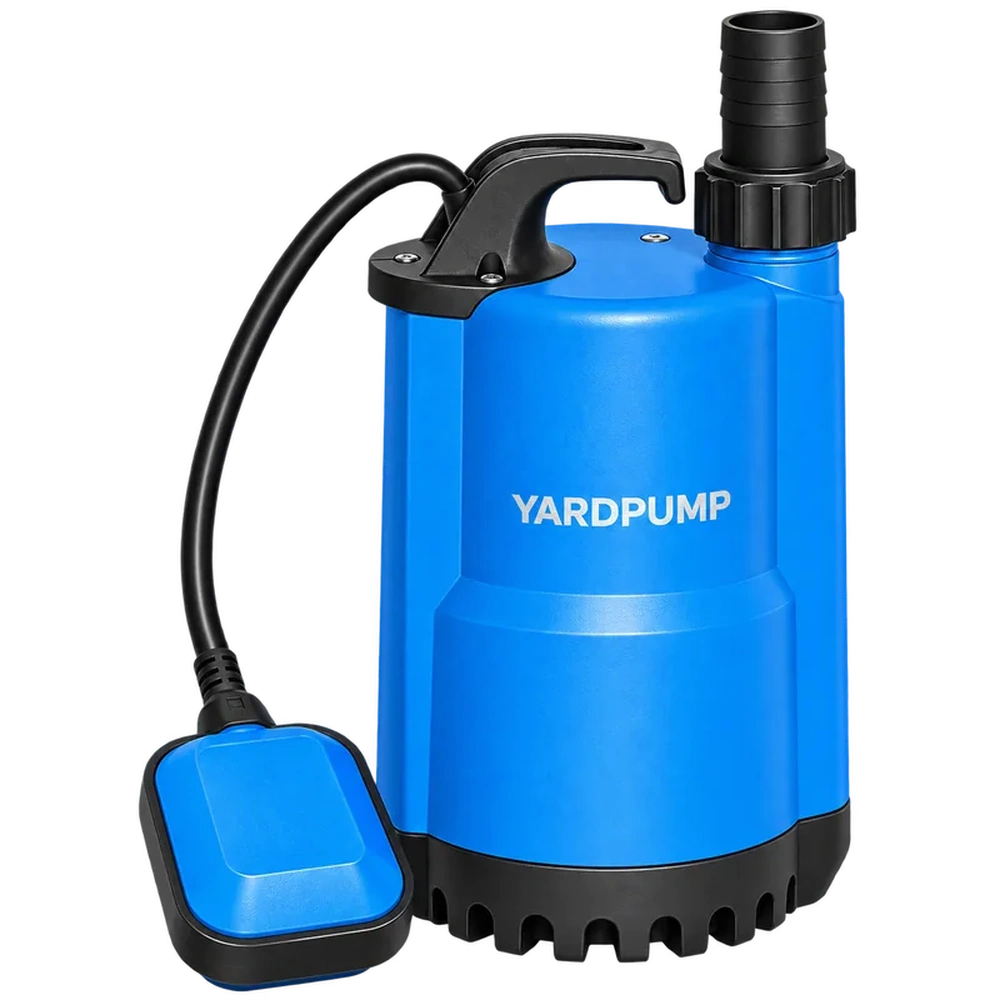
YARDPUMP application expert
“The pump says dirty water. Can I use it for leaves, sand, mud and whatever collects in the pit?”
“Dirty water” is one of the broadest labels in pump retail, yet field failures often come from treating very different contaminants as the same problem. Soft leaves can clog; stringy debris can wrap; sand abrades; settled mud can behave like slurry.
Separate blockage risk from wear risk. A pump can pass a particle through its hydraulic path and still suffer rapid abrasion when that particle is hard, sharp and continuously present.
Think of it like this
Solids passage is the size of the doorway; abrasion is what happens when the doorway is made of sandpaper
A doorway measurement answers whether an object can physically fit through. It says nothing about whether that object will damage the surfaces it touches. Nominal solids passage works the same way.
A soft leaf and a grain of quartz sand may both fit through the pump, but they challenge it differently. The leaf may fold, tangle or block an intake. Sand can travel through the impeller and clearances while steadily wearing surfaces.
This is why “handles 20 mm solids” should never be translated into “handles abrasive slurry.” Those are different claims.
A composite drainage scenario
The storm pit that looked like dirty water but behaved like an abrasive service
Imagine a low point beside a construction area after repeated rain. The water appears thin enough, but every inflow carries fine sand and grit. A general drainage pump removes the water successfully at first, so the operator concludes the application is acceptable.
After repeated use, flow drops and clearances show wear. The pump was able to pass the sand; the mistake was assuming passage meant durability. Continuous abrasive solids create a service-life problem even when the pump never clogs.
A better application review asks how much abrasive material is present, whether it is occasional or continuous, how hard it is, and whether the pump family was designed and validated for that duty.
Sand is a wear problem
Hard particles attack more than the impeller
Pump manufacturers describe abrasion as friction from solid particles in the pumped medium. Sand is a common example because it can wear impellers and other hydraulic components.
The damage path can also involve casing surfaces, wear clearances, seal faces and shaft areas depending on the design. Making one component harder does not automatically make the complete pump slurry-capable.
If the application contains persistent sand or grit, treat abrasion as a primary selection criterion rather than a footnote under “dirty water.”
Leaves and stringy debris are different
Soft solids can block or wrap even when they are not abrasive
Leaves, grass, fibres and plastic strips create geometry problems. They can bridge across an intake, wrap around rotating parts or collect where the hydraulic passage changes direction.
For this reason, solids size alone is still incomplete. Shape, flexibility and concentration matter. A pump that handles rounded soft particles may behave very differently with long stringy debris.
The safest description is the actual material: leaves, fibrous debris, fine sand, gravel, silt, sludge or sewage—not simply “dirty.”
Mud and slurry change the category
Once solids concentration rises, the liquid itself behaves differently
Thin water carrying occasional sediment is not the same as dense mud or slurry. Higher solids concentration changes viscosity, settling behavior, starting load and wear. Purpose-built slurry pumps use different hydraulic and wear strategies because the service is fundamentally harsher.
This is where a general-purpose drainage pump should stop being stretched beyond its validated range. If the application resembles construction slurry, mining washdown or continuously suspended abrasive solids, select a pump family intended for that duty.
Who should care
“Dirty water” needs a different translation for sales, users and OEM teams
A homeowner needs to know what can go down the intake without clogging the pump. A contractor needs to distinguish rainwater with occasional grit from true dewatering slurry. A distributor needs product categories that do not turn “dirty water” into an unlimited claim.
An OEM buyer should specify the expected contaminant, size range, concentration and frequency so the factory can evaluate passage, abrasion and material compatibility separately.
Where this guide stops
Sewage, gravel and dense slurry require purpose-specific validation
Do not infer sewage, slurry or abrasive-duty capability from a general dirty-water label or from housing material alone. The complete hydraulic design, motor loading, seals and wetted materials must fit the service.
For YARDPUMP product selection, use the verified solids limits and application boundaries of the exact model family rather than extending a general article into a product claim.
YARDPUMP expert takeaway
Describe the dirt by its failure mechanism. Soft debris can clog, sand can wear, stringy material can wrap and dense slurry can change the entire hydraulic duty. “Dirty water” is only the start of the specification.