YARDPUMP BOM engineering
“Is a metal impeller automatically better than a plastic one? If I pay more for stainless steel, will the pump definitely last longer?”
This question appears everywhere from sewage-pump buying discussions to pool and industrial-water forums. The instinct is understandable: metal feels stronger in the hand. But an impeller does not work in a hand; it works while rotating at speed, submerged in a specific liquid, attached to a shaft, inside a hydraulic passage.
Impeller material is not a quality ladder. The right material is the one that survives the dominant failure mode while keeping the rotating assembly, hydraulic geometry, chemistry and manufacturing process under control.
Start with the failure mode
“Metal or plastic?” is usually the wrong first question
The better first question is: what are we trying to prevent? Abrasive wear from sand is a different problem from chemical attack, impact, fatigue, cavitation, dimensional instability or a loose hub. A material that improves one risk can introduce another through weight, corrosion behavior, machining tolerance or balance.
For compact household drainage, a well-designed engineering polymer impeller can be entirely appropriate. For a severe abrasive or chemically aggressive duty, the complete hydraulic and material system may need a different approach. The point is not that plastic is always good or metal is always better; it is that material must be selected against the actual failure mechanism.
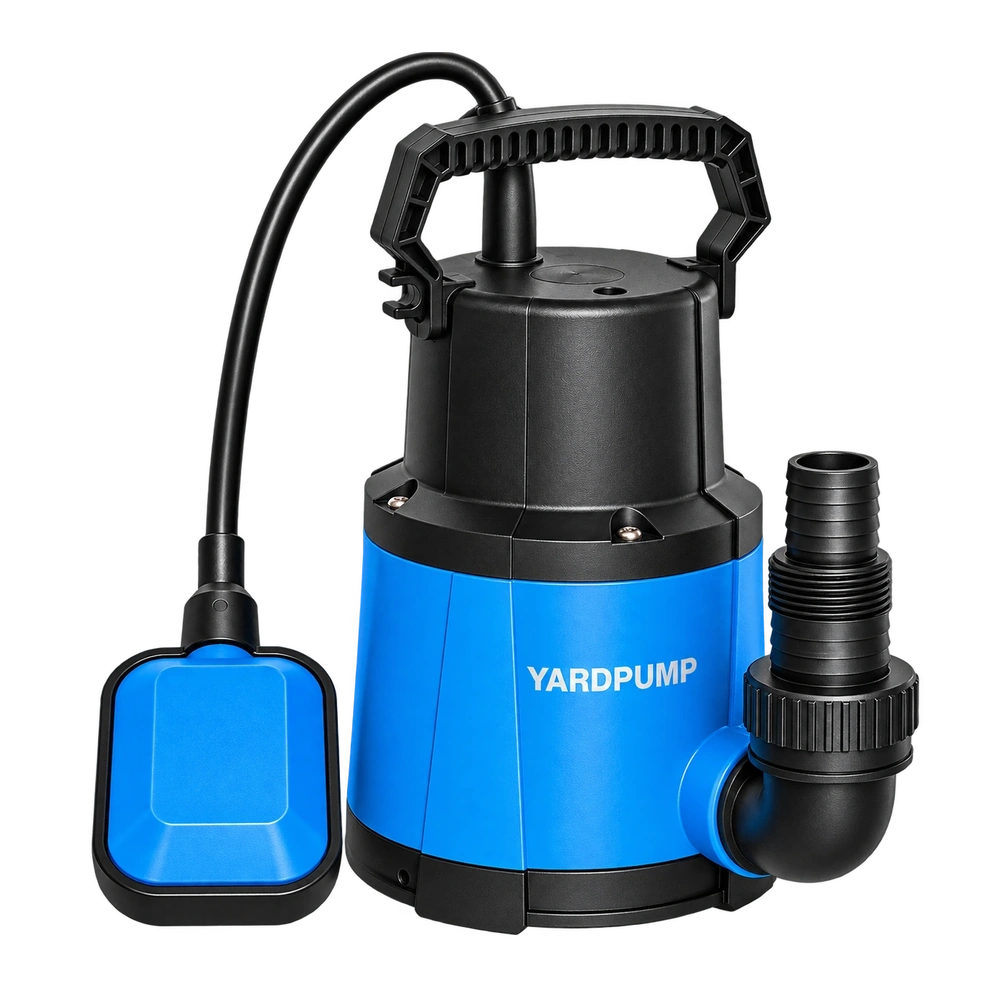
YARDPUMP’s current verified product families use PA66 impellers. Broader material comparisons in this guide explain industry engineering trade-offs; they should not be read as a claim that every alternative material is a validated option on the current YARDPUMP range.
A composite buyer conversation
The distributor who asked for stainless steel—and actually needed a better sand decision
Imagine a distributor receiving complaints from a market where pumps are used to empty rain pits after storms. The returned pumps show worn vane edges and reduced flow. The buyer asks the factory for a stainless-steel impeller because “metal should last longer.”
A useful engineering review would slow that request down. How much sand is present? Is the sand continuously suspended or only entering at startup? Are clearances, casing material and seal faces also seeing abrasion? Is the pump being used as a slurry pump even though the hydraulic passage was designed for drainage water?
If abrasion is the true driver, changing one part may move the wear somewhere else. A harder impeller can survive longer while the casing, seal or shaft interface becomes the next weak link. The right fix may involve application limits, intake geometry, material pairing, speed or a different pump family—not simply a more expensive impeller.
Think of it like this
Choosing impeller material is more like choosing shoes than choosing a medal
A steel-toe work boot is not “higher quality” than a running shoe in every situation. It is better for impact and jobsite protection, worse for a marathon, and unnecessary in a living room. The correct shoe depends on the environment and the failure you are trying to avoid.
Impellers are similar. Polymer can reduce rotating mass, avoid some corrosion mechanisms and simplify molding of complex shapes. Metal can offer stiffness, temperature capability or wear characteristics that are valuable in other duties. Neither word tells you enough without the liquid, geometry, speed, balance and interface.
What material changes
Mass, stiffness, corrosion and manufacturing all move together
Changing from PA66 to a metal is not merely swapping the substance while holding everything else constant. Rotating mass changes. Hub and shaft-fit stresses change. Balance requirements may become more sensitive. Molding becomes machining or casting. Surface condition and corrosion control enter the process in different ways.
Engineering polymers such as PA66 can provide useful strength-to-weight performance and corrosion resistance in suitable liquids. Reinforcement, moisture conditioning, temperature and actual resin grade matter. Metals can provide greater stiffness and wear capability in some conditions, but alloy selection, casting quality, corrosion environment and finishing matter just as much.
This is why a BOM specification should name the grade, geometry and validation requirement that matters—not simply “plastic”, “metal” or “premium impeller”.
What the market question reveals
When buyers ask “plastic or cast iron?” they are usually asking about lifetime
A sewage-pump discussion online captures the underlying concern well: the buyer notices that plastic-impeller versions are common while cast-iron versions also exist, and asks whether there is a meaningful difference in performance and lifespan. That is the real commercial question hiding behind the material name.
The expert answer should therefore translate material into service conditions: solids type, abrasion, corrosion, expected runtime, starts, shock loading, maintenance access and consequence of failure. If those conditions are not known, “upgrade the material” is not yet an engineering decision.
For OEM and QC
A material choice becomes real only when it can be specified and verified
For an OEM buyer, “PA66 impeller” should be more than a line in a sales sheet. The controlled BOM can define resin grade where critical, reinforcement if applicable, molded dimensions, hub/shaft interface, balance or runout expectations and change-control rules. Incoming and process checks should match the risks that matter.
The same logic applies to a metal option in industries where it is validated: alloy identity, casting or machining process, corrosion finishing, dimensions and balance must be controlled. A visually similar substitute is not automatically equivalent.
The best cost-down program is not “replace metal with plastic” or “upgrade plastic to metal.” It is “define the duty, identify the dominant failure risk, then select the lowest total-cost construction that still passes the validation plan.”
Who should care
The same impeller decision means something different to a homeowner and an OEM buyer
A homeowner mostly needs confidence that the complete pump is suitable for the water and will tolerate normal use. A distributor needs category discipline so “dirty water” is not stretched into sand, slurry or sewage claims. A product manager balances cost, weight, positioning and warranty exposure. A quality engineer needs a material choice that can be measured, traced and kept stable when suppliers change.
A good technical article should let all four readers use the same physical explanation while taking different actions from it.
Where this stops being true
Impeller material alone cannot certify abrasion, chemistry or sewage capability
A harder or more corrosion-resistant impeller does not automatically make the whole pump suitable for a more aggressive liquid. Casing, shaft, fasteners, elastomers, seal faces, cable entry and motor cooling can still be the limiting elements.
Treat material as one part of a validated system. For unusual chemistry, persistent sand, dense slurry, sewage or elevated temperature, the exact wetted materials and duty limits need a dedicated compatibility review.
Engineering decision layer
What to lock before you approve this component.
The narrative explains why the decision matters. This reference layer turns that reasoning into BOM, validation and supplier-control points.
- PP / engineering polymer — low cost, corrosion resistant and light for clean/general water.
- PA / glass-filled PA66 — higher stiffness and strength than basic PP in many formulations.
- Stainless steel — corrosion resistant and dimensionally stiff, but grade and fabrication quality matter.
- Cast iron / high-chrome iron — robust for many professional pumps; high-chrome variants target abrasion.
- Urethane rubber — used by some dewatering pumps for abrasion resistance and impact tolerance.
Material cost rises from basic polymers to reinforced polymers and metals, while tooling, machining, balance and corrosion finishing also matter.
Material changes rotating mass, stiffness, abrasion resistance and corrosion behavior. The same hydraulic geometry in a heavier material can change starting and balance requirements.
Abrasive wear, chemical attack, swelling, brittle fracture and cavitation erosion differ by material. No material is universally best.
Failures include worn vane edges, cracks at hubs, corrosion pitting and loss of hydraulic balance.
Weigh/measure molded parts, verify resin or alloy certificates on higher-spec projects, and compare performance after wear testing for abrasive applications.
B2B buyers should specify resin grade or metal alloy, reinforcement percentage where critical, balance limits and media compatibility.
Changing material can require hub, shaft-fit and balance redesign.
YARDPUMP expert takeaway
Do not buy the material name. Buy the failure margin. Define the liquid, abrasives, temperature, geometry, runtime and consequence of failure; then choose and verify the material as part of the complete rotating and wetted system.