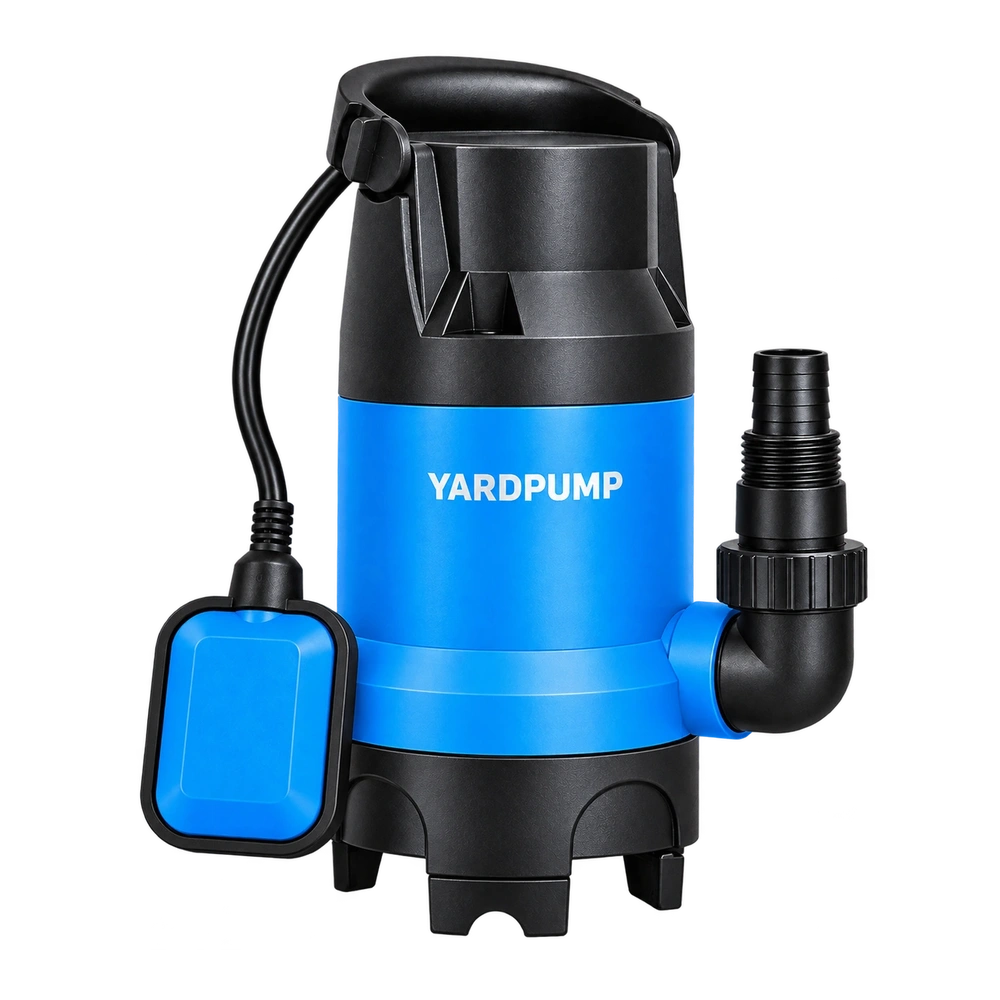
YARDPUMP BOM engineering
“Should we use a finer strainer so the pump is safer, or a more open inlet so it drains faster?”
Users often notice the inlet only when it clogs or when the last few millimetres of water refuse to disappear. In reality, the strainer and base geometry are among the biggest differences between bulk drainage and low-level cleanup.
A finer inlet blocks more debris but can clog sooner; a more open inlet lowers restriction but lets more material reach the hydraulics. Low-level designs trade inlet geometry and placement for lower residual water.
Think of it like this
The strainer is both a sieve and the pump’s front door
Make the openings too small and the door can clog before the pump receives enough water. Make them too large and debris that would have been stopped now reaches the impeller.
The total open area matters as much as the width of an individual slot because it controls inlet velocity and restriction.
That is why strainer design should be matched to the actual debris rather than simply made “finer.”
A composite drainage job
The pump that emptied the pool quickly but left a shallow lake on the floor
A normal drainage pump removes the bulk water efficiently, then stops drawing when the remaining depth falls below the inlet geometry.
The user calls the pump weak, but the real issue is that its base and strainer were designed for general drainage rather than near-dry floor cleanup.
Low-level pumps solve a different last-stage problem and may use removable strainers or flat-suction inlets to reach much lower residual levels.
Low-level geometry
Residual water is a physical dimension, not a marketing adjective
Grundfos documents low-level drainage down to a few millimetres on specific pump designs when the strainer arrangement allows it. That behavior comes from inlet height and hydraulic geometry.
The same geometry can be more sensitive to fine debris or surface flatness than a high-clearance dirty-water inlet.
For B2B sourcing, residual-water level should therefore be measured on a defined flat surface rather than described only as “flat suction.”
Strainer position
Sometimes the cleanest water is not at the bottom
Grundfos offers both fixed bottom strainers and floating suction arrangements in tank applications. A floating intake can draw from below the water surface where there may be less settled debris.
This shows that inlet design includes position as well as mesh size.
For rainwater tanks, pits and sumps, the expected debris distribution should guide whether bottom suction or a cleaner-level intake makes more sense.
What QC should test
A clean-water bench test cannot prove clog resistance
A strainer can deliver excellent flow with clean water and still fail quickly when exposed to leaves, hair or silt.
Validation should include representative debris for the target application, residual-water measurement and inspection for warped bases or broken clips.
The point is to test the inlet as users will actually encounter it.
Where strainers stop
An inlet cannot turn a utility pump into a slurry pump
Blocking large debris protects the hydraulics, but fine abrasive material can still pass through and cause wear. A large opening may improve solids entry without providing abrasion durability.
Treat the inlet as one boundary inside the total liquid-handling design.
Engineering decision layer
What to lock before you approve this component.
The narrative explains why the decision matters. This reference layer turns that reasoning into BOM, validation and supplier-control points.
- Fine strainer — blocks larger debris and protects the impeller, but clogs sooner in leaf/silt-laden water.
- Large-open-area strainer — lowers inlet loss and delays clogging, while allowing more debris to reach the hydraulic set.
- Low-level flat-suction base — designed to draw water closer to a floor, often with narrow inlet passages and specific placement requirements.
Strainers are low-cost parts, but low-level geometries can demand more complex tooling and tighter flatness control.
Open area and inlet height influence suction loss, residual water level and clogging behavior. A very fine screen can reduce usable flow when partially blocked.
Life issues are mostly impact, abrasion, cracking and deformation; performance can degrade long before the part physically fails if passages clog.
Failures include blocked slots, warped bases, pump tilt, broken clips and abrasion around inlet edges.
Measure residual water on a flat reference surface, test with representative debris and inspect molded flatness.
B2B buyers should specify residual-water method, inlet-open-area target, particle limit and clogging test condition.
Low-level inlet design must be matched to impeller/volute NPSH and cooling requirements.
YARDPUMP expert takeaway
The inlet defines what the pump sees first. Choose slot size, open area and suction height from the debris and finish level you actually need, then test clogging and residual water explicitly.