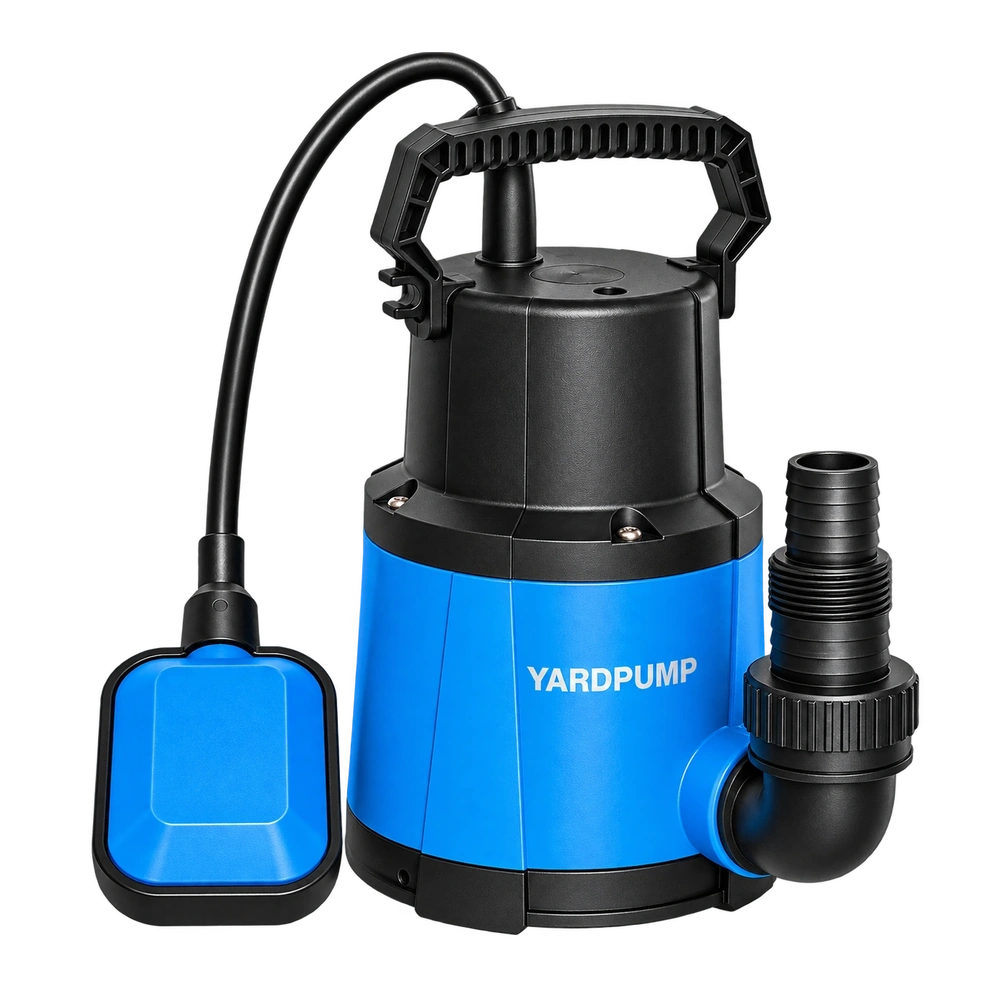
A 1,000-litre capacity tells you almost nothing about fit
Not necessarily. A nominal 1,000 L IBC can hold enough water while still having an access opening too small for the chosen pump-and-hose assembly. Measure the narrowest usable neck opening, the pump's maximum envelope with all fitted parts, the space for automatic controls, and the route for retrieving the pump without lifting its power cable.
The bare pump is not the installed assembly
A marketing photograph rarely shows every interference point. The handle, elbow, hose connector, float switch, lifting attachment and hose bend radius may exceed the width of the bare casing. A float might pass through the opening yet be trapped against the tote wall once the pump reaches the bottom. An inlet might sit on sediment, or a rigid discharge fitting may stop the pump from being withdrawn for cleaning.
Treat the effective opening as a measured dimension, not a generic “standard IBC” number. Cap rings, neck profiles, reconditioned containers and different manufacturers can change the actual free space.
A fit-and-clearance sheet for purchasing
| Item | Buyer must record | Decision impact |
|---|---|---|
| Neck opening | Narrowest clear opening and shape | Installation and later removal |
| Assembled envelope | Pump, handle, elbow and fitted hose envelope | Determines whether the whole assembly clears the opening |
| Level control | Float travel and true start/stop levels | Prevents jamming and short cycling |
| Tank floor | Sediment, support and inlet clearance | Inlet blockage and pump stability |
| Service access | Power-isolated retrieval and disconnection route | Maintenance feasibility |
| Electrical version | Nameplate, cable, plug and protective installation | Market and site suitability |
If the pump supplier does not have a verified assembled-envelope drawing, label the dimension as an open question. “Compact” is not a dimension.
A rainwater job is not automatically a sprinkler job
Transferring water from the tank to a container is usually a flow-and-lift question. Running a long hose to a sprinkler adds the end device's required pressure and flow. Request those values and check the selected pump curve at that duty point; its maximum flow and maximum head are not a simultaneous operating specification.
Roof runoff may carry leaves, sediment or contamination. A clean-water particle limit of 0.2 mm does not imply that a pump can handle abrasive grit; a dirty-water soft-particle limit of 5 mm does not establish suitability for dense sludge. Verify the exact model and liquid before making a channel claim.
Do not force a fit by defeating safeguards
Do not drag a pump through the neck by its power cable, jam the float upright, remove electrical protection or force a stiff connector beyond its designed angle. Confirm the selected model's permitted immersion, minimum water-level and cooling conditions. YARDPUMP's currently standardized maximum submersion figure is 5 m, not permission to run the pump at any liquid level.
An IBC previously used for chemical or unknown contents is not automatically a clean rainwater tank. Review containment, liquid compatibility and disposal requirements first. Stop the job and involve qualified personnel where wet electrical equipment or uncertain wiring is present.
Approve one measured assembly, not a vague product label
For each intended tank-and-pump combination, keep an installation card with the actual opening measurement, approved pump revision, discharge fittings, level-control type, inlet clearance, photographs, removal method, duty point and destination-market electrical version. Trial-fit the sample where safe or obtain a reliable dimensioned assembly drawing before claiming IBC compatibility.
A defensible listing says “suitable for the specified tank opening and approved configuration.” Without the measurements, say fit must be verified. For a YARDPUMP sourcing inquiry, send the actual tote dimensions and the water-transfer task.