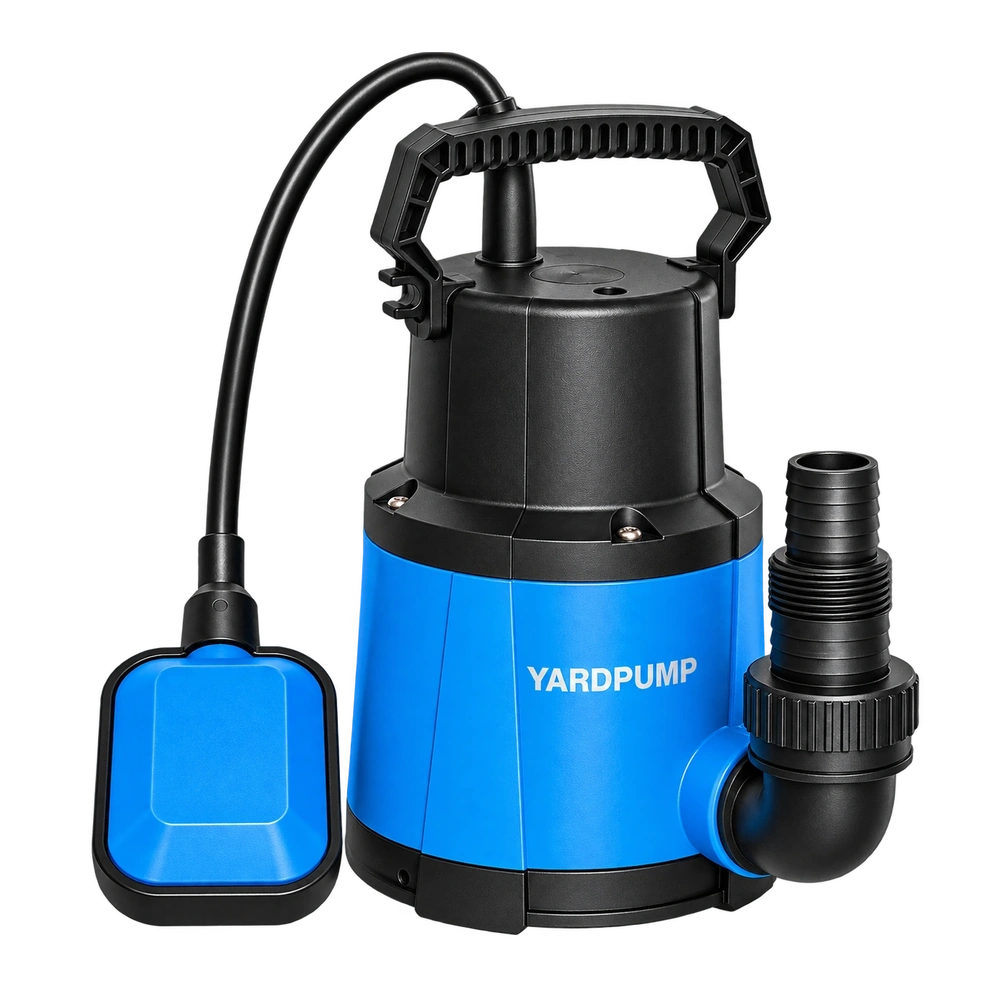
The answer for the category manager
Do not approve a new submersible-pump SKU using FOB price or shelf price alone. Ask how much money each unit contributes after landed cost, channel charges, fulfilment and a defensible after-sales allowance—and whether the item creates a new sale or merely divides demand across lookalike products. Contribution dollars, contribution rate, stock turn and service workload belong in the same decision.
This is different from comparing two supplier quotations. Quote normalization asks whether suppliers have priced the same configuration. A channel-profitability review asks which sellable offer deserves shelf space, working capital and service support.
A small, deliberately hypothetical ledger
Suppose a distributor evaluates two pump offers over the same sales period. Every number below is an illustrative assumption, not a YARDPUMP price, a customer result, a market benchmark or an observed return rate. Figures are US dollars per unit. Net sales revenue is after sales discounts and excludes taxes collected on behalf of authorities.
| Per-unit line item — illustration | Offer A: entry range | Offer B: differentiated range |
|---|---|---|
| Net sales revenue | $52 | $58 |
| Landed product cost | $24 | $29 |
| Channel and payment charges | $8 | $8 |
| Pick, pack and fulfilment | $4 | $4 |
| Budgeted service allowance (hypothetical) | $2 | $2 |
| Contribution dollars | $14 | $15 |
| Contribution margin | 26.9% | 25.9% |
The calculation is contribution dollars = net revenue − landed product cost − channel charges − fulfilment − budgeted service allowance. Offer B earns one dollar more per unit in this example but has a slightly lower contribution percentage. If B needs a slower stock turn, extra display space or more advertising, that one-dollar advantage may disappear. If it meets a real low-level drainage or soft-solids need that A cannot meet, it may generate incremental demand. The table alone does not prove that B is better.
Replace “better product” with a testable channel proposition
Ask four people to review a proposed SKU. The sales manager explains the job a buyer would choose it for and the exact reason it is different from the existing range. Procurement confirms that the difference is present in the approved specification and sample. Customer service lists the foreseeable misapplications and evidence needed to resolve a claim. Finance models the contribution at different net prices, costs and stock-turn assumptions.
| Decision question | Weak answer | Evidence worth collecting |
|---|---|---|
| What is different from the current SKU? | “More watts, premium look” | Liquid class, duty point, residual water, control or accessory difference |
| Why should the customer pay more? | “Stainless steel lasts longer” | Verified material or convenience benefit for the intended duty, without an unproven life claim |
| Does it create incremental demand? | “More SKUs always help” | Pilot sales showing new buyers versus substitution from existing items |
| Is the service allowance realistic? | “It almost never fails” | The distributor's own RMA categories and handling time; mark unknowns honestly |
| When should it be reordered? | “When it sells out” | Lead time, MOQ, inventory cover and a replenishment assumption |
When actual channel data is unavailable, model three stress cases: a lower net selling price, higher fulfilment cost and a larger service allowance. These are financial sensitivities, not predictions of returns or profits. Do not support a premium with unsupported “zero returns” or “double service life” statements.
What a useful pump range looks like on the shelf
A clean-water QDX model, a low-level drainage option, a WQD clean/dirty-water model and a selected 304 stainless-housing model may serve different jobs. Their value depends on water condition, required residual level, controls, actual flow at working head and installation—not a ladder of wattage alone.
For example, a buyer who needs to remove the last shallow layer of clean water must check the selected model's residual-water level and start conditions. A buyer draining water with soft particles must check the documented solids limit; “dirty water” is not permission to pump abrasive slurry. YARDPUMP's confirmed general boundaries are 0.2 mm particles for clean-water models and 5 mm soft particles for the relevant dirty-water families, subject to model-specific documentation. Those figures do not replace a performance curve or operating instructions.
A practical shelf card can use just three lines: suitable water, job solved, and the usage limit that sales must not overpromise. That may help a representative more than a fifth similar colour or wattage option, and it gives customer service a consistent explanation later.
Three gates before adding the SKU
The first gate is sellability: has the destination-market electrical version, cable, plug, label, packaging and required document set been defined? The second is distinctiveness: can the team explain the real difference from the existing range with a verified comparison, not a slogan? The third is economics: is the contribution acceptable after the actual cost structure and expected stock commitment are considered?
If any gate remains open, run a controlled evaluation or postpone the addition. Do not compensate for weak economics by exaggerating power, flow, solids handling or service life.
Channel decision: The best SKU is not automatically the cheapest to buy or the most expensive to sell. It is one that the salesperson can specify correctly, customer service can support and the distributor can replenish profitably under its own channel economics. Compare existing YARDPUMP families at /products/, discuss private-label packaging at /oem/, and confirm the exact configuration and quotation via /contact/.