The answer first
Ask three questions first: what is in the water, where must it go, and must the pump start and stop without someone watching it? Only then should a sales representative discuss a model or wattage. Starting with “How many watts?” can turn a drainage pump into an unsuitable sprinkler recommendation, or put a clean-water low-level pump into a debris-heavy job.
A one-minute counter card that rules out the wrong job
| Ask the customer | Typical answer | Selection direction | Do not promise |
|---|---|---|---|
| What is in the water? | Clean / soft debris / sand or unknown | Check the permitted liquid and solids | “Dirty-water” handles every solid |
| Where does it need to go? | Barrel to can / basement to drain / hose to sprinkler | Separate transfer, drainage and outlet pressure | Qmax is hose-end flow |
| Will it run unattended? | Supervised / automatic sump | Check float clearance and switching levels | Any float works in a narrow pit |
If the customer cannot give total head or hose size, record the vertical lift, hose length and internal diameter, then ask a technical colleague to confirm. Unknown chemicals, seawater, hot liquid, abrasive sand or uncertain electrical conditions are reasons to stop a routine recommendation and escalate the case.
One “submersible garden pump” search can describe three different purchases
A shopper asking for a submersible garden water pump may simply want to fill a watering can from a rain barrel. Another wants to water with a long hand-held hose. A third wants to operate a sprinkler with a specified pressure demand. These are not the same promise. A drainage pump’s maximum head and maximum flow do not establish that it will run a sprinkler at its required pressure and flow. The salesperson needs the sprinkler specification and the pump curve at the same duty point.
A useful reply is: “For moving water out of the barrel, let’s check water condition, lift and the speed you need. For a sprinkler, I also need its working pressure and your hose details. Watts alone won’t tell us.” It is more credible than “The bigger motor will spray farther.”
Put common jobs into the right product basket
| Customer job | Check first | Possible family direction | Avoid saying |
|---|---|---|---|
| Clean tank emptying or shallow cleanup | Inlet condition, residual water, controls | Low-level clean-water, e.g. QDX-PH if suitable | “Always drains to 7 mm” |
| Water with limited soft debris | Permitted particles, discharge and residual level | Clean-and-dirty, e.g. WQD-SD within limits | “Handles sand and all sewage” |
| Rain barrel to sprinkler | Nozzle flow/pressure, hose, elevation | Select by duty point; no default model | “Large Qmax means sprinkler-ready” |
| Automatic drainage in a narrow pit | Float travel, switching levels, backflow | Confirm controls before choosing a model | “The float cannot stick” |
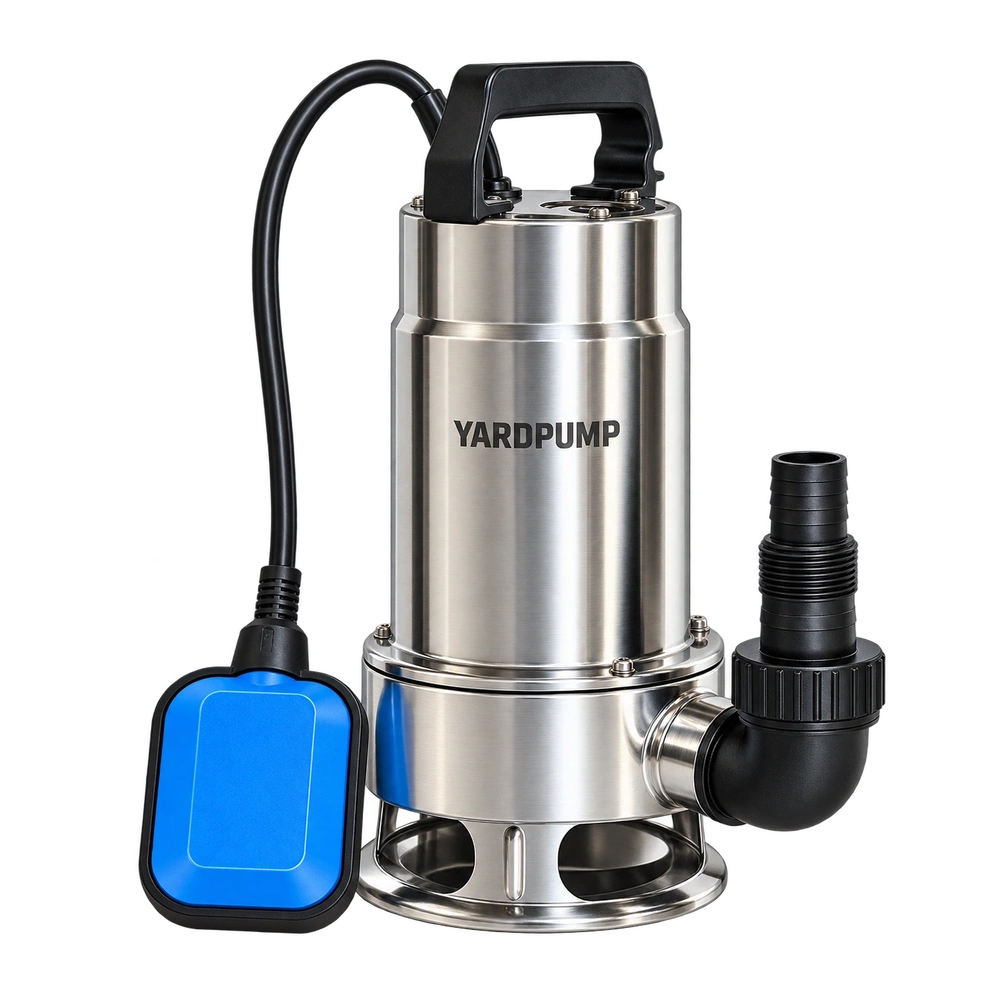
For context, YARDPUMP’s published QDX-PH 370 W version lists a maximum head of 8 m; the clean-water particle limit is 0.2 mm and maximum submersion depth is 5 m. Those are model limits, not a promise of flow through every hose. The WQD-SD family is published for clean and dirty water with soft solids up to 5 mm, a 90 mm remaining-water level and a 5 m maximum submersion depth. That does not establish suitability for abrasive sand. Confirm the selected electrical variant and the full operating conditions.
What should a rep say when the customer points to a higher wattage?
“Wattage is one electrical specification. What you actually need is a pump that moves this kind of water through your particular hose to the required outlet. Let’s match the liquid, lift, hose and switching method, then compare the pumps at the working point. That is safer than guessing from the label.”
A sales rep does not need to become a hydraulic engineer. Good training teaches them when to escalate: no curve for the required duty point, a plug or voltage mismatch, insufficient room for automatic controls, or a potentially hazardous liquid. Write “technical confirmation required” rather than making a verbal guarantee to close a sale.
The eight fields that help sales, purchasing and after-sales speak the same language
Record the application; liquid and debris; source water level and required final level; vertical lift; hose internal diameter and length; outlet-device pressure requirement; automatic versus supervised operation; and destination market with electrical supply. Add the target flow or emptying time if known. A distributor can then identify which recurring questions suggest a product-range gap and which are training issues—using actual cases rather than assumptions.
A correct sale protects margin better than an impressive claim
Gross margin is not net profit. Returns, freight, support time and reputational damage can consume it, but do not publish an invented return-rate reduction. Pilot the card, log the questions, recommendations and later complaints, and assess its value against your own data.