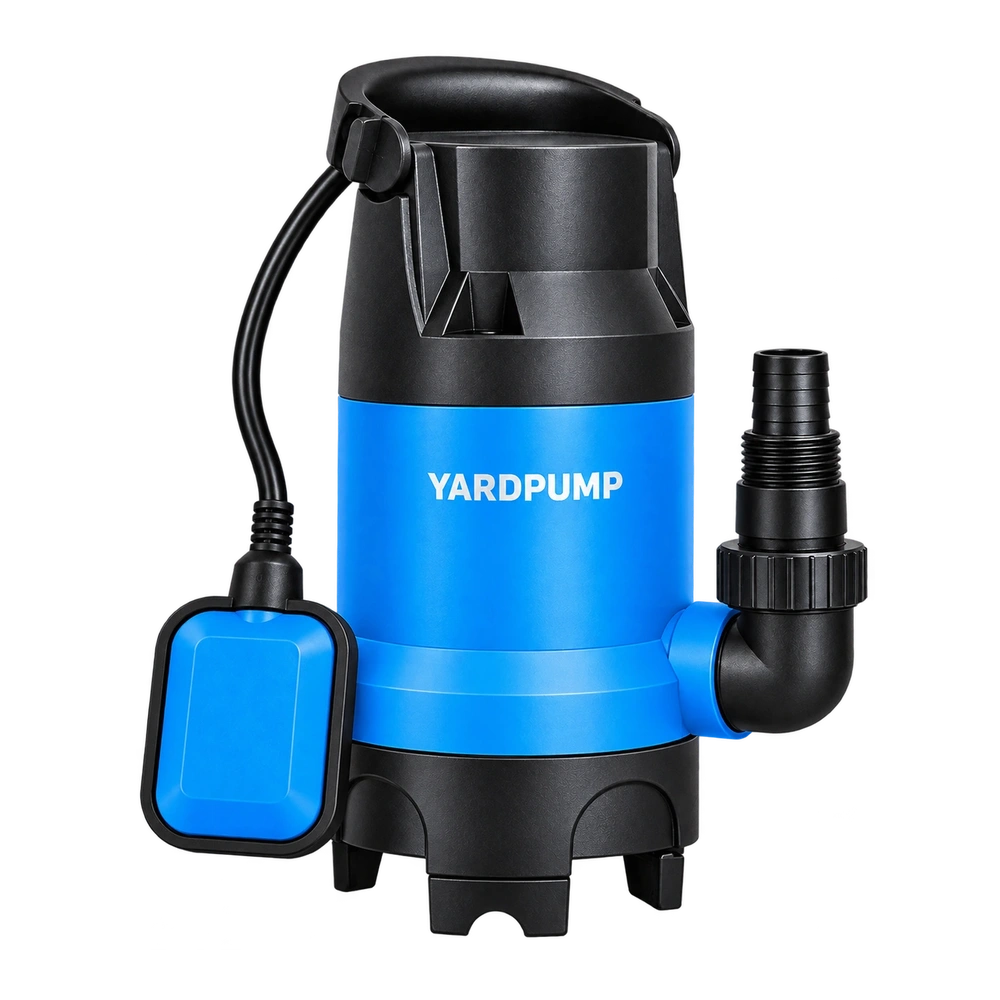
Short answer. A second supplier can support an existing private-label pump range, but a similar housing or matching wattage is not enough to approve the switch. Freeze the customer-facing promise and operating duty, compare the complete supplied configuration, verify destination-market electrical and safety requirements, test identified samples, and approve production against written acceptance criteria. Until those gates pass, the candidate is an alternative to evaluate—not a drop-in replacement.
A distributor may already sell a familiar plastic utility pump under its own label. A new factory offers a nearly identical housing at a lower FOB price, and the buyer assumes the old retail SKU, carton claims and spare-parts policy can remain unchanged. Yet the outlet thread, cable length, plug, float-switch behaviour, minimum operating water level, seal construction or hydraulic duty point may differ. A photograph cannot establish equivalence, and matching maximum head and maximum flow do not prove the same performance at the customer’s working point.
Why a lookalike can still be a different product
A supplier switch is a change-control decision, not just a price negotiation. The existing SKU represents a promise to the channel: what the customer receives, what it fits, what it does and how a return will be handled. If the physical configuration changes, the listing and service process may need to change too.
| What to freeze | Evidence to request | Why a mismatch matters |
|---|---|---|
| Duty point and water type | Flow at an agreed head, permitted solids, liquid conditions and test method. | Two maximum ratings can conceal different installed performance. |
| Electrical market version | Voltage, frequency, plug, cable, protection and applicable market documents. | A mechanically similar unit may be unsuitable for the destination country. |
| Mechanical interface | Outlet thread and adaptor, overall dimensions, base clearance and float travel. | Existing hoses, pits and packaging may no longer fit. |
| BOM and construction | Motor, impeller, shaft, bearing, sealing interfaces, housing resin and permitted substitutions. | Service life and repair compatibility may change. |
| Channel package | Model marking, instructions, accessories, traceability, carton dimensions and warranty process. | Listings and returns handling can become inconsistent. |
Freeze the promise before asking for a quote
Keep retail requirements and technical requirements separate. A retailer may care about carton dimensions, barcode and accessory fit; an engineering team needs a measurable acceptance point. Write down the current approved configuration before requesting an alternative. Do not copy unverified competitor specifications into the contract: if the incumbent’s advertised power or particle rating has never been checked, record it as a claim to validate rather than a fact the new supplier must imitate.
Normalize units and definitions in the RFQ. Maximum flow, shut-off head and input power are not the same as the flow delivered at the agreed operating head. State the intended liquid, installation, supply voltage and frequency, outlet connection, cable and control arrangement. Mark every deviation from the incumbent as acceptable, requiring a channel change, or blocking approval.
Four gates between a sample and a production release
Gate 1 — Paper comparison. Ask both suppliers to complete the same RFQ sheet and provide the exact variant offered. Request an outlet drawing and the float’s full movement envelope where applicable. Resolve missing dimensions and definitions before comparing the prices.
Gate 2 — Identified sample testing. Assign a sample ID and record its BOM revision, electrical version, date, test setup and photographs. Check the agreed duty points at controlled supply voltage and frequency, using the intended hose or an agreed test setup. Confirm accessory fit and safe start/stop behaviour separately. One test cannot replace every other acceptance check.
Gate 3 — Channel and service readiness. Compare the approved sample with the carton, instructions, adaptor and online listing. Confirm whether the old SKU still describes the item accurately. Agree how spare parts, warranty claims and batch identifiers will be handled. If the connector or operating instructions change, a new SKU or a clearly controlled revision may be safer than pretending nothing changed.
Gate 4 — First-lot release. A golden sample is a reference, not proof that every production unit will match it. Before production, define lot size, random selection, inspection timing, pass/fail criteria and the disposition of failures. Compare the first shipment with the frozen sample and configuration record. Require written approval for changes to the motor, seal, impeller, cable, packaging or supplied accessories.
Compare the whole commercial outcome, not just FOB
A lower quoted unit cost is valuable only when the commercial basis and accepted product are equivalent. Include accessory changes, carton volume, incoming inspection, return risk, service parts and replenishment reliability. A supplier can be commercially attractive without being interchangeable. It may be better to approve an additional variant honestly than to force a changed product into an old SKU.
For a compact clean-water sourcing project, the QDX-PH product family can be reviewed as a candidate—not as proof that it matches any incumbent model. Confirm the exact variant, duty point, installation and electrical configuration. The golden-sample revision checklist explains how to preserve the approved configuration after sign-off.
What should a supplier quote include?
Send the current duty point, destination market, voltage and frequency, water type, outlet drawing, packaging requirement, quantity and known acceptance criteria. Ask the supplier to state deviations explicitly. A useful comparison records both the quoted price and the evidence required to release the product; otherwise the buyer may be comparing different configurations as though they were identical.
Frequently asked questions
Can the same retail SKU be kept?
Only if the supplied configuration, claims, compatibility and required compliance evidence remain valid. Otherwise change the SKU or formally revise the specification and channel materials.
Is matching maximum head and maximum flow sufficient?
No. Those maxima are generally reached at different operating conditions. Compare flow at a stated head and record the test conditions.
Does a passing sample prove batch consistency?
No. Agree a first-lot sampling plan and change-control process before shipment.
What is the fastest useful RFQ?
Provide the destination market, water type, required flow at working head, electrical supply, outlet, control method, quantity and packaging requirements. Ask the supplier to list every deviation from the approved version.