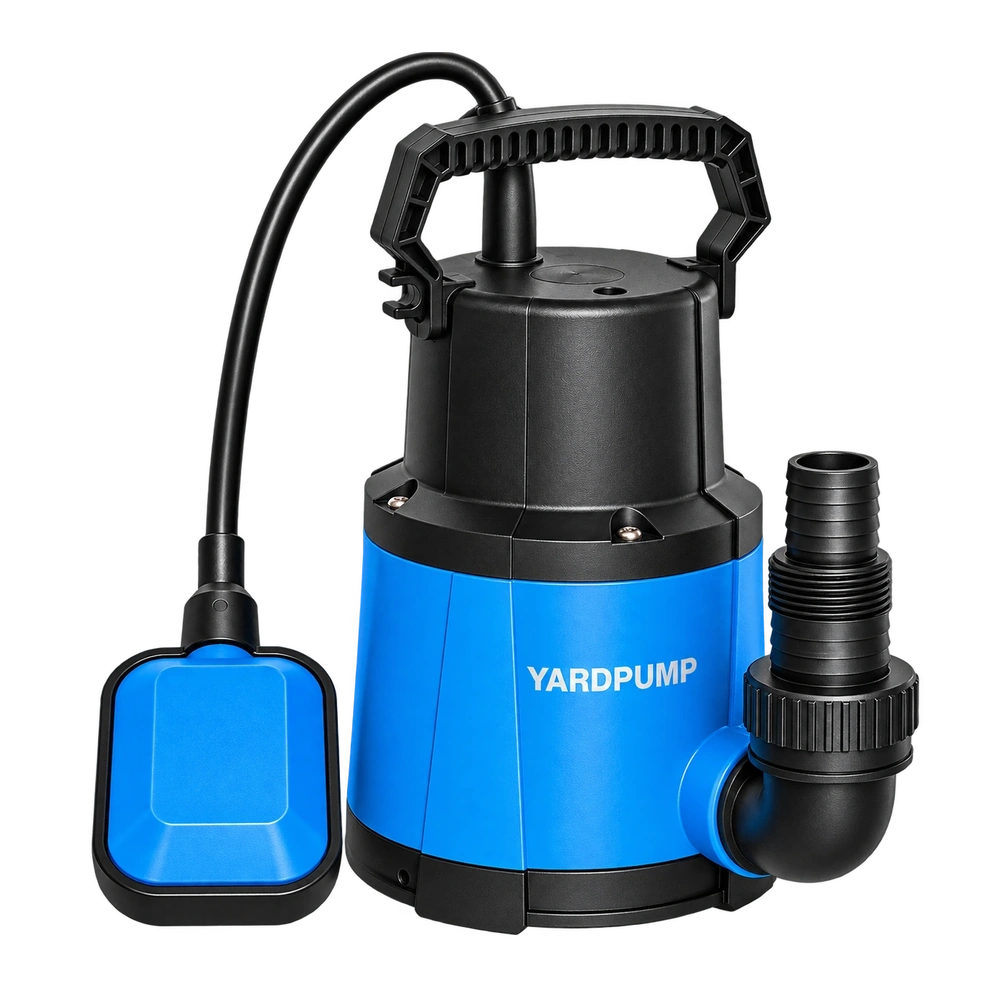
An order changes the power cable from five metres to ten metres, and a sales listing then claims ten metres of submersion. The second statement does not follow from the first. Cable length describes routing to the supply. Maximum immersion depth describes an approved installation boundary. Maximum head describes hydraulic performance.
Keep these quantities on separate lines in the purchasing specification.
More cable does not strengthen the water barriers
In clean water, five metres of depth creates approximately 0.49 bar of hydrostatic gauge pressure, while ten metres creates approximately 0.98 bar. These are approximate physical calculations, not product approval results.
Greater depth exposes the casing, shaft seals, cable entry and other interfaces to different conditions. Adding cable does not automatically change those interfaces or establish their performance.
For illustration, a model documented for five metres of maximum immersion remains subject to that boundary even if supplied with a ten-metre cable. A deeper installation requires assessment of the relevant construction, test conditions and documents. It cannot be approved by editing a price-list cell.
Separate immersion depth from delivery head
Immersion depth normally describes a position below the water surface, using the reference defined in the instructions. Static delivery head is related to the elevations and pressures at the supply and discharge boundaries.
Lowering a pump within the same open tank does not automatically increase the discharge elevation relative to the source water surface. However, it may increase pipe length and friction. As the tank empties, source level, immersion and cooling conditions can also change.
An installation drawing should therefore show the highest and lowest water levels, pump reference position, discharge location and pipe route. A single note reading “ten-metre cable” does not establish suitability.
Specify the cable as an electrical component
Cable length needs to be considered with conductor area, insulation, sheath, mechanical restraint, temperature and supply conditions. Additional resistance can affect motor voltage and starting behaviour. The design and testing determine whether a conductor change is needed.
A cable length or type required for a particular market is not evidence of a deeper submersion rating. A complete factory-installed long cable is also different from an improvised field extension.
Use the manufacturer’s approved arrangements for entry, joints and routing. Ordinary plugs, sockets and connectors do not become immersible because they supply a submersible pump. Support the pump at its designated handle or lifting point rather than allowing the cable to carry its weight.
An IP marking must be read with its specified conditions. IPX8 does not establish unlimited depth, duration or liquid compatibility. Water protection also does not independently establish corrosion resistance, oil compatibility or suitability for drinking water.
Connect the order to the installation
Confirm effective cable length and its measurement endpoints, conductor and sheath specification, plug version, maximum immersion, minimum operating water level, liquid temperature and required hydraulic duty.
Ask the supplier to mark these conditions on the installation sketch. This produces a much clearer acceptance reference than a statement such as “long waterproof cable”.
Incoming inspection should compare the cable version with the identification and accompanying documents. Measuring length alone misses the approved electrical and installation conditions.
If a design change is intended to increase immersion depth, retain the corresponding validation and approval. If the cable is longer only to cross the tank wall and reach a dry supply location, the original immersion boundary can remain unchanged.
A useful sales question is: how far below the highest water level will the pump be installed, and how far must the cable actually travel? Those distances commonly differ. Establishing both prevents an adequately long cable from concealing an unsuitable installation.
Questions buyers ask
Can the whole cable length be treated as the permitted water depth? No. Establish the limits for the complete pump and each relevant connection from their documentation.
Can a longer cable change delivered performance? It can, through supply-voltage effects and other conditions. Check conductor sizing, routing and measured operation.
Does maximum delivery head indicate maximum submersion? No. They describe different capabilities and must be verified separately.