The buyer’s starting point
The riskiest first order is not always the wrong pump. It may be five pumps that all appear to do the same job—while none has a clear answer to the customer’s actual problem.
Build the shelf around jobs, not a ladder of wattages
Imagine a hardware and garden distributor launching a compact submersible pump range. The supplier offers 200 W, 250 W, 370 W, 550 W and 750 W variants. It is tempting to buy one of each. Yet customers rarely enter the store asking for 370 W instead of 550 W. They ask how to empty a flooded basement, move water from a rain barrel, or clear the last shallow layer from a floor.
The first assortment decision should therefore be about jobs, liquid condition, duty point and controls. Wattage alone does not establish whether two products serve different customers. A well-defined product role is easier to sell, train and support than a shelf full of overlapping codes.
| Customer job | Questions to ask | Possible range role | Do not promise |
|---|---|---|---|
| Floodwater removal | Soft debris? Pit depth? Unattended operation? | Dirty-water drainage with suitable level control | Mud, fibers or toilet sewage capability |
| Rain-barrel transfer | Water condition, tank depth, hose, end device | Clean-water submersible garden transfer | Enough pressure for every sprinkler |
| Shallow-water cleanup | Residual depth, start level, supervision | Low-residual clean-water pump | A perfectly dry floor |
| Higher-flow transfer | Required flow at total working head, outlet | Curve-matched higher-flow family | Maximum head and maximum flow together |
Every SKU needs a one-sentence reason to exist
If two pumps are both described as “good for drainage, watering and general transfer,” the distributor has not built an assortment; it has added stock codes. Give each SKU one primary mission, one explicit exclusion, one decisive installation or duty-point question, and one defensible reason to trade up.
For example: “This is a clean-water transfer option for a rain barrel. If the customer wants to run several pressure-dependent sprinklers, check nozzle pressure, hose losses and the pump curve first.” This is less flashy than a universal-use claim, but it reduces misunderstanding. People searching for a submersible garden pump or submersible garden water pumps may need exactly that distinction.
Use a substitution test to remove overlap
Put candidate models A and B side by side. What job can A do that B cannot? What customer benefit justifies the extra landed cost of B? When the customer describes a job without knowing wattage, can a salesperson consistently recommend one rather than the other? If all three answers are vague, consider a smaller trial rather than stocking both heavily.
Unit price is not channel economics
A distributor’s commercial decision includes freight to warehouse, applicable duties and taxes, barcode and packaging handling, storage, support effort, damage and return processing. The mix differs by market and Incoterm. An FOB quotation is not the same as landed cost or retail margin.
Here is a purely hypothetical planning example, not a sales forecast: for a 120-unit trial, the team allocates 50 units to its main drainage mission, 40 to clean-water transfer and 30 to a specific shallow-water job. Two weeks later, it reviews enquiries, stockouts, reasons for returns and how hard the models were to explain. The next order follows local evidence—not the largest wattage or a generic industry percentage.
| SKU signal | What to record |
|---|---|
| Demand fit | Job described in enquiries versus model recommended |
| Velocity | Units sold, days in stock, stockouts |
| Profit quality | Landed cost, channel price, support and return cost |
| Mis-selling | Disputes about water, head, controls or accessories |
| Cannibalization | Customers repeatedly choosing between near-identical models |
Three field cards can outperform a thick catalog
Give the sales team a 30-second selection card for each SKU: allowed liquid, required duty-point checks, manual or automatic controls, accessories and exclusions. Add a common-objections card: why a longer hose reduces delivered flow, or why some sprinklers will not work. Finally, prepare a service-evidence card listing the model, batch and installation photos needed when a complaint arrives.
For private-label programs, the product listing, carton, nameplate and manual should tell the same story as the sales cards. “Can pass specified soft particles” must not become “pumps abrasive slurry.” Maximum head and maximum flow must not be presented as simultaneous operating performance.
How YARDPUMP can support a distributor assortment
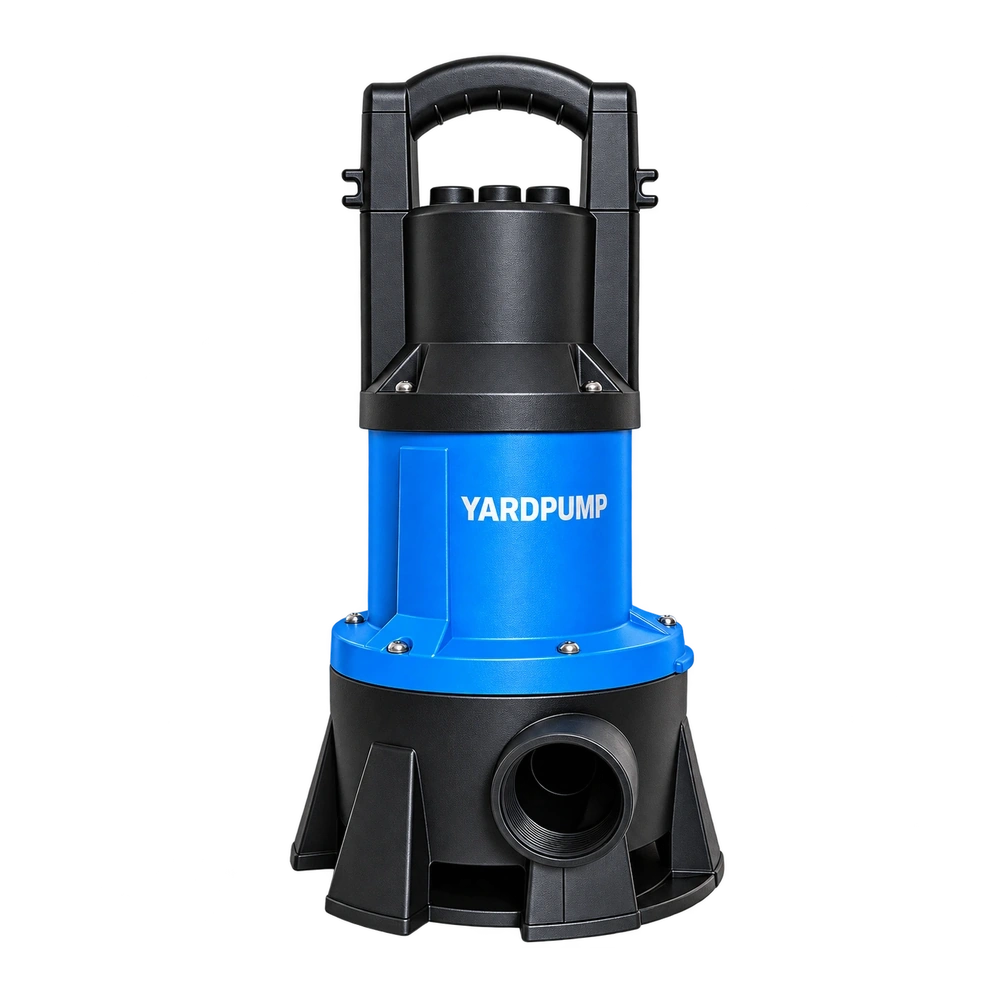
YARDPUMP can discuss candidate products from its confirmed compact clean-water, clean-and-dirty-water and low-level submersible families. The actual selection must be confirmed against the destination electrical version, liquid, duty point, controls, accessories and packaging. This article is not a suitability guarantee for any particular model, and it does not imply every submersible pump is appropriate for continuous irrigation or high-pressure sprinklers.
The distributor’s takeaway: the strongest assortment is not the neatest wattage ladder. It is the clearest separation of customer jobs.