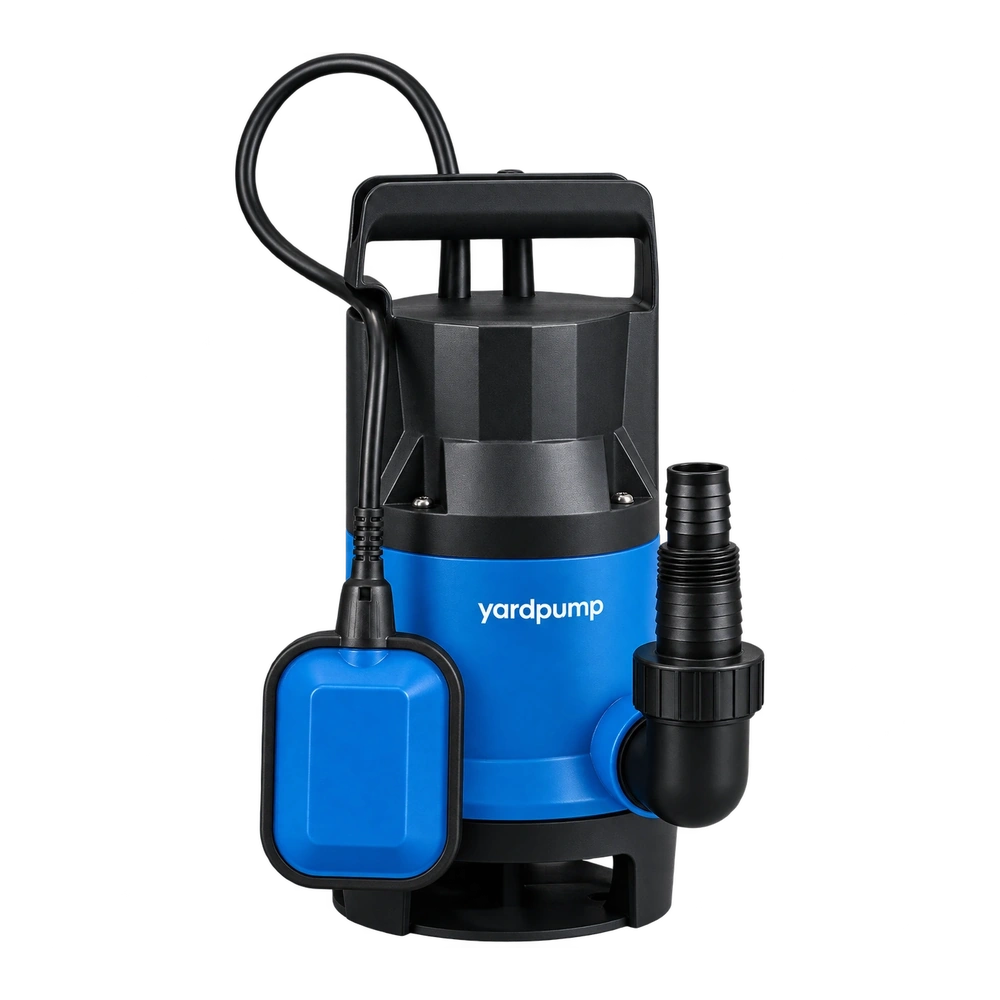
After heavy rain, a flat roof may retain only a few centimetres of water. The tempting response is to place a low-level utility pump on the membrane and run a long hose to ground level. The first decision is not motor wattage. It is whether the roof can safely support the equipment, whether the pump can remain adequately cooled in shallow water, and whether the discharge route creates backflow, erosion or a hazard below. Select the pump from actual water depth, vertical lift, hose loss and the residual-water target.
What drives the result
Static elevation head is the final discharge elevation minus the roof water-surface elevation. A lower outlet assists drainage; an eight-metre downward drop is not eight metres of positive lift for the pump to overcome. Hose friction, fittings and outlet velocity still consume energy. At startup, water must reach any hose crest; after a continuous water column forms, a descending hose may siphon. Maximum flow and maximum head are different operating points. In shallow water the inlet can draw air and motor cooling can change. A low-level intake does not cancel dry-running or minimum-immersion limits. Protect the membrane from sharp feet, trapped grit and vibration.
An illustrative way to check
Consider a method example, not a product claim. The final outlet is eight metres below the roof water surface, the hose is twenty-five metres long, and it passes over a parapet 0.4 metres above that surface. The endpoint elevation term is minus eight metres; reading the curve at positive eight metres plus friction is incorrect. Check that the pump can first establish flow over the crest. Once the line is full, verify actual flow against the system and the pump's permitted operating range, watching for siphoning, hose collapse and flow after shutdown. Do not extrapolate an ordinary published curve into unvalidated negative-head operation. During rain, installed discharge must still exceed credible inflow.
An RFQ should not ask only for a flat roof drainage pump. It should state the liquid, highest and lowest water levels, vertical lift, hose bore and length, target emptying time, solids or fibres, electrical supply, and whether operation is supervised or automatic. The supplier can then identify a duty point instead of combining maximum flow, maximum head and rated power as though they occur together. Validate the first sample through a complete start-run-stop cycle in the intended piping. A brief no-load sound check does not represent the service.
Actions for the site or purchasing team
- Confirm roof access, load limits, membrane protection and the permitted discharge location. Keep the power connection dry and use the required ground-fault or residual-current protection.
- Place the pump on a broad, smooth support board. Remove screws, stone chips and large leaves, and never suspend the pump by its cable.
- Record vertical lift, true hose bore, length and fittings. Avoid flattened hose, sharp bends and reducers that become the smallest passage.
- During the first run, watch the water level, discharge stability and signs of air ingestion. Stop at the model's permitted minimum level.
- Route water where it cannot wash out foundations, return to the roof or fall onto people and electrical equipment below.
Limits and application boundary
Permanent roof drainage, structural loading and electrical installation require competent local review. A portable pump is not automatically suitable as an unattended permanent roof-flood system. Water containing mortar, abrasive roofing granules or cleaning chemicals also requires a separate media-compatibility check.
Frequently asked questions
Will a low-level pump leave the roof completely dry? Not necessarily. Residual water depends on inlet geometry, roof flatness, pump position and the permitted stopping level.
Does a longer hose merely add a little time? Length and small bore increase friction and can reduce the duty-point flow substantially.
Can the pump be lowered by its power cable? No. Use the handle or the lifting method stated for the model so the cable entry is not damaged.
Related reading
If a Pump Drains Down to 7 mm, Will It Start Automatically at 7 mm?
Pump Flow Drops After Connecting a Garden Hose: A Five-Step Diagnostic Guide