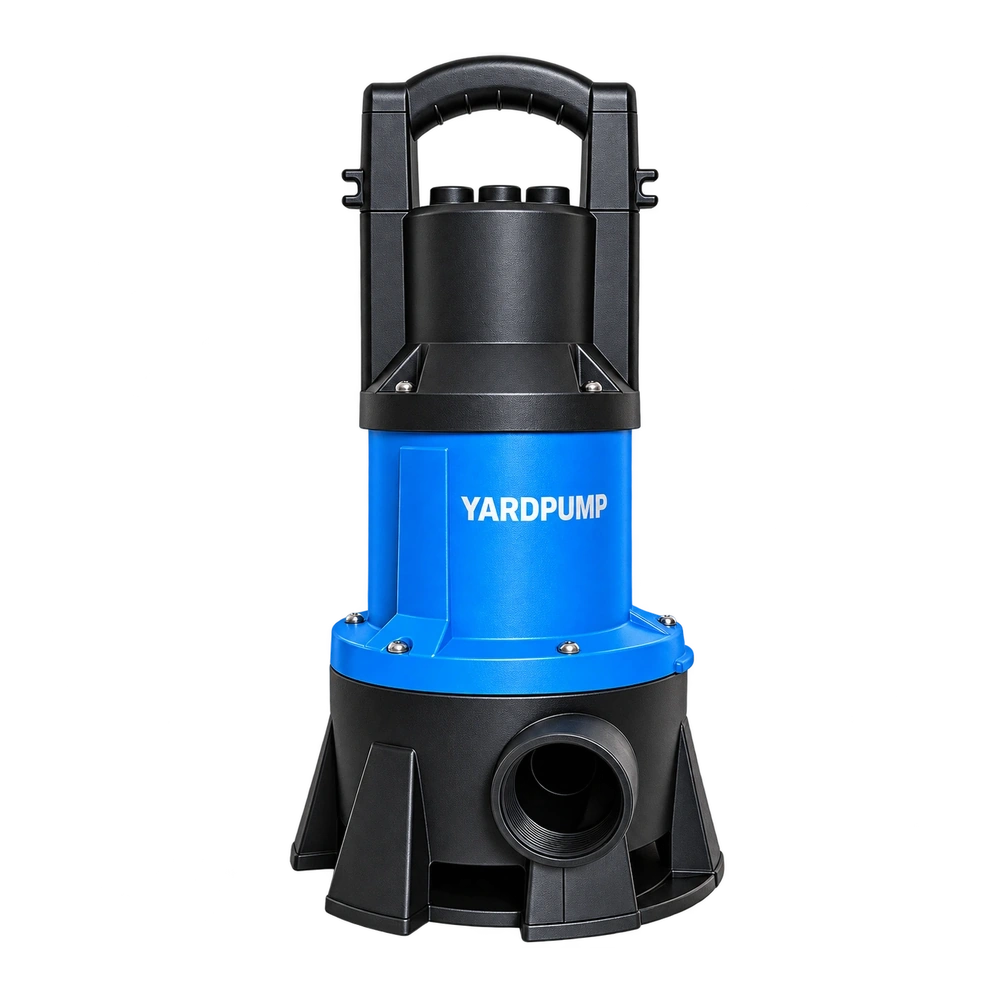
Imagine a narrow sump where the float swings freely during a dry fit. After the discharge hose is connected and the pump has run, the body has turned slightly. The float now brushes the wall and the pump stops later than it should. Check the pump's position and the entire float travel with the final hose in place. Clearance measured beside a stationary pump with an empty hose does not prove clearance during use. Replacing the float or shortening its tether before addressing the movement can conceal the real problem.
An empty hose does not pull like a filled hose
It is easy to swing an empty hose aside. When it fills, its mass increases, the shape at a bend can change and a constrained segment can pull at the outlet. Movement during a cycle, or a hose being pulled from outside the pit, can rotate a pump that is not stably supported. The outlet may show no visible crack, even though the float now faces the wall. The power cord or another cable can also cross the float's new path.
For illustration, a fully charged three-metre hose with a 32 mm internal diameter contains about 2.4 kg of water. That does not mean the outlet carries all that mass: the support geometry decides where the load goes. It does show why a dry hose draped over a pit edge tells you little about its working position. Neither the power cord nor the float lead is a restraint for the pump.
Check the swept space, not just the end positions
After isolating power as directed, mark the pump's feet and outlet direction. Check that the base is level, the discharge line is supported separately and the adapter is not twisted. Inspect the entire arc from low to high, including the float lead, cables, check valve and openings in the cover. A float can clear both ends and still hang on a fitting in the middle. A vertical or compact switch uses its own installation dimensions and level requirements, so do not substitute a tethered float measurement for its manual.
Have a qualified installer observe a normal wet test from a dry, safe position using the approved procedure. Do not hold the pump, move the float by hand or reach into the pit while equipment is energized. When isolated after the cycle, compare the position with the marks. If the pump moved, correct the hose route, bend and support before testing again. If the body stayed put but travel was interrupted, look at the cable arrangement, wall and float itself.
A small turn can consume a visible gap
For an illustrative layout, take a part of the float's swept area about 18 cm from the pump's pivot. A rotation of 20 degrees can move it sideways by about six centimetres in one orientation. Four centimetres of dry-fit clearance can disappear. Actual clearance depends on the tether, float shape and pipe layout. These numbers explain the geometry; they are not a required gap for any model. Check the tightest part of travel as installed.
Prove the installation over several cycles
Record actual start and stop levels and steady delivery with the same hose and pit layout before and after the change. After supporting the discharge and positioning the pump, run several normal fill and drain cycles to check that the pump stays in place, the float clears and the joint is not being forced out of alignment. A dirty-water pump's ability to pass specified solids does not solve a cramped switch. If the pit cannot provide the required space, look for an approved compact control arrangement rather than tying up a float or bypassing it.
Two photographs from the same angle can help: the first shows the dry feet and hose support, and the second shows the position after testing and isolation. They give service staff more to work with than a note that the float moved freely.
Frequently asked questions
The float clears the wall at the top and bottom. What else can catch it?
Check the middle of its travel for hoses, cables, brackets and the underside of the cover.
Can I tie the discharge hose to the float cable?
No. Support the discharge independently as directed and keep the float cable free to move.
Is one wet cycle enough?
Several normal cycles show whether filling the line, stopping and restarting change the hose position or the pump's direction.