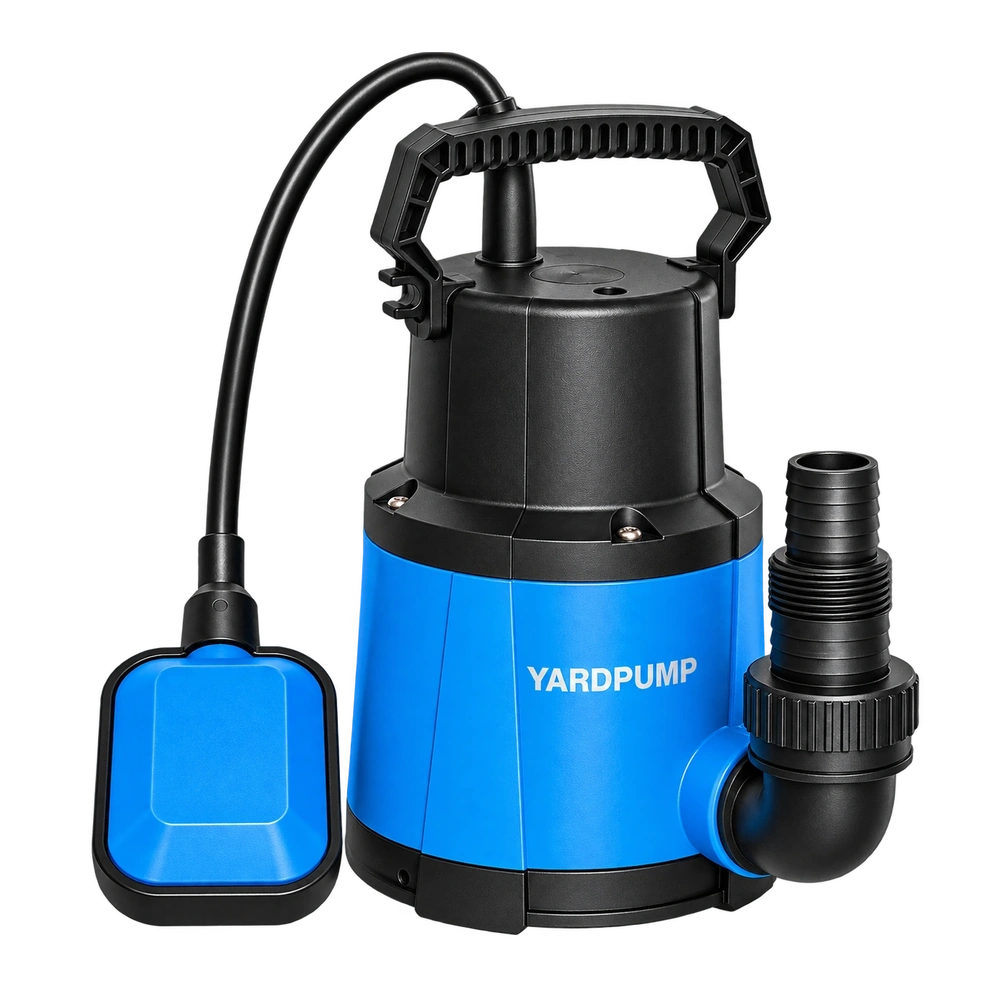
A pump that fits inside a pit is not necessarily a pump that can operate safely there. The float switch needs enough room to move through its complete start-and-stop travel. The pit also needs enough usable water volume between those levels to avoid excessive cycling. Before choosing a compact sump pump, measure the space available to the pump and its control mechanism, not just the pump body.
Why the pump footprint is only the first measurement
A tethered float swings through an arc. A vertical float moves along a guide. An integrated level sensor may have a smaller moving envelope but brings its own water-level and cleanliness requirements. A wall, hose, cable, check valve or pit cover can obstruct any of these arrangements.
For an existing pit, record the internal width or diameter, depth, inlet position, discharge route, cover clearance and the location of any backup pump. Then compare those measurements with the exact model's installation drawing and switch travel—not a product photograph.
| Installation condition | What to check | Why it matters |
|---|---|---|
| Narrow round or rectangular pit | Full float movement at every water level | A float that touches the wall may fail to start or stop |
| High inflow from perimeter drains | Pump flow at the actual operating head | Maximum advertised flow is not the flow at installed head |
| Small vertical distance between on and off levels | Usable drawdown volume | Small volume can create frequent start-stop cycles |
| Hose, cable or backup pump in the pit | Clear routing and separation | Accessories can snag the control mechanism |
| Sediment or debris | Intake and sensor cleanliness, permitted solids | Blocked intake and fouled sensors can alter operation |
Calculate the water removed per cycle
For a cylindrical basin, an initial estimate is:
Drawdown volume (litres) = π × (inside diameter in metres ÷ 2)² × vertical distance between ON and OFF levels in metres × 1,000.
For example, a pit with an internal diameter of 0.40 m and a verified switch travel of 0.12 m has approximately 15 litres of geometric volume between the two levels. This is a calculation example, not a YARDPUMP specification. Real usable volume can be smaller because the pump and piping occupy space; the pit may also be non-cylindrical.
Now distinguish incoming water from pumped water. If inflow is 5 L/min and the pump actually discharges 25 L/min at the installed head, the pit fills by roughly 15/5 = 3 minutes while the pump is off and empties by roughly 15/(25−5) = 0.75 minutes while it runs. That is about 16 cycles per hour in this simplified steady-flow illustration. Actual inflow fluctuates, and permitted starts per hour must come from the exact motor and control documentation. Do not treat the illustration as a recommended operating limit.
A practical selection sequence
First, confirm whether the pit is intended for clean drainage water, dirty water or sewage; the terms are not interchangeable. Next, establish required flow at the working head including vertical rise, hose or pipe losses and fittings. Only then compare pump dimensions, outlet, solids limits, float type and start/stop levels.
If the pit is too narrow for the float to travel freely, do not defeat, tie up or bypass the automatic switch. Choose a suitable certified control arrangement or redesign the pit with qualified installation support. A low residual-water claim does not prove that an automatic float will restart at that same level.
What a distributor should ask before recommending a model
Ask the customer for a photo of the empty pit with a tape measure, a sketch of the discharge route, the highest observed incoming water level, whether a backup pump is present, and the exact plug/electrical market. If any of these are missing, give a conditional recommendation rather than promising that a particular pump will fit.
For a broader comparison, use the pump selection library and technical articles. For an OEM or distributor application, send the pit dimensions and target duty point via the YARDPUMP inquiry page so a specific configuration can be checked.
Selection conclusion: A good narrow-pit choice satisfies four conditions at once: hydraulic duty, water/solids suitability, free switch travel and acceptable cycling. Passing only the first two is not enough.
FAQ
Does an integrated float always work in a smaller pit? Not always. Confirm the manufacturer's minimum clearance and sensor operating conditions for the exact model.
Can a float be tied up to make the pump run? Do not defeat automatic protection to compensate for a poor installation fit. Follow the model instructions and qualified electrical guidance.
Is low residual water the same as low automatic start level? No. Residual water after pumping and the switch-on level are separate specifications.