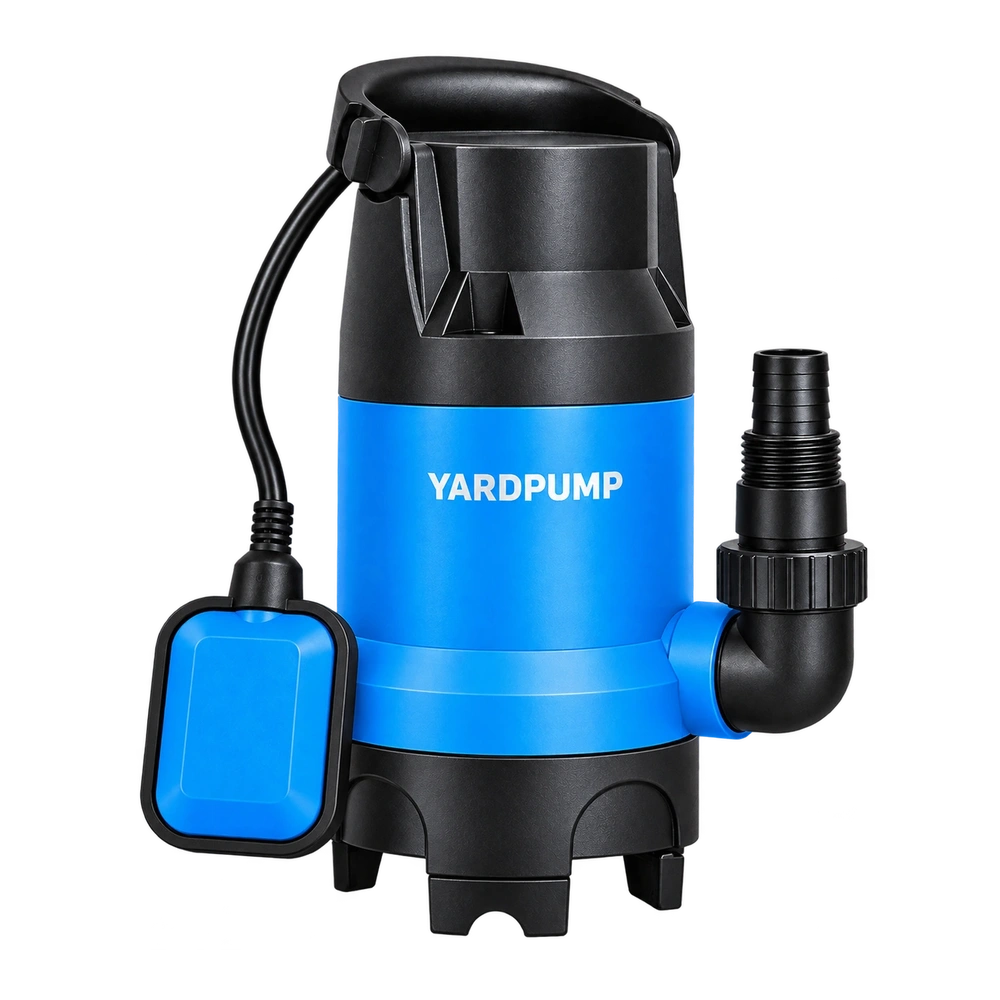
“The pressure reading was low, so why did the plastic outlet crack?” In a typical portable-pump installation, a long hose hangs beside the discharge connector and is occasionally pulled across the ground. Once filled, that hose loads the connection differently from an empty hose. Internal pressure is only one part of the load case. Weight, bending and twisting must be considered separately before assigning the failure to either the pump or the installer.
Record the loads separately
Pressure acts on wetted surfaces. Hose and fitting weight are transmitted through their supports and connections. Misalignment, assembly force and handling can introduce additional bending or torsion. These effects may occur together, but a pressure gauge does not measure all of them. Normal water delivery does not prove that the outlet root is mechanically unstressed.
| Observation | Conditions worth checking first |
|---|---|
| The pump tilts when the hose is connected | Hose weight, supports and connection alignment |
| Whitening or distortion appears near the connector | Thread compatibility, sealing method, assembly force and previous damage |
| The outlet moves whenever the hose is pulled | Inadequate independent support or repeated mechanical loading |
These are investigation clues, not a diagnosis from a photograph. Material condition, moulding, transport damage and earlier assembly damage remain possible contributors. Preserve the arrangement before changing it so the original load path can be assessed.
A full hose is a different object
Water contributes to hose weight. As an illustration, a round hose with an internal diameter of about thirty-eight millimetres contains approximately 1.1 litres per metre. That adds about 1.1 kilograms of water per metre, before counting the hose and accessories. A five-metre filled section cannot be treated as a lightweight empty tube.
The share carried by the pump outlet depends on routing, ground contact and supports. It is not automatically the whole weight of the hose. Bending also depends on the lever arm: moving the same force farther from the connection can increase its effect. This explanation does not provide a universal allowable bending moment or tightening torque.
Inspect four places before installation is accepted
First, check the pump outlet itself. The connector, thread and sealing surface must match the specified arrangement. An incompatible fitting should not be forced into engagement. Second, examine the first hose section: it should not pull the pump out of its approved position after connection.
Third, inspect bends, wall crossings and suspended sections for movement and sag when full. Fourth, identify walkways and handling areas where the hose may be pulled. The discharge hose must not become a lifting handle for the pump. Perform inspection or adjustment with power isolated and pressure safely released, rather than dismantling or changing load-bearing connections during operation.
Support the route instead of tightening harder
Pipework should align naturally with the connection. The pump outlet should not be used to drag misaligned pipework into position. A flexible connector may accommodate movement, but it does not automatically support a suspended hose. Brackets, restraint points and connector arrangements need to follow the equipment and installation requirements.
Further tightening can temporarily reduce a leak while increasing local stress, stripping plastic threads or damaging a seal. “It still turns by hand” is not an assembly specification. A metal adaptor may also increase weight and leverage, moving the weak point into the plastic housing rather than removing the load.
If cracking has already occurred
Stop use and isolate the equipment safely. Record the relative pump and hose positions, support points, filled condition, accessory identification and crack location. Where appropriate, qualified personnel should document the loading direction before dismantling. Do not repressurize a damaged pump for photographs or apply adhesive and return it to service without an approved repair assessment.
Returned-part analysis should distinguish the crack origin, thread damage, material condition and mechanical evidence. Whitening alone does not prove excessive installer torque. Equally, low water pressure does not prove a manufacturing defect. Sharing the installation and sample evidence is more useful than choosing a responsible party before investigating.
Put connection boundaries in the OEM specification
Specify more than outlet size. Identify the connection type, sealing method, approved fitting combinations and support requirements. If the product will use long hoses or undergo frequent reconnection, evaluate the actual accessory combination, including its filled condition and the effect of operating cycles on sealing and structure.
Include any support hardware and installation guidance in quote comparisons. A connection's internal-pressure capability does not establish its ability to resist arbitrary external bending. Drawing the water route and the mechanical load path together provides a better basis for selection than asking only for a thicker outlet.
Frequently Asked Questions
Does a metal adaptor prevent plastic outlet failure?
Not necessarily. It may add weight or transfer force to the plastic root. Compatibility and independent support still need assessment.
Is support irrelevant when most of the hose lies on the ground?
No. Local suspended sections, wall crossings and handling can still load the outlet. Follow the actual route rather than the overall hose length.
Does low pressure exclude installation-related causes?
No. Internal pressure, external weight and assembly stress are separate conditions requiring separate evidence.