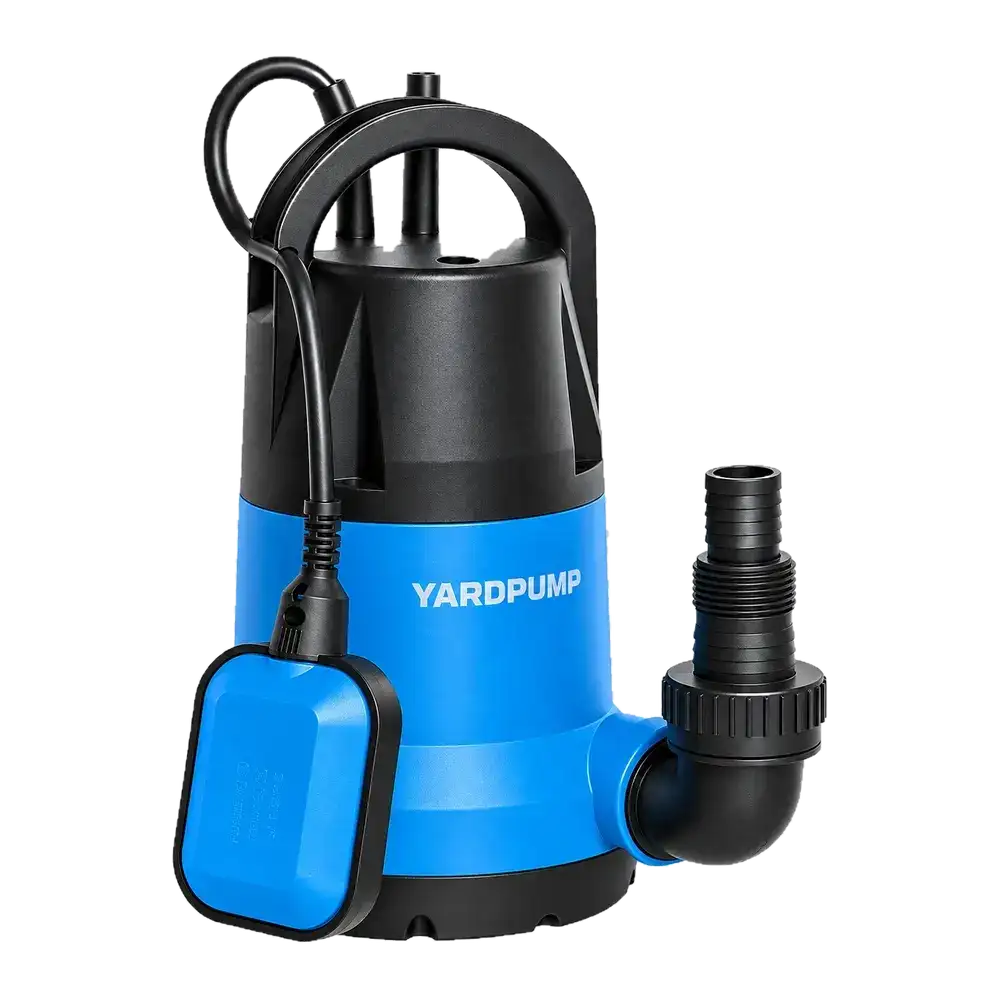
Dropping a drainage pump into the deepest part of a garden pond is rarely the best first step. Fish, fry, string algae and bottom sediment all move toward the inlet, while a pump close to the floor stirs the material it is meant to avoid. Decide how much water and livestock must remain, then separate clear-water transfer from sludge removal.
What drives the result
A solids passage rating describes whether a specified geometric object may pass through the hydraulic path. It does not establish safety for fry and does not prove long-term abrasive-sand capability. Inlet velocity depends on flow and effective open area; a small guard creates stronger local suction and blinds faster with algae. Raising the pump reduces sediment pickup, but it must be supported from the handle on a stable frame, never by the power cable. A low-level pump may help with the clean final layer yet places the inlet closer to deposits.
An illustrative way to check
For example, when replacing one third of the pond water, livestock can first be moved to a suitable container holding original pond water with appropriate aeration. The pump can then sit in a broad perforated basket above the bottom and remove the clearer upper layer. The remaining turbid water and sludge are handled separately. This staged approach is easier to control than trying to expose the pond floor in one run.
An RFQ should not ask only for a garden pond draining pump. It should state the liquid, highest and lowest water levels, vertical lift, hose bore and length, target emptying time, solids or fibres, electrical supply, and whether operation is supervised or automatic. The supplier can then identify a duty point instead of combining maximum flow, maximum head and rated power as though they occur together. Validate the first sample through a complete start-run-stop cycle in the intended piping. A brief no-load sound check does not represent the service.
Actions for the site or purchasing team
- Define partial exchange, full draining or sludge removal, and arrange livestock, plants and replacement water first.
- Describe sediment, sand, leaves and string algae. Select the guard and cleaning interval around the most difficult material.
- Use a large coarse basket to reduce local inlet velocity. Keep it visible, retrievable and easy to clean.
- Send discharge only to an approved location. Treated pond water may not be suitable for a storm-water route.
- Lower the level in stages while observing livestock, screen fouling, pump sound and discharge stability.
Limits and application boundary
An oil-filled drainage pump is not automatically approved for continuous operation with aquatic life. Verify biological suitability, continuous-duty capability and wetted materials for the exact model. This article addresses supervised temporary drainage only.
Frequently asked questions
Does a large solids rating prevent string-algae blockage? No. Long fibres behave differently from round test particles.
May the pump hang from its cable above the pond floor? No. Support it by the handle on a stable frame.
Is a low-level pump best for pond sludge? Not necessarily. Its inlet sits close to deposits, so sludge should be evaluated as a separate duty.
Related reading
Rated to Pass Particles but Still Blocking? Sand, Fibres and Sludge Behave Differently