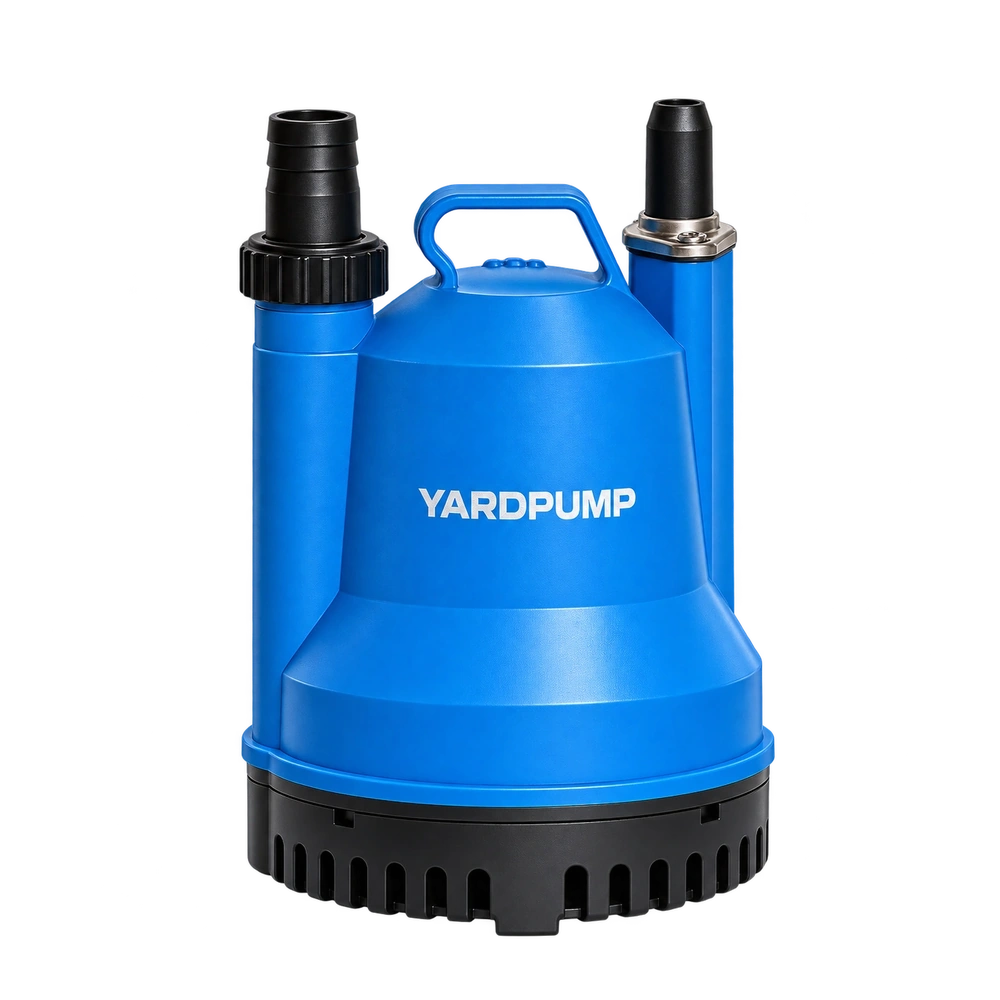
Short answer. A compact submersible pump may be suitable for temporary transfer of a hydroponic reservoir's liquid, but only after the actual nutrient solution, wetted materials, temperature, particles and operating duty have been checked against the exact pump version. A clean-water rating does not automatically approve fertiliser solution, concentrated additives or continuous nutrient circulation. Treat reservoir emptying and permanent recirculation as different applications.
A hydroponics retailer receives a familiar question: “We have a 500-litre nutrient tank and want to change the solution quickly. Can we use an ordinary drainage pump?” The first response should not be a wattage recommendation. It should establish what is in the tank, how often it is emptied, where the liquid goes, and whether the buyer wants a portable service pump or a permanently installed system component.
Decide whether the job is transfer or circulation
Emptying a tank once every few weeks is a time-limited transfer task. Circulating nutrient solution through channels, filters or growing beds all day is a different duty. It may require continuous-operation approval, predictable low-flow performance, compatible seals and a control strategy for dry running. A pump advertised for emergency drainage should not be relabelled as a continuous hydroponic circulation pump without the appropriate evidence.
The outlet requirement also changes the answer. Transferring to a nearby waste container may require modest head. Pumping to a high collection tank through a long, narrow hose can move the operating point far down the curve. A headline maximum flow does not predict the time needed to empty the reservoir.
The chemistry is more than the pH number
Hydroponic solutions contain dissolved nutrients. Their electrical conductivity (EC) changes with concentration, while pH describes acidity or alkalinity. Neither measurement identifies every chemical present or establishes compatibility with a pump's shaft, fasteners, elastomers, seal faces and motor-entry system. Even when a solution falls within a general pump pH range, concentrated nutrient stock, cleaning chemicals, oxidising disinfectants or prolonged exposure may be outside the pump's intended use.
Ask for the nutrient recipe or product safety information, approximate concentration, pH, EC, temperature, cleaning chemicals and the expected contact time. Check the complete wetted-material list for the proposed model and configuration. Do not assume that a plastic housing makes the complete pump chemical-resistant; metallic parts and seals can still contact the liquid.
| Question | Why it matters | Practical buyer evidence |
|---|---|---|
| Diluted nutrient solution or concentrate? | Different chemical exposure | Ingredient list, concentration and SDS where applicable |
| pH, EC and temperature? | Operating conditions vary | Representative measurements and expected extremes |
| Sediment, roots or fibres? | Inlet blockage and abrasion | Tank photograph and solids description |
| Tank dimensions and lowest level? | Fit, cooling and safe stopping | Opening, floor clearance and water-level drawing |
| Outlet height and hose? | Determines actual delivered flow | Lift, hose bore, length and fittings |
| Temporary or continuous duty? | Motor cooling and service life | Cycle length, frequency and supervision |
Protect the intake without choking the pump
A nutrient reservoir may contain root fragments, biofilm, precipitates and loose growing media. A small mesh screen may protect against large debris but can clog quickly, especially if its effective open area is too small. Removing the screen to improve a single test can expose the impeller and seals to material the pump was not designed to handle. A prefilter or settling approach should be evaluated as part of the system rather than treated as an afterthought.
Position the intake where it will not draw settled solids into the pump, while preserving the model's required submergence and cooling. If the reservoir must be nearly emptied, the last shallow layer may need a different method. A residual-water specification is not the same as a safe automatic start level or a dry-running permission.
Work out the duty point before promising emptying time
For an illustrative calculation, suppose 500 litres of liquid must be transferred and the selected pump actually delivers 3,000 litres per hour at the installed total head. Ideal pumping time is 500 ÷ 3,000 hours, or about ten minutes. That is not a YARDPUMP test result or a guarantee: the flow can change as water level falls, the hose can add loss, and stopping before the tank is dry leaves some liquid behind. A real estimate requires the performance curve and the installation.
Where the discharge is higher than the tank, include vertical elevation, hose friction, bends and any required outlet pressure. If the system feeds a filter or irrigation emitter, include that component's required operating conditions too. For a temporary transfer, record the minimum expected water level and how the operator will stop the pump before cooling or dry-running limits are crossed.
Keep electrical and environmental boundaries visible
Nutrient solutions conduct electricity; their EC measurement is useful for growing management, not an electrical-safety certificate for the pump. Protect plugs and connections from water, use the electrical protection required by the destination and installation, and isolate power before touching the pump or intake. Do not handle a pump in water if an electrical fault is suspected. A power cable must never be used as a lifting rope.
The destination of the used solution also matters. Do not assume it can be discharged into a storm drain, stream or sanitary sewer. Follow local water-disposal and nutrient-management requirements. A buyer should specify whether the transfer is to a recovery container, an approved treatment route or another controlled destination.
For a retailer or OEM brand, the most useful product claim is a conditional one: “suitable for specified temporary transfer after liquid-compatibility and duty confirmation,” not “works with all fertilisers.” Use the YARDPUMP Selection Guides to organise the water, hose, duty and control questions before asking for a model recommendation.
Questions hydroponics buyers ask
Does a pH rating of 4–10 prove that a pump handles any nutrient solution within that range?
No. pH is only one property. Dissolved salts, additives, disinfectants, temperature and exposure time can affect wetted materials independently.
Can the same drainage pump run a nutrient-circulation loop continuously?
Only if the exact version is approved for that duty and its cooling, controls, chemical compatibility and working point are verified. Temporary drainage approval is not sufficient.
Will a 500-litre tank empty in the time implied by maximum flow?
Not reliably. Maximum flow is not the flow at the installed head. Use the curve and account for water-level changes and the required stopping level.
Should a distributor promise “fertiliser resistant” on the carton?
Not without a defined liquid, concentration, temperature, exposure duration and evidence for the complete wetted assembly.