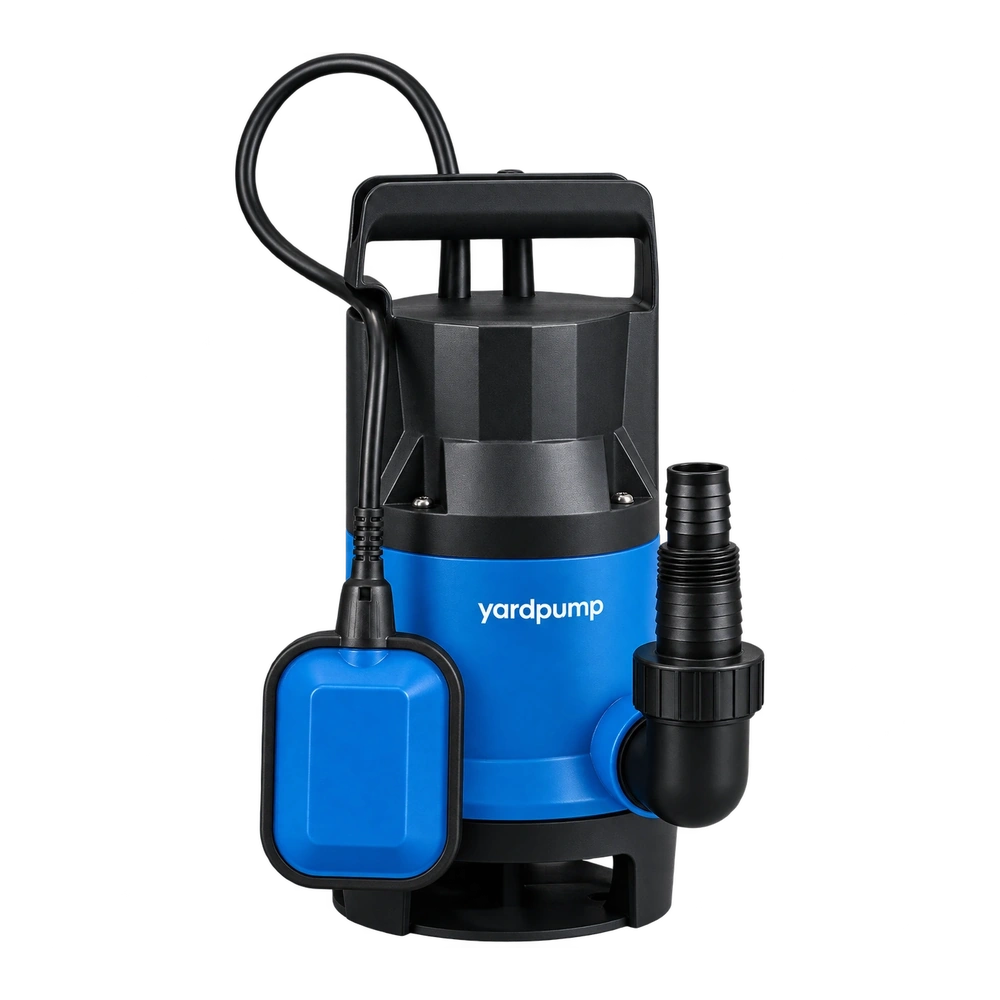
Suppose a low-level pump is described as leaving 7 mm of residual water. A buyer asks whether it can be placed in a 7 mm puddle and start automatically. That figure alone cannot answer the question. Residual depth describes an endpoint under specified operating conditions. Minimum starting depth concerns establishing pumping from rest. Automatic control has separate switching levels. All three categories need confirmation before promising unattended shallow-water drainage.
An endpoint is not a starting condition
A centrifugal drainage arrangement needs suitable filling and air-release conditions. A pump already filled and operating may continue lowering water to a shallow level. The same pump newly placed in a thin layer may still contain air in the casing or passages. Its minimum starting depth can therefore differ from its achievable residual depth. There is no requirement that these values be identical.
Low-level capability also does not mean dry-running permission or unlimited operation at the lowest water level. Cooling method, running duration, water temperature and stopping instructions still apply. Some designs have specific shallow-water arrangements; others need higher water or prescribed operating steps. The characteristics of one model must not be applied to every submersible pump with a low-suction label.
The controller may be above the intake
A float switch may not reach its start position merely because water touches the inlet. Electronic level sensors likewise have detection positions, delays and reset behaviour. Low suction describes part of the hydraulic arrangement; automatic describes a control function. Those labels together do not establish automatic starting from an extremely thin layer of water. Ask for the actual switching specification.
Automatic stopping may also occur before the lowest residual level achievable in another permitted operating mode. Holding a float up, bridging a sensor or bypassing protection changes the approved arrangement. Buyers should request separate figures for automatic operation and any other permitted mode. The end user should not be expected to force continuous running to reproduce a headline residual-depth claim.
| Information category | Question answered | Conditions to identify |
|---|---|---|
| Minimum starting level | Can pumping establish from rest? | Filling, air release and installation |
| Automatic switching levels | When does the controller start and stop? | Sensor, position, delay and mode |
| Residual level | What water remains after the prescribed operation? | Surface, intake and operating method |
The surface changes the result
A result obtained on a level test surface does not guarantee the same depth at every point on an uneven floor. Water may disappear around the pump while remaining in a distant depression. That can be a collection and connectivity issue. A soft liner or debris covering the intake is another restriction. Neither observation, without the test conditions, proves that the declared residual figure is false.
For sample validation, agree the surface, initial water depth, discharge route, control mode and stopping criterion. Identify where and when remaining water is measured. The 7 mm figure here is a hypothetical label example, not a specification for a particular product. Comparing the lowest observed point from different tests does not establish which pump provides better automatic drainage at an actual site.
Ask for a complete operating-level schedule
Request minimum starting depth, automatic switching range, continuous-duty boundary and the correct low-water stopping method alongside the residual figure. If the real job involves recurring thin puddles, establish whether the equipment can detect the condition and restart reliably without attendance. One successful manually supervised emptying operation does not demonstrate that repeated automatic task. The application specification should describe both situations separately.
Where starting conditions cannot be met, ask the supplier and competent installer to assess a suitable control arrangement, collection location or different equipment. Do not fill the functional gap by bypassing protection. A useful selection covers how pumping starts, how it stops and what remains afterwards. A low endpoint number cannot substitute for the first two parts of that operating sequence.
Questions about shallow-water pumping
Does a lower residual figure mean better automatic performance?
Not necessarily. Starting level, detection reliability, stopping conditions and the actual surface also determine the result.
Can lifting the float by hand validate automatic shallow starting?
No. Validation needs the prescribed installation and genuine control conditions, without bypassing normal operation.
Can the pump run empty while waiting for more water?
Only follow the exact model's permitted operation and dry-run protection requirements. Low-level pumping is not permission for dry running.