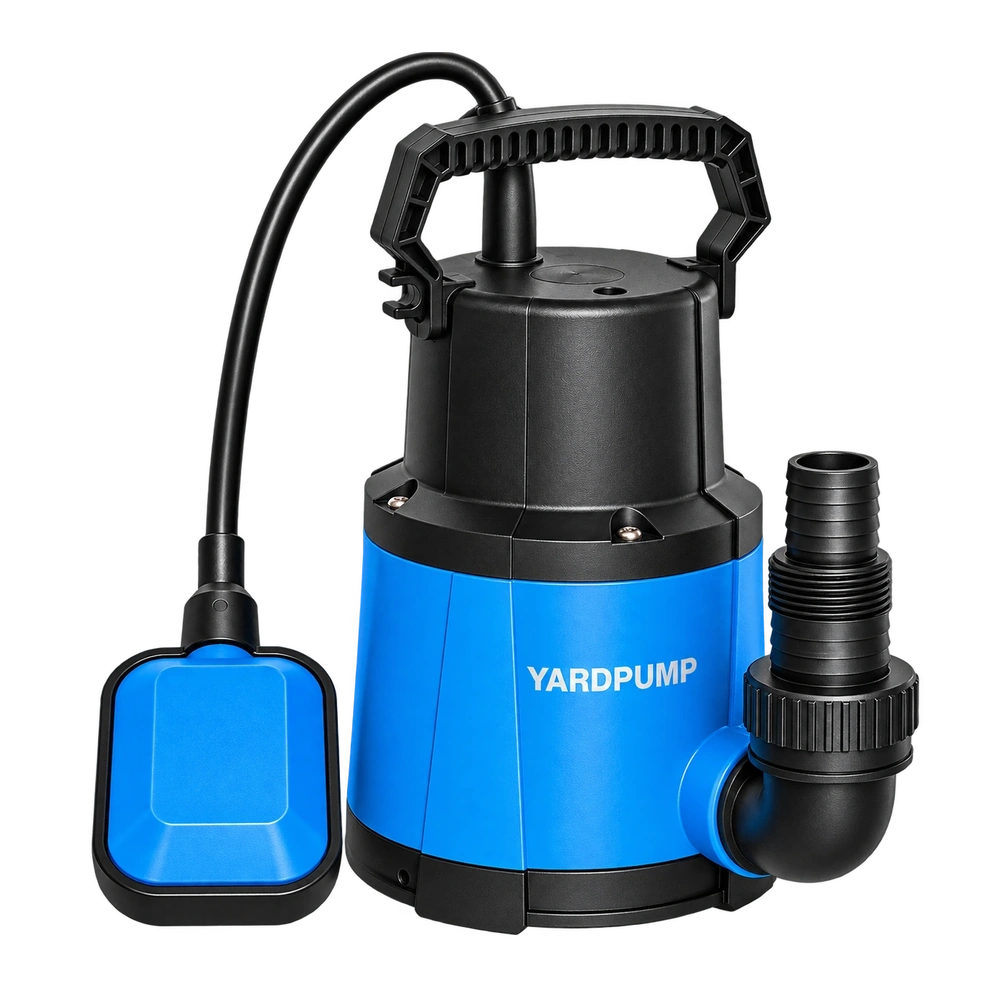
When rain collects in the centre of a pool cover, the pump itself pushes a flexible cover lower and draws more water and leaves toward that point. This is not the same duty as emptying the pool. The selection must protect the cover, manage leaves, respect switch-on and minimum-running levels, route the discharge safely and allow retrieval. A high-capacity pump that is poorly supported can abrade or pull the cover.
What drives the result
A flexible cover creates a changing shallow basin. As the pump lowers the nearby level, water farther away may move slowly through folds, so a large nominal flow cannot always be sustained. A fine screen blinds with leaves; an exposed intake may grip thin material. Pump feet, adapters and hose weight create concentrated loads, and hose movement can pull the pump sideways. An automatic switch also needs a defined level change. Minimum suction depth is not the same as automatic starting depth.
An illustrative way to check
As a method example, the cover may hold a substantial total volume while only forty millimetres surrounds the pump. A switch that requires a higher level may never start. Manual operation may then draw air quickly. Compare three separate values: switch-on level, minimum continuous operating level and expected residual depth. Maximum flow alone answers none of them.
An RFQ should not ask only for a pool cover drainage pump. It should state the liquid, highest and lowest water levels, vertical lift, hose bore and length, target emptying time, solids or fibres, electrical supply, and whether operation is supervised or automatic. The supplier can then identify a duty point instead of combining maximum flow, maximum head and rated power as though they occur together. Validate the first sample through a complete start-run-stop cycle in the intended piping. A brief no-load sound check does not represent the service.
Actions for the site or purchasing team
- Confirm the cover maker's permitted loading and drainage method, and remove sharp objects before positioning equipment.
- Use a broad, smooth support or a purpose-designed cover-pump base so the intake cannot attach directly to the membrane.
- Provide a removable leaf guard with generous open area. Do not wrap the pump tightly in fine fabric.
- Use a light hose of adequate bore and restrain it outside the pool so its weight and recoil cannot drag the pump.
- Supervise the first complete cycle and observe starting, stable flow, air ingestion, stopping and retrieval.
Limits and application boundary
Pool-cover construction, load capacity and anchoring vary widely. Follow both cover and pump instructions. Isolate the area whenever people, animals or electrical equipment could contact the water.
Frequently asked questions
Is minimum suction depth the same as automatic start level? No. The switch geometry sets the start level, which is often higher than the minimum running level.
Should fine mesh be wrapped around the pump when leaves are present? Fine mesh can blind quickly. Use a guard with adequate open area that can be cleaned safely.
Can the pump remain on the cover permanently? Only if both products permit it and weather, electrical, hose and maintenance risks have been addressed.
Related reading
If a Pump Drains Down to 7 mm, Will It Start Automatically at 7 mm?
Rated to Pass Particles but Still Blocking? Sand, Fibres and Sludge Behave Differently