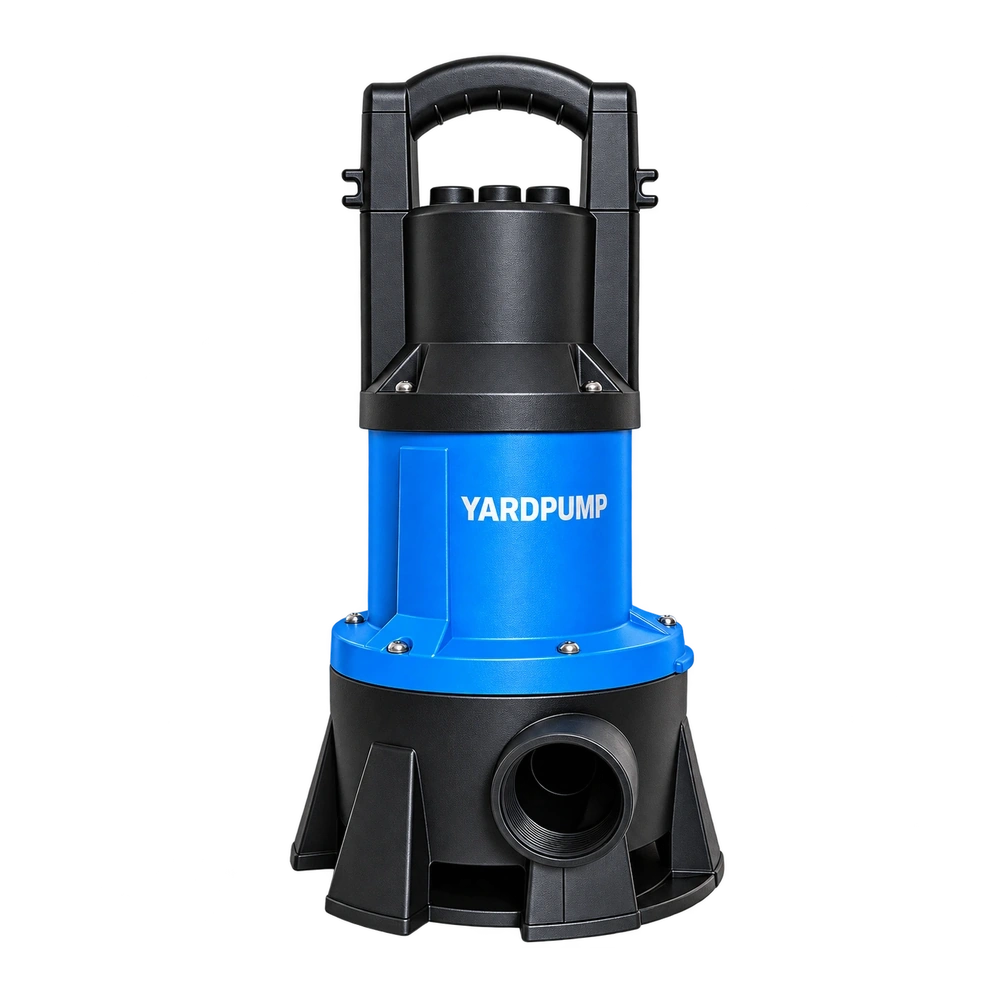
At a typical pond edge, a portable pump delivers normally until waves rock it sideways. Later, a small fall in water level brings air into the inlet. A larger flow rating will not solve this installation problem. Treat support, intake position, hose forces and the lowest operating water level as one arrangement. Average water depth does not establish continuous submergence.
Start with a stable support
A muddy bank, loose sediment or a sloping bottom may not support the pump securely. Follow the model's permitted orientation and use a stable base that does not damage the housing. Any platform or bracket needs adequate strength, restraint and clearance around the inlet.
Do not suspend the pump by its electrical cable. Arrange the discharge hose so its weight, movement and reaction cannot pull the pump off the support. A hose that looks relaxed when empty may load the connection differently when full or when the outlet is moved.
A floating intake is a purpose-designed assembly. It is not created simply by fastening foam around an ordinary submersible pump. Buoyancy, stability, intake immersion and hose forces need assessment together. Unapproved floating installation can change cooling and operating conditions as well as mechanical stability.
Assess wave troughs and drawdown
Consider an illustrative depth budget. The inlet has an average cover of twenty centimetres, but local waves move the surface fifteen centimetres below that average. Only about five centimetres of cover remains at the trough. Neither dimension is a recommended requirement for a particular pump; the example shows why the average alone is inadequate.
Additional allowance may be needed for local drawdown around the inlet and the response of the control system. A device responding to a slowly changing average level may not prevent brief air intake during waves.
Do not simply extend a control delay so the pump ignores every trough. Check the model's cooling and air-handling restrictions first. A more sheltered position, a suitable collection well or an engineered calming arrangement may provide a better solution than forcing the pump to operate through unsuitable conditions.
Debris protection must remain observable
Wind can collect leaves and floating debris on one side of a pond. A suitable coarse barrier can reduce large debris reaching the pump, but a clogged barrier also creates a local water-level difference. A pump can then lack water at its inlet while the surrounding pond still appears deep.
Provide safe access for inspection and cleaning. Wrapping the pump in a small fine-mesh bag may conceal progressive restriction rather than improve reliability. For sandy locations, maintain appropriate separation from the sediment and verify the pump's liquid suitability. A support frame should not itself trap a pocket of silt around the inlet.
Where people, animals or boats are present, provide appropriate physical separation. A temporary drainage arrangement is not a substitute for a purpose-designed safety installation.
Accept the installation through its changes
Under controlled, safe conditions, assess the expected high and low levels, surface movement, hose loading and starting sequence. Record pump orientation, movement of the support, interrupted delivery, control response and the route for cleaning.
A short test in still clean water establishes only one condition. Distributor troubleshooting should include a wider installation photograph and water-level observations, rather than a nameplate photograph alone. Correct support or hose forces before judging whether the pump meets its performance claim.
If cable damage, housing cracks or suspected electrical leakage appear, isolate power and have competent personnel inspect the equipment. Nobody should enter the water to steady or reposition an energised pump.
Provide visible level and position references that can be checked from shore. Restrain hose bends where pedestrian, vehicle or boat movement could transmit force back to the outlet. Include these external supports in the post-maintenance reset check. Returning the pump to its original spot does not establish that the complete hose load path has also been restored.
Questions about exposed intakes
Will deeper placement solve everything?
No. Maximum immersion, sediment exposure, support and maintenance access still apply. Going deeper can introduce a different problem.
Will a float switch deal with every wave?
Not necessarily. Its position and response may not prevent brief air entry at the inlet. Validate the complete installation.
Can the discharge connection support the pump?
Only where the equipment and installation are expressly designed for that load. An ordinary flexible-hose joint should not be assumed to be a lifting point.