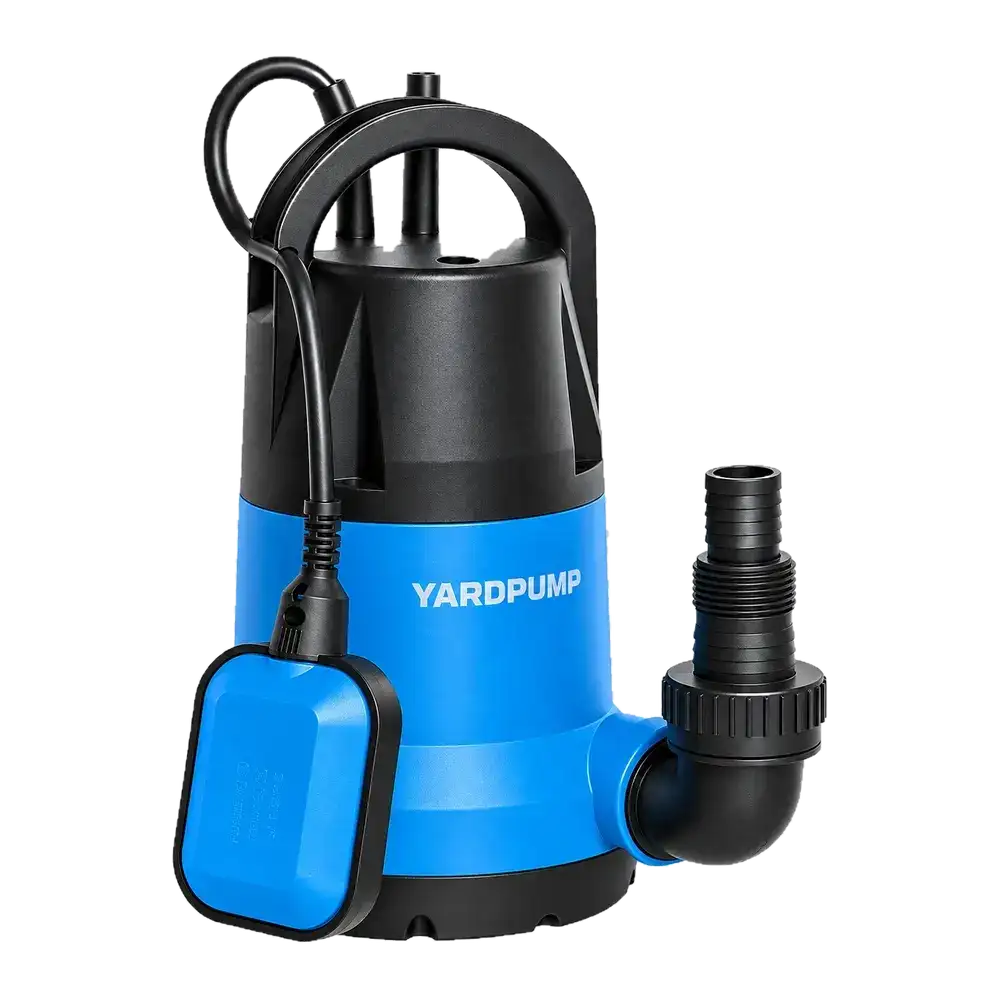
“The sump is shallow. If I lay the pump on its side, the motor will stay underwater. Why would that be a problem?” This is a typical installation proposal, rather than a reported customer case. The answer is that permitted orientation belongs to the complete pump design. Water coverage alone does not establish acceptable bearing loads, cooling, venting, seal operation or automatic control. Check the instructions for the exact model before changing its position.
An adjustable outlet does not approve a different motor position
An elbow may redirect the discharge without changing the position of the pump shaft. Likewise, a photograph showing a horizontal discharge does not necessarily show a horizontally installed motor. A useful installation drawing identifies the shaft direction, supporting surfaces, outlet arrangement and clearance required by the controls.
Ask for the model, revision and control configuration to be identified together. Another manufacturer's horizontal submersible assembly demonstrates what that particular design permits. It provides no approval for a portable drainage pump with different bearings, fluid passages and switching hardware. Where instructions do not address the proposed position, obtain written engineering confirmation rather than creating a dealer installation rule from a short trial.
Submerged does not always mean adequately cooled
Water around the casing helps remove heat, but cooling also depends on motor construction, local circulation, liquid temperature and operating load. Some motor arrangements require a defined flow path along their surfaces. Other pump assemblies depend on their normal position to fill and release trapped air. A water level above the casing does not verify every one of these conditions.
Tilting an assembly may also create a local air pocket that affects hydraulic filling or lubrication at a seal interface. Whether this happens depends on the actual construction. Avoid applying a cooling-velocity figure from a borehole motor to an unrelated portable pump, or assuming that every submerged motor needs the same flow sleeve.
Changing orientation changes the load case
Rotor weight acts in a different direction relative to the shaft when a pump is turned through ninety degrees. A load previously carried axially may become a radial load. Bearing arrangement, support span, shaft movement and seal tracking therefore require consideration together. Comparing bearing brands alone will not answer the installation question.
Support is equally important. Resting the unit on a cable entry, float bracket or discharge connector loads parts that may never have been designed as feet. Even an approved horizontal assembly needs its specified supports, adequate intake clearance and access for inspection. Approval of an orientation is not approval of every way of holding the pump in that orientation.
Automatic water levels need a separate check
Tethered floats combine buoyancy, gravity and free movement. Turning the pump changes the relationship between the tether, nearby walls and the switch travel. An integrated level mechanism may also have a defined direction of operation. Its original start and stop levels cannot simply be transferred to a different mounting position.
Consider an illustrative pump that starts at a relatively high water level and stops much lower. Laying it down lowers the highest point of the casing, but does not establish that its switch will start correctly or that cooling remains adequate. Starting, stable running and stopping must all be checked. A video of water leaving the hose records only one part of that sequence.
Solve the shallow-pit requirement before fixing the arrangement
Measure the pit footprint, available depth, incoming water, sediment clearance and discharge route. An approved low-level configuration, a different control arrangement or a professionally assessed change to the collection space may be more suitable. Begin with the permitted operating conditions instead of deciding that an existing pump must be laid down.
Building drainage alterations and fixed electrical work require appropriately qualified people. Isolate power before inspecting or moving equipment, and do not enter potentially energized standing water. Bypassing a float or thermal protector does not remove the mechanical or cooling restrictions and is not an acceptable way to validate a new installation position.
What an OEM orientation change should demonstrate
Specify the intended position together with supports, pipe loads, changing water levels, temperature, duty point and controls. Engineering verification should address filling and venting, starting and acceleration, stable performance, temperature rise, sealing, vibration and repeated operating cycles. Keep the assembly revision and test conditions with the results.
A successful short run establishes only that one sample delivered water under those conditions. It does not establish service life, electrical safety or production consistency. Horizontal operation is a conditional capability of an approved assembly. That is the evidence a distributor needs before adding it to installation instructions.
Frequently Asked Questions
Is covering the motor with water enough to approve horizontal operation?
No. Cooling circulation, trapped air, mechanical loading and control operation still have to meet the requirements of the complete assembly.
Can manual operation solve an orientation restriction?
Changing the switching method does not remove bearing, seal or cooling limits. Do not bypass protective devices to force an unsupported installation to operate.
Can instructions for another model from the same brand be used?
Only with explicit confirmation that they apply to the exact model, revision and configuration. Similar appearance and a shared brand are insufficient evidence.