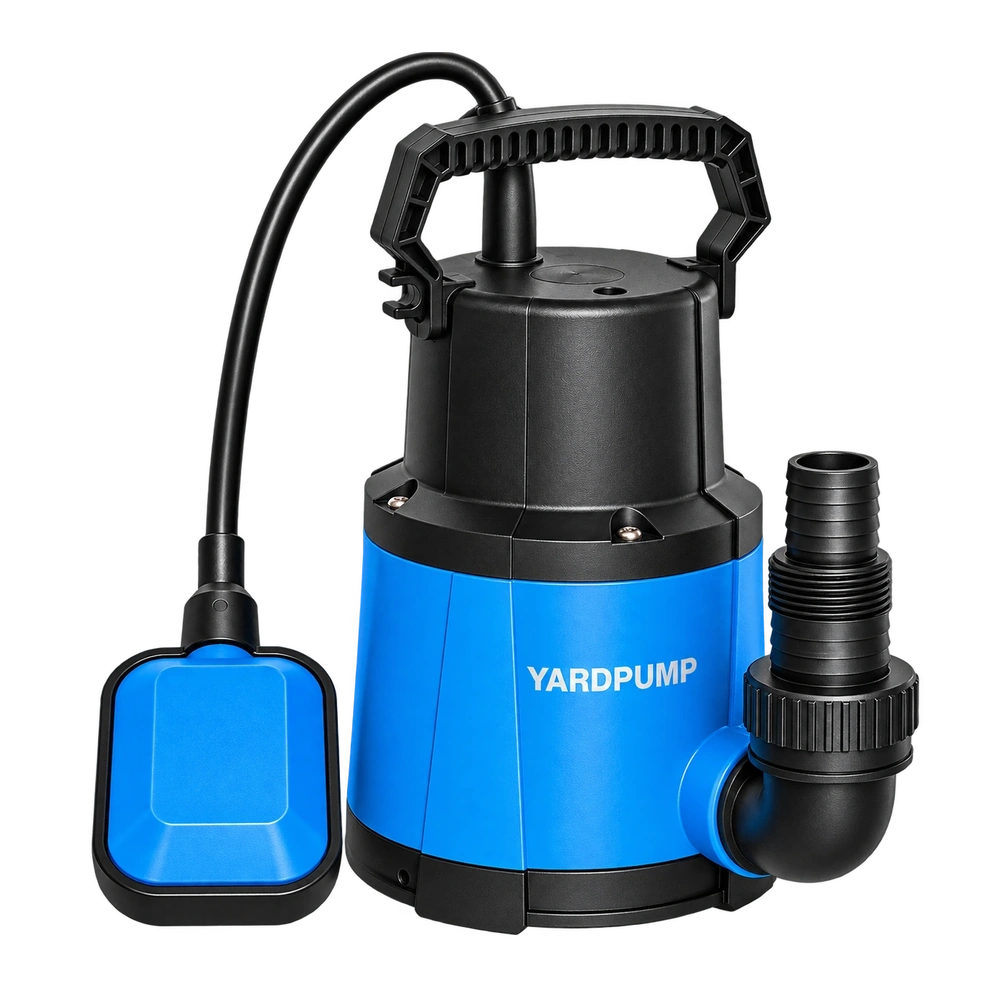
Suppose you check a small clean-water pump with a bucket. The hose is pushed into the bucket. Water arrives quickly at first, then slows as the bucket fills. Check whether the bucket water has covered the hose end. If a free discharge becomes submerged, the downstream water level can change the duty point during the measurement. Dividing the collected volume by the elapsed time still gives an average for the interval. It does not necessarily give a stable flow at one head.
The measuring vessel can change the system
With a fixed outlet open to air, the water discharges to atmospheric pressure at a known elevation. Losses through the hose and fittings still matter. Once the hose end is submerged, pressure outside the end rises as the receiving surface rises. For open, nearly still vessels, the difference between the two liquid surfaces is a convenient basis for calculating static head in the submerged arrangement. Account for discharge losses consistently; do not count the same depth again on top of the receiving surface. The source can change as well. A falling source level increases the lift as a rising destination level does. A declining result is not in itself evidence of a worn pump.
For example, suppose the source level remains almost steady. The hose outlet is initially 0.80 m above it and flows freely. Then the bucket level rises to 0.15 m above the hose end. The static elevation difference between the two liquid surfaces is now about 0.95 m. Those two figures do not tell you how much the flow will fall. The outlet condition, line losses, bore and pump curve also matter. The observation shows why one fill time should not be described as a measurement at the original free-discharge condition. Low-head setups with little margin may make the effect easier to notice.
Secure a free outlet above the highest collection level
Support the hose so the outlet stays above the highest water level you will use. Allow for splashing and keep the hose clear of tight bends. Do not hand-adjust it while running. Restore the source vessel to the same starting level for each comparison and prepare to collect clean water without flooding the inspection area. Once the required stable condition is reached, record the known volume difference and elapsed time. A wider vessel or a verified meter of a suitable range may help when a small bucket changes level too fast. Use a setup that keeps water away from power connections. Stop and isolate the equipment at a safe, dry location and deal with retained pressure before repositioning it.
If it takes 15 seconds to collect 10 L, the average is about 40 L/min. Repeat with the same outlet height, hose route, source level range and timing window. Very short intervals make reaction time a larger fraction of the result; long intervals can let the source level fall too far. Record a startup delay or water initially held in the line separately. Avoid counting water that splashes out, or a test in which the hose changes position halfway through.
Agree a different test when the real outlet is under water
Some transfer installations deliberately discharge below the receiving surface. An above-bucket measurement does not guarantee the same flow there. Specify the range of both water levels, or arrange a stable reading at a defined downstream level. A bucket test helps compare installation changes and estimate delivery. Contract curve acceptance needs a suitable test stand with documented flow, head and measurement conditions.
Frequently asked questions
Does the flow always drop sharply as soon as water touches the hose outlet?
No fixed drop applies. Partial submergence, outlet conditions, line resistance and further level rise all matter. First identify and control the outlet condition.
Can I raise the hose and compare the new number directly with the original test?
Raising the outlet changes the test. Recreate the same outlet elevation and water levels for a direct comparison and document the raised setup separately.
Can I time only the last few seconds before the bucket fills?
That can describe the average near the final water level. For two pumps, choose the same level range and a consistent outlet condition so the readings answer the same question.