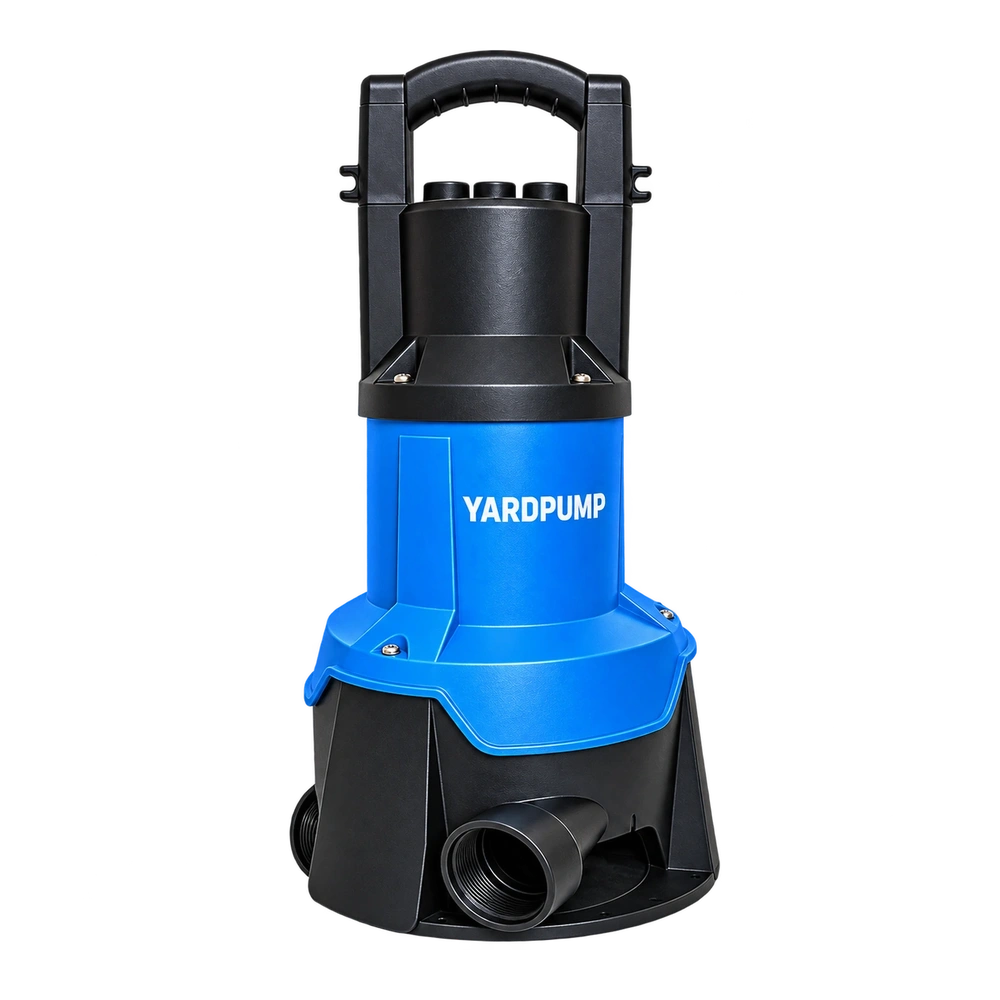
Direct answer. A compact submersible pump can move water out of a rainwater tank, but that does not prove it can operate a sprinkler or a pressure-regulated drip system. First obtain the pressure and flow required at the irrigation device. Add elevation, hose and fitting losses, and filtration or regulator losses. Then check whether the pump can deliver the required flow at that total working head. A high maximum-flow figure measured near zero head is not an irrigation-pressure rating.
Consider a distributor choosing one “rain barrel pump” SKU for two customers. The first fills watering cans and occasionally runs an open hose. The second wants six sprinklers across a lawn. Both start with the same tank; their pressure requirements are not the same. The wrong pump may look powerful when discharging freely but produce an uneven spray pattern once nozzles are connected.
Compare the outlet device before the pump
| Irrigation task | Main hydraulic question | Extra system concern | Typical buying decision |
|---|---|---|---|
| Open hose or watering can | How much water reaches the outlet after lift and hose friction? | Hose diameter and length | Compare the pump curve at the actual hose route |
| Dripline or emitters | What inlet pressure and filtration does the specified emitter system require? | Filter, regulator, pressure uniformity, clogging | Match the complete drip zone, not just total tank volume |
| Pop-up spray head or sprinkler | What pressure and flow are required while all selected heads operate? | Nozzle count, spray uniformity, zone design | Verify the duty point; a drainage pump may be unsuitable |
Drip is not synonymous with “no pressure.” Some commercial drip components specify operating ranges around 15–30 psi, while others are designed differently. Likewise, sprinkler pressure depends on the exact head and nozzle. Never substitute a generic pressure figure for the component’s technical sheet.
Convert pressure to the head a pump must overcome
A useful water approximation is 1 bar ≈ 10.2 metres of water head. It is a unit conversion, not a promise of pump performance. Suppose an irrigation device needs about 2 bar at its inlet. That alone is roughly 20 m of pressure head. Add a hypothetical 2 m vertical rise and 2 m of pipe/filter losses: the system needs approximately 24 m of head at the required flow. This is an illustrative calculation, not a YARDPUMP product test. A pump whose published maximum head is below the requirement cannot meet that duty, regardless of its maximum litres per hour.
Conversely, an open hose at low elevation may need little terminal pressure. In that case, hose friction and the desired filling time can dominate the choice. The buyer should ask for the pump curve and plot the proposed operating point instead of choosing the largest wattage printed on the carton.
Four details that change the answer in the field
1. Filter and sediment. Rainwater tanks accumulate debris and fine sediment. A dripline may need finer filtration than a pump inlet screen provides. Put filtration where it protects the emitters without starving the pump; monitor pressure loss as the filter loads. See the rainwater tank sediment and intake-height guide.
2. Number of operating zones. Running two irrigation branches at once changes total flow and often shifts the pump’s operating point. Closing one branch changes it again. The two-zone garden pump guide covers that separate control decision.
3. Start/stop control. A float switch responds to water level; it does not automatically provide constant discharge pressure. If the system requires pressure control, specify the appropriate control architecture and confirm compatibility with the pump. Do not assume a drainage pump can safely run against a closed irrigation valve.
4. Actual tank water and duty. Check sediment, water chemistry, expected operating hours, minimum safe water level and available power supply. Continuous irrigation duty is not established by an IP rating or by a successful short drainage test.
What this means for the YARDPUMP range
The QDX-PT and QDX-PH families are documented as compact clean-water submersible pumps with different control configurations. They are legitimate starting points for discussing water transfer from a clean rainwater tank, but their published maximum heads and flows are endpoints, not evidence that a given sprinkler or drip zone will work. Ask for the exact electrical variant, pump curve, hose arrangement and required irrigation pressure before proposing a model. If the calculated duty point is outside the verified curve, recommend a purpose-designed pressure system rather than stretching a drainage-pump claim.
Selection conclusion: Choose the irrigation device and its duty point first. The pump comes second.
FAQ
Will a pump rated at 8 m maximum head supply a sprinkler that needs 2 bar? No. Two bar is roughly 20 m of water head before elevation and friction losses.
Does a dripline always need less pressure than a sprinkler? Not necessarily. Compare the actual emitter and sprinkler specifications; both can have minimum operating-pressure requirements.
Can I use a float switch to keep irrigation pressure constant? No. A float switch manages liquid level, not constant line pressure.
Does a larger outlet automatically solve weak spray? No. It may reduce one restriction, but the pump must still meet the required pressure and flow at the operating point.