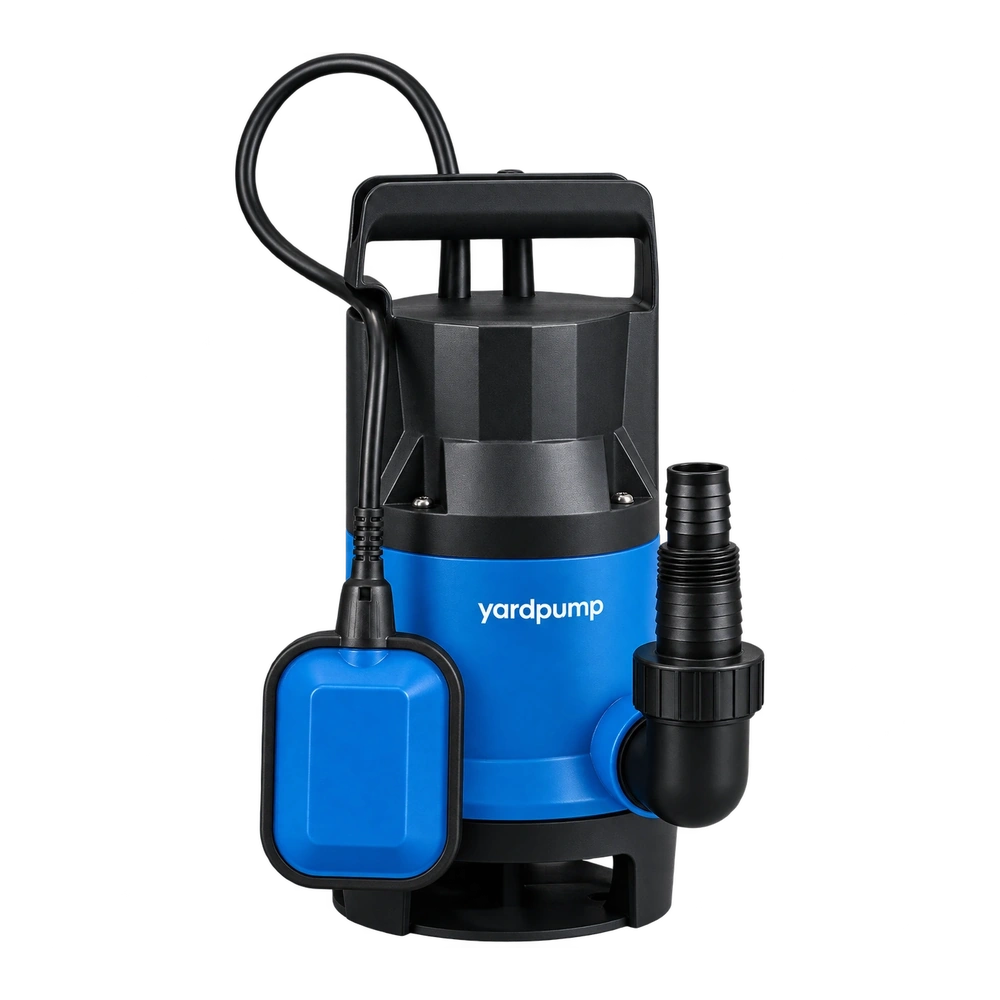
The pump sits squarely on the bottom of a full rainwater tank, then leans over halfway through a drawdown. The hose is a likely source of sideways force. A change in water level can alter how much of the hose is floating and where a bend pushes against the tank. Fixing the hose route can remove the force that would otherwise need to be resisted at the base.
Watch where the force reaches the pump
A buoyant or curved hose can apply side force and torque at the outlet. Falling water level changes hose buoyancy and bend geometry, while sediment or an uneven tank floor can reduce the pump base contact area.
Look at the first bend above the outlet. A steep turn forced by a narrow tank opening can act like a lever, especially when the rest of the hose is tied hard to an outside pipe. When the water level falls, a hose segment that had been supported by the water can hang from the outlet. A flexible hose can also shift sideways as it fills on startup. Check each of these positions with the tank in an accessible, safe state.
The support has to do two jobs. It gives the pump a flat bearing surface and keeps the inlet clear above the sediment that the pump instructions permit you to avoid. A small block under one edge can concentrate the load near a foot. A plate spread across an unsound floor may still rock. Use a level support made for the tank and pump that does not move into the inlet or on the switch path.
Put the restraint on the line
Place an accessible support on the hose or fixed discharge line in accordance with the tank and pump instructions. Leave a relaxed bend between that support and the pump outlet. Leave enough slack for service retrieval and cable routing without a loose loop that can catch the float. A threaded adapter is easier to inspect for side load if you can see whether it is sitting square before and after the line fills.
Observe a full drawdown cycle with the final hose, adapter and cable routing. Mark pump position, check the inlet clearance and outlet load at several levels, and retrieve the unit only by the approved handle or lifting arrangement after isolation.
For example, a pump may remain stable at 80 percent tank level but lean when the hose becomes partly unsupported at 30 percent. The percentages explain a changing geometry, not a YARDPUMP limit.
Accept the layout through a full drawdown
Observe the tank from outside at a few levels when the cover and control arrangement are in their normal positions. Useful observations are a foot lifting, a hose pulled against the wall, the float touching an accessory and the inlet coming close to the allowed minimum water level. That last observation sets where the cycle must stop. A base that solves tipping by raising the pump can also leave more stored water below the intake.
Do not anchor the pump by its power cable, drill the housing or add an improvised weight that obstructs cooling, controls or intake.
For a distributable kit, put an annotated sketch in the installation pack showing where the hose is supported and how the pump can be removed. A compact pump returned with a cracked outlet is easier to evaluate with a photo that keeps the first bend and the tank pass-through in frame.
Frequently asked questions
Will changing to a softer hose cure the leaning?
It may reduce bend force. Check that the replacement still retains its bore, resists kinks and is suitable for the water and pressure. Test it fully supported through the operating water levels.
Can I raise the pump on a platform to avoid sediment?
Use a model-compatible stable support with clear access to the intake. Recheck allowed submersion, usable water volume and switch operation after changing the height.
Where can I grip the pump to lift it?
With power isolated, use the approved lifting point and means stated for that model. Keep the cable and hose free of lifting load.