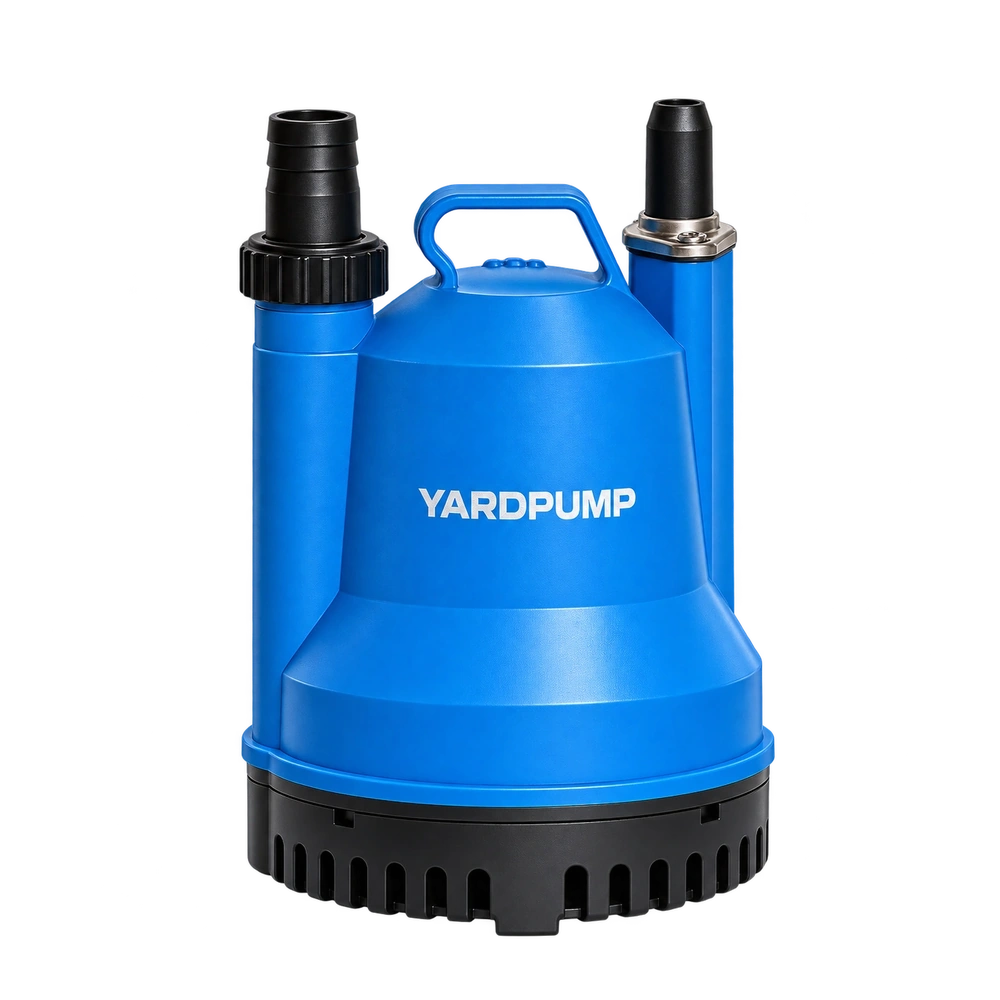
Short answer. A compact submersible drainage pump may move water through a small decorative feature, but it should not automatically be sold as a continuous-duty waterfall pump. First define the desired flow at the installed total head, then check the exact model's permitted running duty, minimum water level, water chemistry, debris and control arrangement. A pump that performs well during a short drainage test may not be approved for uninterrupted circulation.
A garden retailer receives two requests that sound alike: one customer wants to empty a pond after maintenance; another wants water to flow over a stone lip every day. Both involve water, a hose and a submersible pump. The first is a transfer or drainage duty; the second is a continuous hydraulic and thermal duty. Treating them as one category can create avoidable returns.
Start with the appearance of the water, not the wattage
A waterfall has an intended visual effect: a thin sheet, a broad curtain or a lively cascade. The designer should state the spillway width and the flow needed to produce that effect. There is no universal flow-per-centimetre value for every rock profile. A smooth, level lip behaves differently from irregular stones, and a narrow channel can concentrate water even when the pump flow is modest.
Use the intended visual flow as a design target, not a claimed pump output. For example, suppose a 30 cm feature requires 5,000 litres per hour at the spillway. That is 5 m³/h at the installed discharge—not a request for a carton labelled “max 5,000 L/h.” If the water has to rise and travel through tubing, the pump will normally deliver less than its zero-head maximum.
Calculate the operating head the pump will actually see
Total dynamic head combines the static difference between the source water surface and the discharge water surface with friction and fitting losses. Measure the lift while the system is operating; include the full tubing route, internal diameter, bends, valves and any filter. A high loop in the pipe may affect priming and startup even when its peak is not the steady-state static lift. Check both startup and normal operation.
| Selection input | What the buyer records | Common mistake |
|---|---|---|
| Visual flow target | Desired litres per hour over the lip | Treating maximum pump flow as installed flow |
| Static head | Water-surface elevation difference | Measuring only the pump-to-lip distance |
| Hose and fittings | Inside diameter, length, elbows and valves | Ignoring pressure losses in a narrow hose |
| Water level | Normal and lowest operating depth | Assuming residual drainage level is the start level |
| Runtime | Hours per day and rest intervals | Assuming every drainage pump can run 24/7 |
| Water condition | Leaves, sediment, treatment chemicals, temperature | Treating all pond water as clean fresh water |
A simple acceptance trial measures actual flow into a safe test receiver at the intended head, then checks temperature and stable operation for the permitted duty. Do not infer a full performance curve from one measurement. If the application needs filtration, use a system designed for that filtration duty rather than forcing a debris-sensitive utility pump to do it.
The continuous-duty decision comes before the sale
A portable drainage pump can be intended for intermittent removal of water, with cooling and level-control assumptions specific to its design. A dedicated pond or waterfall circulation pump may be built around different inlet screening, hydraulic efficiency, duty rating and maintenance access. Neither name alone is proof: inspect the model instructions and rated conditions.
If the chosen pump has an automatic float, its start and stop levels may interrupt a shallow decorative basin. A tied-up float or bypassed protective device is not an acceptable shortcut. A manually controlled version also needs an approved means to prevent dry running and a safe electrical installation. Outdoor equipment must be selected and installed for the applicable electrical and environmental conditions; keep plugs and connections out of wet locations and use required protective devices.
Our greenhouse floor drainage guide explains why the liquid condition, water depth, discharge route and control requirements must be matched to the actual duty; similar housing alone does not establish the permitted runtime. YARDPUMP’s compact submersible families can be discussed for transfer and drainage applications, but a continuous-waterfall claim must be confirmed for the exact variant rather than assumed for an entire product family.
Give distributors a useful selection card
Ask the end customer for a sketch with the source water level, waterfall lip height, hose size and length, desired visible flow, daily runtime and water quality. Then request a pump curve showing the required operating point and written confirmation of allowed duty. Record whether the application is occasional pond emptying, temporary display operation or permanent recirculation. This one distinction is more useful than choosing by wattage alone.
Questions buyers ask
Can a pump with 8,000 L/h maximum flow deliver 8,000 L/h to the waterfall? Not necessarily. Maximum flow is normally measured at very low head; the installed flow depends on the pump curve and system resistance.
Does a larger motor guarantee a fuller waterfall? No. Hydraulic design, head losses, tubing and the actual duty point matter.
Can I keep the float switch permanently raised? Do not defeat the control or protection arrangements. Select an approved control solution for the intended basin and duty.
Can a pump that drains a pond also circulate treated pond water? Only if the exact model's materials, liquid limits and duty rating support it. Pool chemicals, salt and abrasive sediment require separate checks.
What should an importer ask the factory? Request the flow-head curve, permitted runtime, minimum water levels, water-chemistry limits, cable and plug options, and the specific tested configuration.