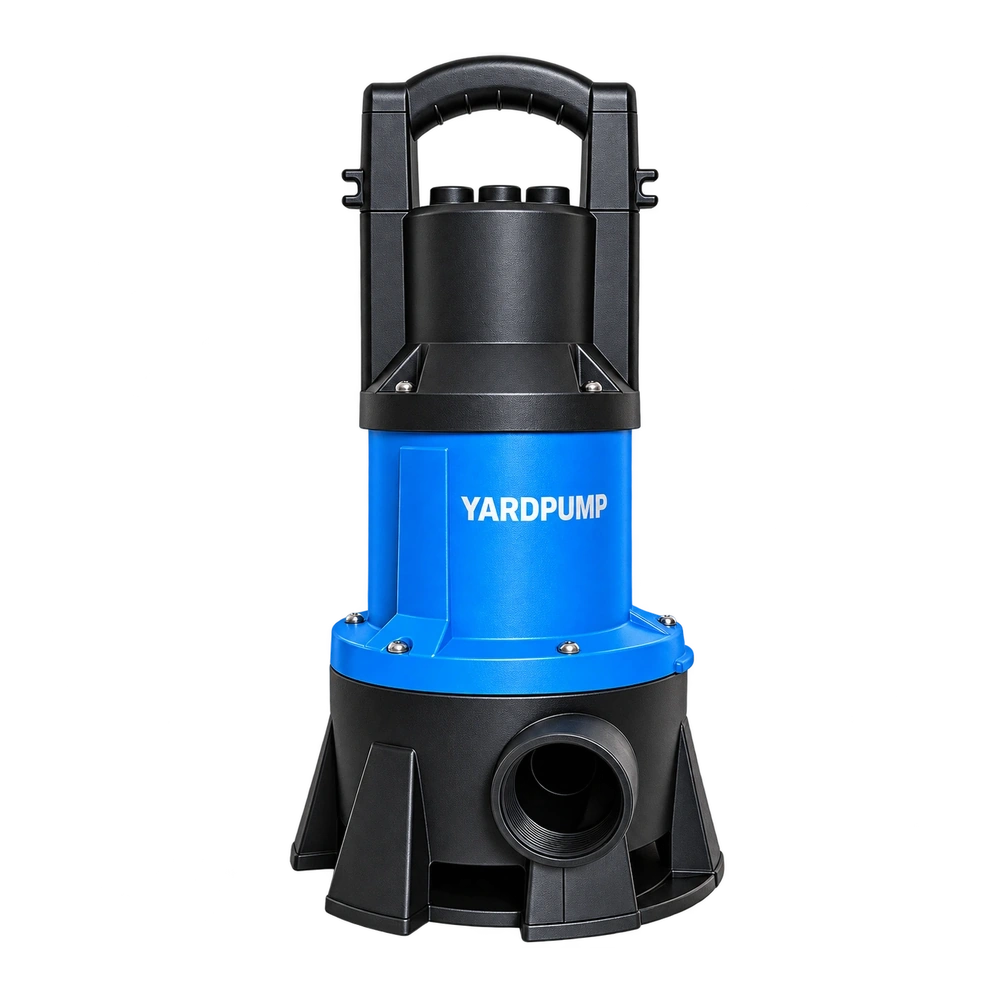
Short answer. A compact submersible utility pump may remove relatively clean standing water from a greenhouse floor, but the correct choice depends on the depth at the intake, sediment and plant debris, discharge route and electrical environment. A low residual-water figure does not prove that a pump will start automatically in a shallow puddle. Fertiliser solution, disinfectant and pesticide runoff also require a separate material-compatibility and disposal assessment; they must not be treated as ordinary clean water.
Picture a greenhouse aisle after an irrigation-line failure. Water spreads across a smooth floor, carrying loose soil and leaves toward a drain. The operator wants to clear the aisle before the next shift. The obvious temptation is to buy the pump with the biggest advertised flow. But if the water is only a few centimetres deep, the intake can uncover or ingest grit before that headline capacity matters.
Measure the water, not just the floor area
Start with the deepest point, the lowest reachable intake position and how water can move toward it. A local depression can collect enough water for a portable pump, while a nearly level floor may require a squeegee, temporary bund or a designed sump. Record the minimum water level at which the pump can be started, its stop level and the residual depth after shutdown. These are different measurements.
If automatic operation is required, check the float or sensor operating envelope and the clearance around it. A tethered float may need far more lateral room and water depth than a low-level manual pump. Never assume that a low-level pickup design also includes unattended dry-run protection.
Choose the pump by what is actually in the water
| Floor-water condition | Selection consequence | What to confirm |
|---|---|---|
| Mostly clear irrigation water | Clean-water utility pump may be considered | Actual particle allowance and permitted water chemistry |
| Loose soil, sand or grit | Abrasion and blocked intake become important | Strainer access, cleaning and sediment-control plan |
| Leaves, roots and stringy plant matter | A nominal particle size does not prove fibre tolerance | Prevent entry or choose a specifically approved dirty-water design |
| Fertiliser, cleaning agent or pesticide runoff | Ordinary clean-water approval is insufficient | Contacted materials, seal compatibility and lawful collection/disposal |
| Very shallow film across a wide floor | A pump alone may leave most of the film | Collection point, floor slope and finishing method |
Do not convert a laboratory particle-size rating into a promise that a pump will handle every mixture of sand, roots or sludge. The shape, concentration and abrasiveness of solids matter. Where the liquid contains chemicals, verify the entire wetted assembly—including seals and cable interfaces—against the actual concentration and temperature before use.
The discharge route can dominate the useful flow
Measure the vertical rise to the discharge point and the full hose run, including diameter, bends, fittings and any high point. The pump operates where its curve intersects the resistance of this actual route. Maximum flow on a product page is not the flow through a long, narrow hose. If a small garden hose is attached to a larger outlet, the restriction can be the main reason drainage is slow.
For a temporary job, use the largest practical hose permitted by the pump and site layout, avoid kinks, secure the discharge away from electrical equipment and prevent water from returning to the greenhouse. Do not route dirty water into a storm drain or irrigation reservoir without checking local site rules and contamination risk.
Treat electrical safety and access as selection criteria
Wet floors, extension leads and greenhouse irrigation systems create a demanding electrical environment. Use only the electrical version and protective arrangement approved for the installation; keep connectors and supply equipment out of water, and have qualified personnel assess grounding, residual-current protection and any permanent wiring. Never lift a pump by its power cable or handle a connected pump in standing water.
If staff will use the pump repeatedly, compare handle access, strainer cleaning, hose coupling, storage and the ability to isolate power before maintenance. An apparently cheaper unit that requires unsafe improvisation is not a good fit.
A procurement brief for a greenhouse drainage trial
Record a floor sketch, deepest and shallowest water levels, photographs of the sediment, water chemistry, hose diameter and length, vertical rise, electrical supply and whether a worker will supervise the job. Ask the supplier to identify the model variant, supported liquid, start/stop conditions and measured duty-point flow. Run a controlled on-site trial with the actual hose and record the residual water.
For relatively clean water, the QDX-PH compact clean-water family can be examined as a candidate, subject to its confirmed water-quality, immersion and operating limits. It is not a blanket recommendation for fertiliser or pesticide runoff. Where the water is dirty, choose an appropriately rated design instead of forcing a clean-water pump to perform a sewage duty.
Frequently asked questions
Will a low-level pump start in 7 mm of water?
Not necessarily. Residual pickup depth, minimum start depth and automatic sensor thresholds are separate values; verify the exact model.
Can a clean-water pump remove greenhouse fertiliser runoff?
Only after checking the actual chemical composition, concentration, temperature, wetted materials and disposal requirements. Clean-water suitability alone does not establish compatibility.
Why is drainage slow through a garden hose?
Narrow bore, length, bends and lift add resistance. Compare the pump curve with the actual discharge route.
What if the floor has only a thin water film?
A pump needs a usable intake depth. A collection point, floor squeegee or drainage design may be needed to finish the job.