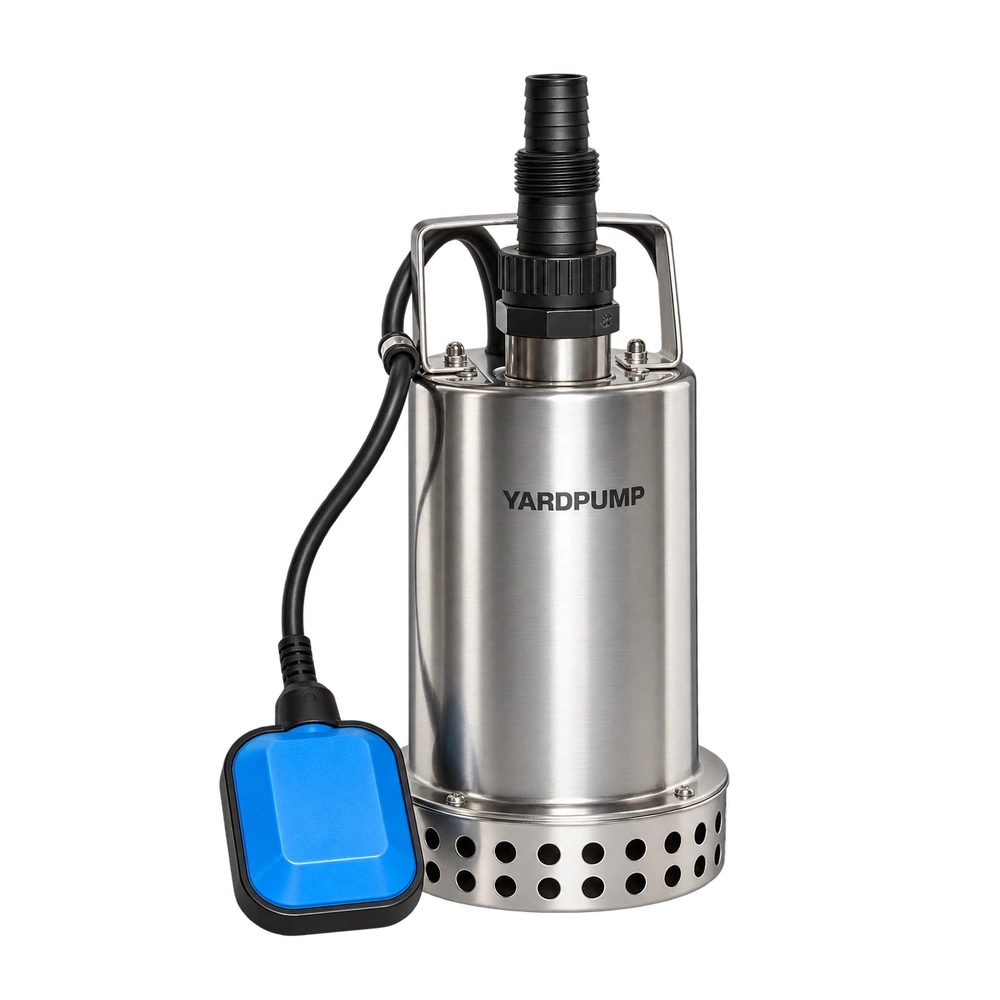
A typical stormwater complaint begins with a large pump already installed: the pit still overflows during heavy rain. Move the discussion from advertised maximum flow to three quantities that change with time: incoming water, actual discharge and available storage. Storage can delay overflow, but cannot indefinitely compensate for a sustained shortfall in pumping capacity.
Keep a water balance for the pit
Over any interval, the increase in stored water is the volume entering minus the volume actually leaving. The level falls when discharge exceeds inflow and rises when inflow exceeds discharge. If the outlet sends water back toward the collection area, impressive visible flow may mainly represent recirculation.
Stormwater inflow is rarely constant. Catchment area, surface infiltration, roof connections, short-duration rainfall and travel time through pipes all affect the peak. Dividing a day's rainfall evenly across twenty-four hours can produce a misleadingly small design inflow.
Formal flood protection or building drainage design requires suitable professionals and the applicable local requirements. A simple water balance is useful for diagnosis and early discussion, but is not a complete drainage design.
Calculate the storage time honestly
Consider an illustrative interval with 180 litres of available storage, an inflow of 100 litres per minute and actual pumping of 70 litres per minute. Net accumulation is thirty litres per minute, so that storage provides approximately six minutes of buffering from the stated starting condition.
If the pump has not started yet, the available time is shorter. The example is not a flood-protection guarantee. It illustrates how a pump can be running normally while the pit continues to fill.
Available storage means the volume between the current level and the permitted maximum level. It is not the pit's entire geometric capacity. Equipment, steps, sediment and space already occupied by water must not be counted again. An irregular or tapered pit needs its actual level-volume relationship.
Starting and pipework consume part of the allowance
Water continues entering while the level reaches the start point and the pump establishes discharge. A narrow hose, long route, restrictive valve or submerged outlet can reduce installed delivery. Free discharge through a short test hose cannot represent that condition.
Increasing pump capacity can also change cycling. Check the effective cycle volume, permitted starts and minimum running time. Lowering the start level without limit is not a solution: cooling, intake conditions and float movement still have to be maintained.
Treat increased discharge capacity and revised control levels as connected but separately verified decisions. The first changes the water balance while running; the second changes when pumping begins and how much storage is available at that moment.
Collect evidence that changes the decision
Record start, stop and highest-water times, estimate installed discharge under safe conditions, and inspect the final discharge destination. A level that keeps rising during operation indicates inadequate net removal under that condition. A level approaching overflow before starting also points toward storage or control response.
If backup pumping or alarms are warranted, consider consequences and common causes such as power loss, shared pipe obstruction or a blocked outlet. A larger main pump does not automatically create redundancy.
For a distributor, a simple time-based record of water level and pump operation gives a designer more useful information than a request for the next wattage size. It can separate a genuine pump fault from a system that asks a functioning pump to remove more water than it can deliver through the installed route.
Where inflow is not directly metered, the level-rise rate with the pump off and a known level-volume relationship can estimate inflow for that interval. Do this only where stopping is safe and permitted; do not remove critical drainage protection to obtain data. The estimate describes the observed interval, not a larger future storm, and should remain distinct from a professional design scenario.
Questions about stormwater storage
Will a deeper pit prevent overflow?
More storage can delay the rise, but it is eventually exhausted if inflow remains greater than discharge. Structure, groundwater and maintenance conditions also need review.
Is maximum flow above estimated inflow enough?
Compare inflow with installed duty-point flow, allowing for starting and outlet conditions. Maximum flow is a curve endpoint, not the capacity available at every head.
Does slow drainage after rain prove the pump is defective?
No. Continuing inflow and water returning from the discharge area can offset normal pumping. Check the complete water balance first.