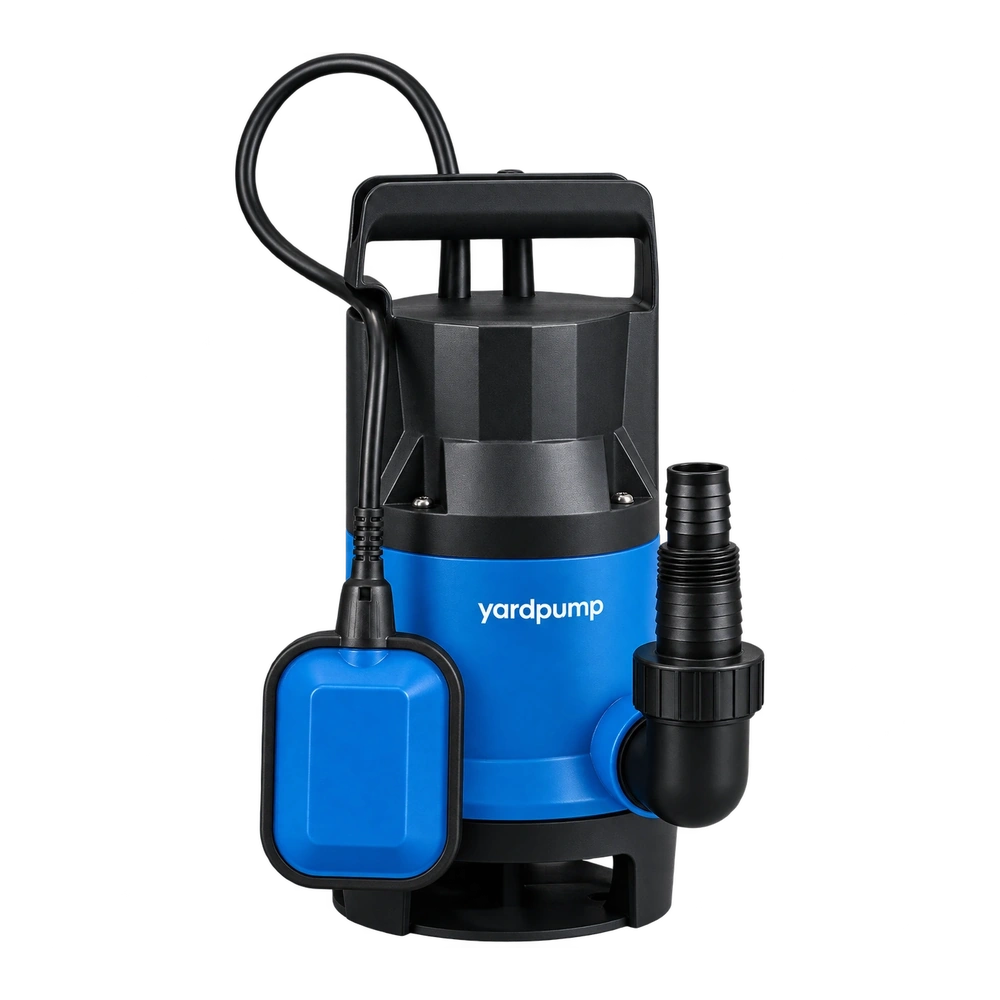
A 50 Hz pump already has established tooling, and a customer now needs a 60 Hz version. Can the factory retain the motor and impeller and simply change the plug and label? Only an explicitly designed and validated supply combination can be used within its approved conditions. Frequency changes can alter speed and hydraulic load even when the housing looks identical.
Frequency changes the motor operating conditions
The synchronous speed of an induction motor depends on supply frequency and pole count. A two-pole motor has a synchronous speed of 3,000 revolutions per minute at 50 Hz and 3,600 at 60 Hz. Its actual loaded speed is lower because of slip, which depends on the motor and load.
A measured speed such as 2,830 revolutions per minute describes a loaded operating condition. It should not be substituted for synchronous speed when interpreting a rule or calculating an ideal speed ratio.
With unchanged pole count and similar fractional slip, moving from 50 Hz to 60 Hz can increase speed by approximately twenty percent. Whether the motor starts correctly and operates thermally within its limits also depends on voltage, winding design, capacitor selection and protective arrangements. Successful rotation is only the beginning of the assessment.
Hydraulic power can rise faster than flow
For a centrifugal pump with unchanged impeller geometry and suitably similar operating conditions, the affinity relationships approximate flow as proportional to speed, head as proportional to speed squared and shaft power as proportional to speed cubed.
If the speed ratio is exactly 1.2, the corresponding ideal ratios are approximately 1.2 for flow, 1.44 for head and 1.728 for shaft power. These are engineering estimates used to identify potential loading changes. They are not guaranteed catalogue values for a frequency conversion.
For illustration, a corresponding original condition requiring 500 watts of shaft power would scale to approximately 864 watts under those assumptions. That helps explain why a twenty-percent speed change can create a much larger increase in mechanical demand.
The actual installation moves to the intersection of its system curve and the revised pump curve. Efficiency and slip can also change. A supplier should measure the new performance rather than multiply the old maximum flow and head and present the results as test data.
Review voltage and capacitor behaviour together
The same frequency change can produce different electrical conditions at different voltages. Voltage relative to frequency affects the motor’s magnetic operating state. Retaining voltage while increasing frequency is not equivalent to a deliberately matched voltage-frequency design.
In a single-phase capacitor motor, capacitor reactance changes with frequency. Winding branch currents and their phase relationship therefore require assessment. A larger capacitor or a higher thermal-protector setting should not be used informally to conceal an unsuitable motor and hydraulic combination.
Record every authorised change in a controlled version. A report needs to correspond to the actual winding, capacitor, impeller, protection and supply. The absence of a thermal trip during a brief test does not establish safe operation throughout the intended range.
Accept the complete market version
Begin with the destination voltage, frequency, phase, plug and cable requirements. Identify the motor and hydraulic components actually supplied. Obtain a curve and measurements of real input power, current, speed and temperature rise for the target combination.
Include the relevant starting, warm-restart and abnormal-operation assessments in the applicable test plan. Confirm the destination’s compliance documentation separately. Replacing “50 Hz” with “60 Hz” on an old curve does not create evidence for a new version.
A report may legitimately cover multiple frequencies when it explicitly identifies the configurations and test coverage. Use that stated scope rather than assuming either universal coverage or universal incompatibility.
The reverse conversion also needs review. A 60 Hz assembly operated at 50 Hz may lose hydraulic performance and encounter a different voltage-frequency relationship. Release a tested motor-pump combination, with matching documentation, for each intended use.
Questions buyers ask
Does a 50/60 Hz marking mean identical performance at both frequencies? No. Check the relevant curves, supply details and operating limits.
Can a smaller impeller solve increased loading? It may be part of an engineered solution, but its revised performance and motor temperatures need validation.
Can every single-phase submersible pump use a frequency converter? No. Motor, capacitor, control and insulation compatibility must be confirmed for that application.