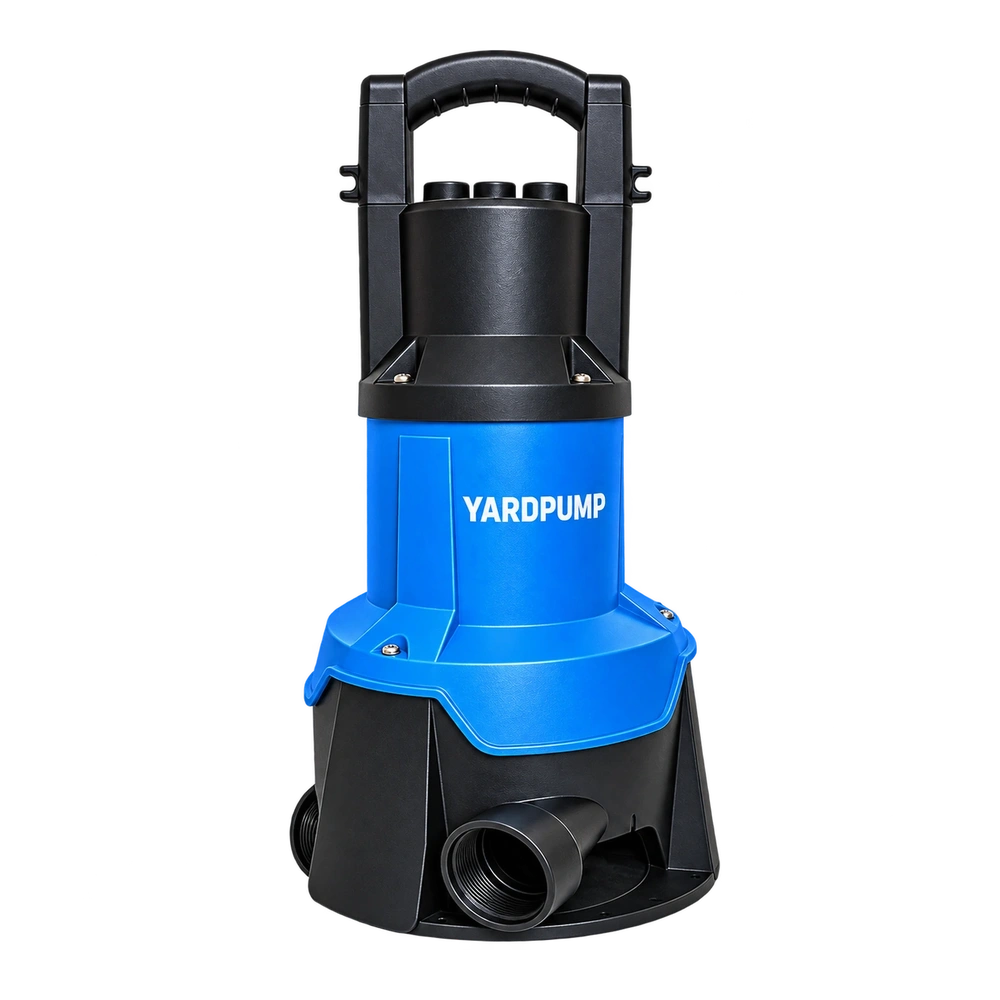
Short answer: Do not assume it can. Closing a nozzle stops the outlet flow; it does not switch off an ordinary manual utility pump. Whether any period of closed-discharge operation is permitted depends on the exact pump design and its instructions. If the manual does not explicitly permit it, stop the pump before closing the outlet for an extended period.
The garden-hose misunderstanding
A customer puts a portable submersible pump into a rainwater tank and connects a garden hose. Water flows when the nozzle is open. The customer releases the trigger, expecting the pump to stop like an automatic pressure system. But a typical drainage pump may have only a manual power switch or a float responding to water level—not a pressure sensor that recognizes a closed nozzle.
With the nozzle closed, the system moves toward zero discharge flow while the impeller may continue rotating. Energy can be dissipated as heat within the pump. The resulting risk depends on construction, cooling, water level, time and manufacturer limits. It is not correct to declare a universal safe number of minutes for all submersible pumps.
Three control arrangements buyers must not confuse
| Product arrangement | What normally triggers stopping? | Buyer check |
|---|---|---|
| Manual utility/drainage pump | User disconnects or switches off supply | Who supervises it when the nozzle closes? |
| Float-controlled drainage pump | Water level drops to the switch-off level | Does the float still have water and remain up while outlet is closed? |
| Purpose-designed automatic pressure pump | Its specified pressure/flow control logic | Does the exact model allow tap/nozzle shut-off? |
A float switch does not detect that the garden-hose trigger has been released. It only responds to its level-control arrangement. Likewise, a thermal protector is not a substitute for normal switching or permission to operate against a closed outlet.
What the distributor should put in the listing
Say whether the product is intended for drainage/transfer or for pressurized watering, and identify the actual control method. Include the connection size and the effect of a long, narrow hose on delivered flow. If the customer plans to use a hand-operated nozzle or sprinkler, ask for the required pressure, flow, duty cycle and the control behavior when the outlet is shut.
A manufacturer may specify a model-specific limit for closed-discharge operation; that limit cannot be copied to another pump. In all cases, observe minimum water level, electrical protection and the manufacturer's instructions. Never deliberately block the discharge to “test maximum pressure” without an approved method.
A safer buying conversation
The seller can ask four questions: Will the customer leave the pump running unattended? Is the outlet a continuously open drain or a trigger nozzle? Does the job require pressure when the nozzle opens? What happens when the tank runs low? If the task is regular on/off garden watering, a purpose-designed pressure-controlled solution may be a better match than a basic drainage pump.
YARDPUMP's compact product range should be evaluated against the selected model's duty and control limits, not treated as universally pressure-controlled. Start with Rainwater Tank Transfer, Product Models and Contact.
FAQ
Will the float switch turn the pump off when I release the nozzle? Not because of the nozzle. A float responds to water level, and it may remain in its on position.
Is a thermal cut-out enough? No. It is a protective device under specified conditions, not normal user control.
Can I simply add a pressure switch? Do not assume an add-on makes the pump suitable. Controls, hydraulic duty, cooling and electrical safety must be engineered for the exact model.