The short answer
If a submersible pump listing says 2,450 US GPH and 247 L/h for the same flow, the numbers do not match. A US gallon is approximately 3.785 L, so 2,450 US gallons per hour is approximately 9,274 L/h, or 9.27 m³/h. By contrast, 247 L/h is only about 65.3 US GPH. This is a unit-conversion discrepancy, not evidence that the pump itself performs badly.
A marketplace buyer should flag the text for clarification before copying it into a catalogue or using it for a technical comparison. Never silently ‘correct’ the specification of a particular product without checking the manufacturer’s approved data sheet and test basis.
A compact conversion table
| Listing number | Correct mathematical conversion | Important note |
|---|---|---|
| 2,450 US GPH | ≈9,274 L/h ≈9.27 m³/h | Assumes US liquid gallons |
| 1,800 US GPH | ≈6,814 L/h ≈6.81 m³/h | Flow, not head |
| 30 US GPM | ≈113.6 L/min ≈6.81 m³/h | 1 hour = 60 minutes |
| 25 ft of head | 7.62 m of head | Length conversion, not flow |
| 247 L/h | ≈65.3 US GPH | Not equivalent to 2,450 GPH |
The arithmetic is universal; the performance claim is not. A conversion only restates the number. It does not establish whether the original flow was measured at zero head, at a working head, or under the intended electrical supply.
Five checks for cross-border product managers
1. Confirm which gallon. US liquid gallons and Imperial gallons are different units. Listings aimed at North America commonly use US GPH/GPM, but the source document should specify the convention.
2. Confirm the time denominator. GPH means gallons per hour; GPM means gallons per minute. Confusing them introduces a 60-fold error.
3. Do not join two separate maxima. Maximum flow usually refers to a low-head endpoint, while maximum head refers to the near-zero-flow endpoint. Ask for the actual Q–H curve and the target duty point.
4. Check the electrical version. A listing for 120 V/60 Hz cannot automatically be copied to a 230 V/50 Hz product. The approved performance data must match the version being sold.
5. Verify the units everywhere. Compare the technical table, infographic, product title, marketplace attribute fields, downloadable manual and carton. One typo may spread into six sales assets.
A practical buyer handoff
When you see conflicting units, record the product URL, screenshot date, the two original numbers, the arithmetic conversion, the source document requested and the status: ‘pending clarification’. That keeps a data-quality finding separate from a product-quality accusation.
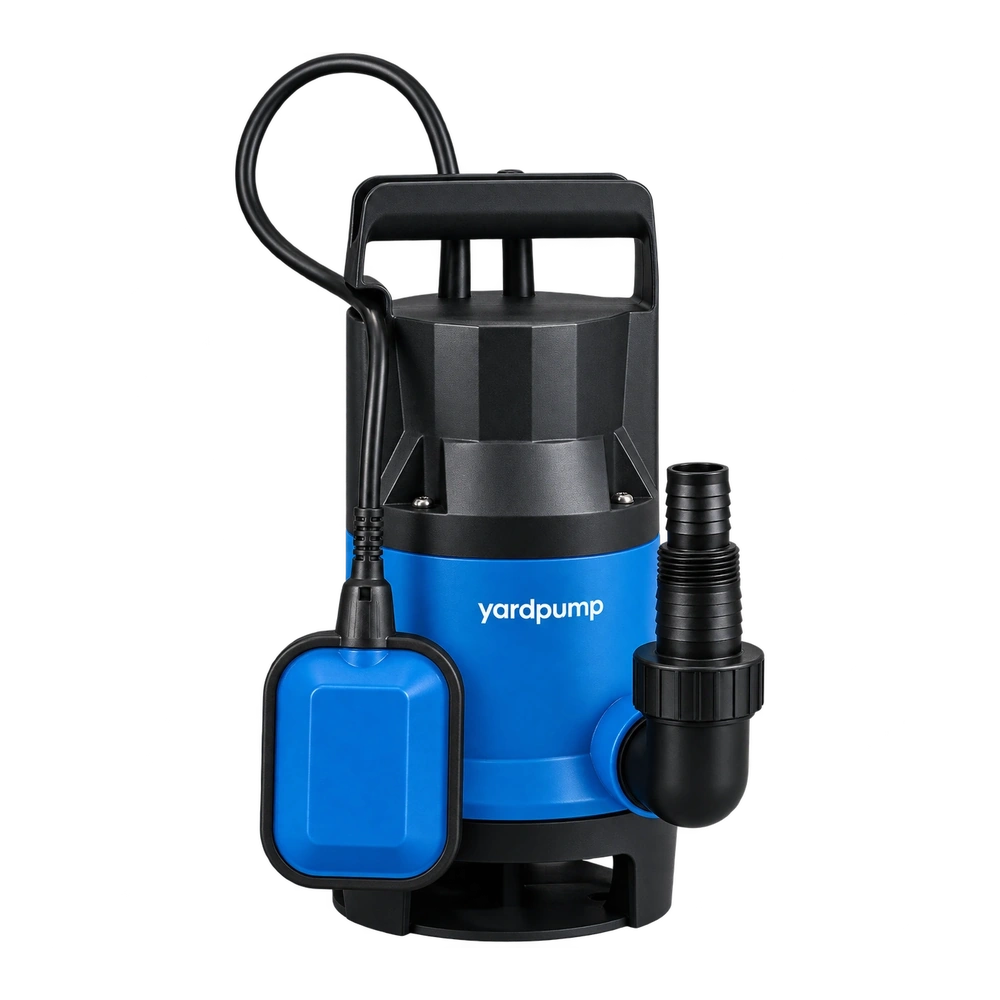
A useful OEM enquiry includes the required flow at the working head, the intended hose or pipe, voltage/frequency and target market. The YARDPUMP product range separates model families, while the technical resources explain selection principles. Send unresolved version questions through the contact form.
FAQ
Is 2,450 GPH always 9.27 m³/h in actual use? It is the correct unit conversion for a stated US-GPH value. Actual installed flow depends on the pump curve and system resistance.
Can I compare 25 ft maximum head with 2,450 GPH maximum flow? Only as two separate endpoints. They are not normally simultaneous.
Does a unit mismatch prove a seller is exaggerating performance? No. It may be a copy, translation or data-entry error. Request the approved specification before drawing conclusions.
Editorial boundary: The numerical example is a conversion check, not a claim about the tested performance of any named competitor.