“Would PPS make a better impeller than PA66?” It may be worth investigating when moisture-related dimensional change or retention of fit at elevated temperature is the actual concern. The resin name cannot approve the conversion. An impeller is a rotating part transmitting torque and carrying hydraulic loads. Compare the specific moulded grade, local strength, shaft connection and complete-pump performance. A higher material temperature capability does not preserve the original tooling, dimensions or assembly requirements automatically.
Define the problem before selecting the resin
If the original impeller jammed on a hard object or was assembled with an unsuitable clearance, a more expensive polymer may leave the same problem unresolved. Record whether damage starts at a vane root, hub, bore or outside edge. Relate it to moisture exposure, temperature, rubbing and starting events. The material decision should address an identified mechanism.
PPS generally offers low moisture absorption and useful thermal and chemical resistance. Actual behaviour depends on grade, reinforcement, processing and service conditions. A general description cannot establish every grade’s hot-water, impact or wear performance. Nor can a resin test temperature become the permitted liquid temperature of the finished pump.
The original tool may produce different dimensions
Mould shrinkage compensation belongs to a material and process combination. A resin or reinforcement change can alter directional shrinkage, warpage and local geometry. An outside diameter that still appears correct does not establish bore size, face position, vane thickness or running clearances.
For an illustrative dimensional budget, suppose one interface has only a tenth of a millimetre of available allowance. A manufacturing or thermal change of similar magnitude deserves assessment. This is not a recommended pump clearance. Use actual tolerances, temperature effects, axial location and moisture condition to determine whether the candidate part covers the assembly’s required operating range.
| Comparison level | Evidence to request |
|---|---|
| Specific PPS grade | Reinforcement and data relevant to liquid and temperature |
| Moulded impeller | Critical dimensions, warpage, meeting regions and stable processing |
| Hub and shaft connection | Torque transmission, retention and long-term stability |
| Complete pump | Curves, real input, temperature, vibration and endurance results |
Stiffness is not every mechanical property
Greater stiffness can reduce some deformation while leaving a stress concentration at a vane root. The hub must still transfer shaft torque into the polymer. Fibre direction, flow-front meeting regions, bore edges and insert interfaces need examination in the actual load path. One tensile-strength value from a test specimen can miss the weakest region of the component.
Assembly impact and abnormal loads also matter. Hitting a part, improvising a stall test or spinning it outside an approved procedure cannot demonstrate acceptable durability. If inserts, fastening or vane thickness change, record those changes separately. An improved combined result cannot be attributed entirely to PPS.
Compare the actual operating configurations
Two impellers in one casing are not a resin-only comparison if their surface, effective width or clearance differs. Retain the original configuration as a reference, measure the manufactured geometry and compare under matching supply, liquid, duty and temperature conditions. A short clean-water run establishes only the behaviour covered by that trial.
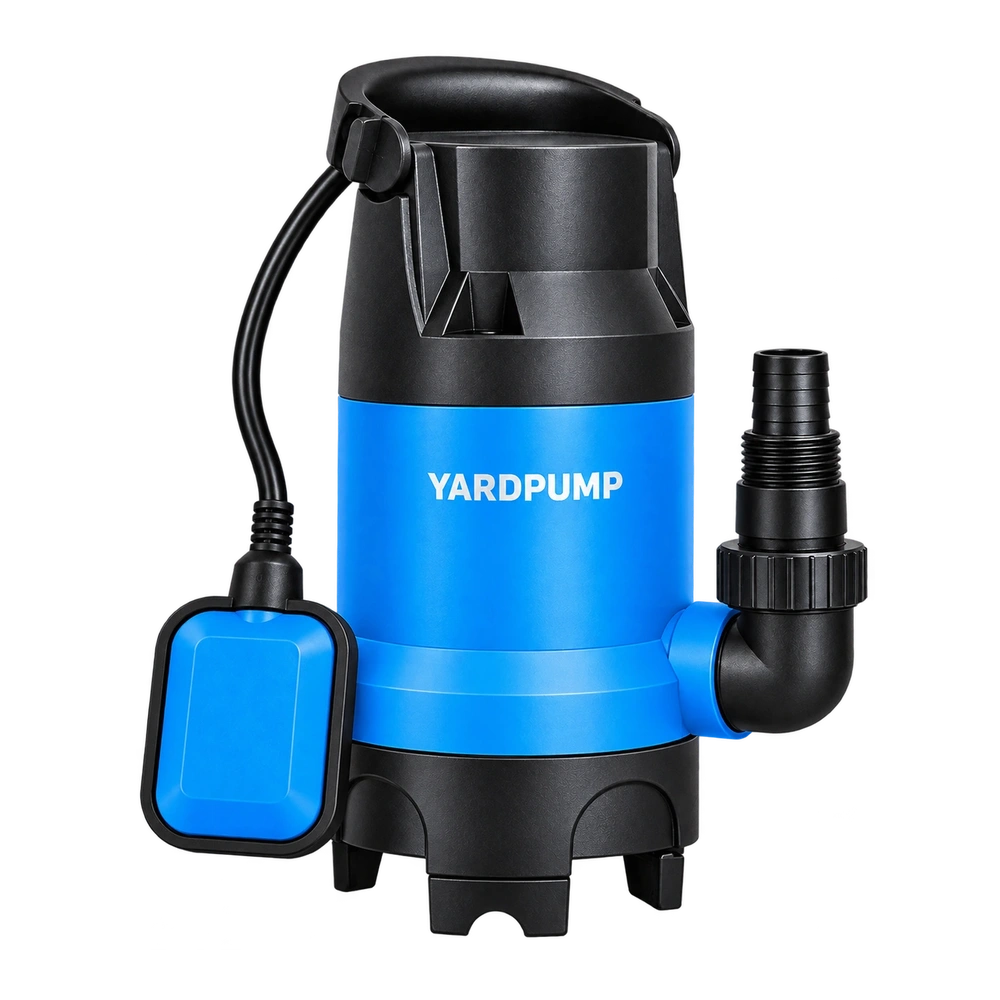
For saltwater, cleaning solutions or other intended liquids, validate the complete wetted assembly. A PPS impeller does not extend the limits of shafts, seals, cable entries or other materials. This is a candidate-design discussion, not a statement that every YARDPUMP model offers or has validated a PPS impeller.
Approve a component revision
The order should identify resin grade, drawing revision, critical dimensions and accepted process-change boundaries. Preserve the relationship between development samples and production parts. A substitute described simply as another PPS may require reassessment of the evidence supporting the approved version.
If the existing PA66 arrangement already meets the task, PPS should solve a defined concern or improve an acceptable overall cost. Include tooling changes, process development, production yield, validation and spare-part control before judging the resin price. The useful purchasing result is an approved impeller configuration with a reason for its material choice.
Questions about PPS impellers
Does low moisture absorption remove the need for hot dimensional checks?
No. Thermal expansion, moulding condition and assembly loads can still change fit.
Can the original PA66 tool produce PPS parts directly?
Appearance cannot establish that. Review tooling, processing, shrinkage and the resulting component.
Is PPS inherently more durable than metal or PA66?
There is no universal ranking. Compare complete arrangements against the actual liquid, load, temperature and failure mechanism.