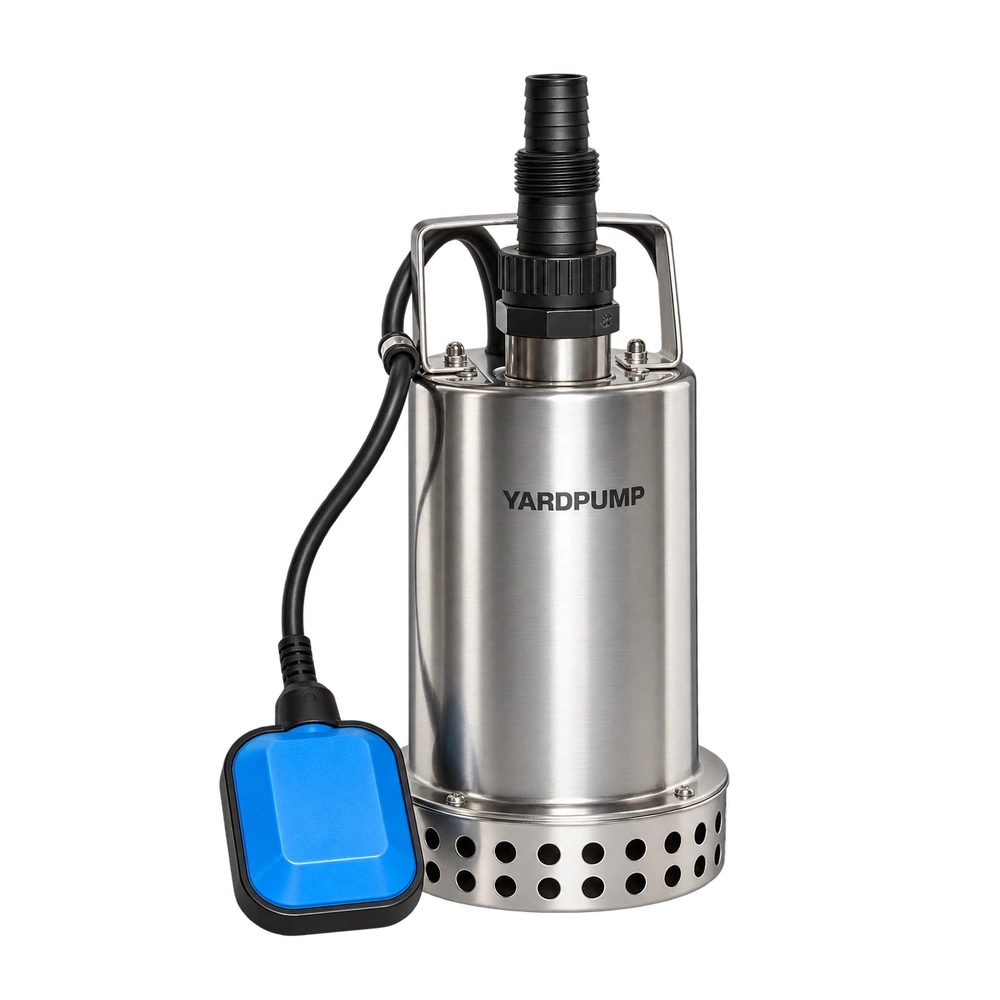
The answer before the quotation
“Suitable for a fish pond” does not mean “approved for seawater aquaculture.” A 304 stainless-steel housing does not make the complete pump seawater-resistant. Before a distributor or private-label brand makes a saltwater claim, it needs the actual liquid composition, salinity or chloride content, temperature, operating schedule, particles, duty point and full wetted-material configuration. The supplier must then confirm a suitable version and agreed verification plan. Until that is done, the defensible statement is “subject to water and duty review,” not “universal seawater pump” or “corrosion-proof.”
This is a sales-claim and warranty-boundary problem, not simply a debate about 304 versus 316. The water may contact the housing, shaft, fasteners, impeller, seal faces, elastomers, cable entry and any relevant chamber or internal hardware. Upgrading one visible component does not qualify the complete assembly.
Two aquaculture enquiries that should not receive the same answer
Imagine a distributor receiving one request for periodic freshwater-pond transfer and another for long-running circulation at a coastal shrimp farm. Both customers ask for a submersible pump. The first still requires pH, sediment, soft-particle, temperature, flow and head checks. The second adds salinity, stagnant-water exposure, cleaning chemicals, longer immersion and compatibility of the entire wetted assembly. These are illustrative enquiries, not reported YARDPUMP customer cases.
A salesperson who sees “stainless steel” and replies “seawater is fine” may leave procurement, the operating instructions and the warranty team with three incompatible interpretations. If corrosion, seal leakage or reduced flow later occurs, the evidence may not show whether the cause was liquid selection, installation, maintenance, configuration or a manufacturing issue.
Start with a water-condition decision table
| Customer description | Missing facts to request | Claim to avoid before approval |
|---|---|---|
| Freshwater pond transfer | pH, temperature, sediment, soft solids, duty point and runtime | “Works in every pond” |
| Brackish-water aquaculture | Measured salinity/chloride, temperature, treatment chemicals and stagnant exposure | “Use the standard freshwater version” |
| Seawater shrimp farm or vessel drainage | Full wetted BOM, seal and cable arrangement, duty cycle, cleaning and validation plan | “304 or 316 housing means seawater-ready” |
| Chemically treated pond or pool | Chemical identity, concentration, temperature, contact time and discharge rules | “pH alone proves compatibility” |
Public technical guidance from a professional stainless-steel association cautions against treating 304 as a seawater-service material; 316 also has limits, including pitting and crevice-corrosion risks influenced by temperature, flow, stagnant exposure and geometry. Even a proposed 316 option requires system-level review. This article does not claim that any YARDPUMP model has passed a seawater endurance test.
The evidence packet behind a saltwater claim
| Evidence category | What the buyer should obtain | Approval owner |
|---|---|---|
| Duty and liquid brief | Salinity/chloride, pH, temperature, chemicals, particles, flow at head, runtime | Customer/project engineer |
| Wetted-material BOM | Housing, shaft, fasteners, impeller, relevant bearing components, seal faces, elastomers, cable entry | Supplier engineering and quality |
| Operating limits | Maximum submersion, minimum running water level, cooling and continuous/intermittent duty | Supplier engineering |
| Verification plan | Test liquid, exposure period, inspection method, acceptance criteria and sample revision | Both parties in writing |
| Sales and warranty wording | Approved liquid range, maintenance instructions, exclusions and evidence requirements | Brand, channel and service teams |
YARDPUMP's currently confirmed general maximum submersion depth is 5 m. The clean-water particle boundary is 0.2 mm, while relevant dirty-water families have a 5 mm soft-particle boundary. Solids passage does not prove sand-abrasion resistance; a pH range does not establish seawater compatibility. A 304 housing designation does not tell the buyer that every shaft, bearing-related component, fastener, seal or cable has equivalent corrosion resistance. Any seawater programme needs separate feasibility, sample and verification confirmation.
When a complaint arrives: preserve the distinction between evidence and blame
If the complaint includes a tripped protective device, damaged cable, abnormal heating or suspected water ingress, the first response is to stop use and refer electrical work to qualified personnel. Do not ask the customer to dismantle or test a live pump. Then record the model, serial or batch information, rating plate, operating history, water condition, installation depth, hose route and photographs. Ask about saltwater, treatment chemicals, abrasive particles and maintenance without assuming misuse.
Retain the returned assembly and relevant photographs for engineering or quality review. Decide whether inspection, material verification or further testing is needed before assigning a root cause. A corroded component is evidence of a condition, not by itself proof of a manufacturing defect or proof that the customer used the product incorrectly.
A practical service taxonomy separates outside-approved-liquid conditions, installation or operating deviation, delivered-configuration mismatch, and manufacturing issue still under investigation. The aim is accurate resolution and better product selection, not automatic warranty denial. Carry the approved liquid limits into the sales card, manual and service workflow so that the channel's promise matches the product actually supplied.
A sales response that can still win the enquiry
For freshwater transfer: “Please send the water condition, particle information, required flow at head and daily operating time so we can check a specific model.” For brackish or seawater: “We can review wetted materials and seal options for your project; we will not describe a standard freshwater version as seawater-suitable until the liquid and verification scope are agreed.” That is a stronger long-term offer than a fast but unsupported claim.
Buying decision: An aquaculture range benefits from clear boundaries: freshwater candidates, brackish-water configurations pending review, and seawater projects requiring separate validation. YARDPUMP's verified internal application page is /applications/pond-aquaculture/; compare product families at /products/ and submit the liquid and operating brief via /contact/ for project-specific confirmation.