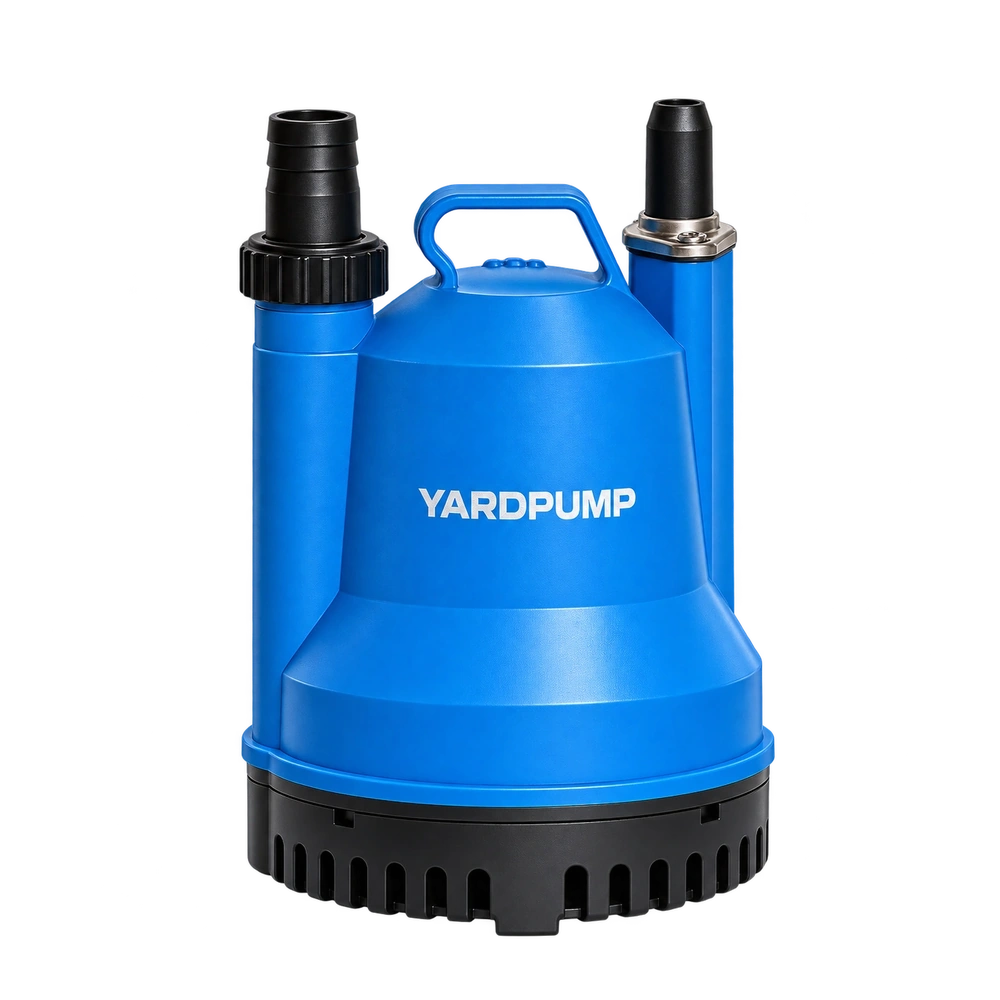
A pump starts normally on utility power but only hums on an inverter whose advertised watt rating appears larger. Another pump makes a generator’s voltage collapse during starting. In these typical situations, the missing specification is often starting capability, rather than running watts alone. Stop promptly if the motor cannot accelerate; repeated stalled attempts can create thermal damage.
For off-grid drainage, establish running input, starting apparent power and duration, supply quality and the required protection arrangement.
Running watts and starting capacity are different requirements
First identify whether the pump’s stated power is shaft output P2 or electrical input P1. For a single-phase supply, apparent power S is approximately voltage multiplied by current, in volt-amperes. Active input power also depends on power factor. A source’s continuous rating and short-duration overload capability are not interchangeable.
Starting demand depends on the actual motor, starting method, mechanical load and supply voltage drop. A universal multiplier cannot cover every pump. Likewise, an inverter’s advertised peak may last too briefly to support acceleration. Confirm that its waveform and control behaviour are suitable for the specific motor load.
An assumed example, not a sizing rule
Suppose a pump draws 800 W of active input while running with power factor 0.80. Its running apparent demand is approximately 1,000 VA. Suppose separately that verified information for this particular hypothetical combination establishes a starting demand near 3,000 VA for 0.3 seconds.
A source promising 1,000 W continuously, but lacking the relevant transient capability, cannot be assumed suitable. These values are illustrative; they are not specifications for an arbitrary 800 W pump. Obtain actual starting information or perform an agreed compatibility test.
| Requirement | Ask the pump supplier | Check with the source supplier |
|---|---|---|
| Normal operation | P1, current, power factor and duty | Continuous W and VA, temperature derating |
| Starting | Demand magnitude and duration | Overload curve and voltage response |
| Supply quality | Permitted voltage, frequency and waveform | Output behaviour under the load |
| Protection | Earthing and protective requirements | Output arrangement and suitable protection |
An inverter also depends on its DC supply
The battery, battery-management system, cables and terminals can become the limiting elements even when the inverter’s AC rating appears sufficient. A starting-related DC voltage dip may trigger shutdown and resemble an inverter-capacity problem. Competent personnel should check discharge capability, permissible minimum voltage, temperature and connection losses.
Do not fit oversized protection or bypass the battery-management system to force a start. Runtime estimates should use actual input power and operating duty, allowing for conversion loss, usable battery energy and temperature. Dividing nominal battery watt-hours by shaft output does not provide a dependable drainage duration.
Include other connected loads and any possibility of simultaneous pump starts. A staged starting arrangement may reduce coincident demand, but its suitability must be confirmed rather than assumed.
Generator placement is part of the installation
Operate a fuel-powered generator outdoors in a suitable position, well away from doors, windows, vents and occupiable buildings, with exhaust directed away. Never use it in a basement, garage or shed, even with doors open. Carbon monoxide risk remains. Follow the manufacturer’s and local requirements for weather protection, earthing and electrical protection.
A qualified electrician should confirm the supply arrangement. Never backfeed building wiring through a plug connection. Portable sources can have different neutral and earthing arrangements, so a utility-supply assumption may not apply directly.
Verify the actual starting condition
Use the intended water level, pipe arrangement and source condition for cold starts and permitted repeat starts. Qualified personnel should record the voltage minimum, frequency behaviour where relevant and any protective operation using appropriate instruments. Do not repeatedly attempt starts until the equipment overheats.
A compatibility record should identify the exact pump and source variants, battery condition if applicable, connected loads and test conditions. Without that information, a successful demonstration with one combination cannot justify every unit carrying a similar watt rating.
For emergency standby, distinguish a freshly charged battery demonstration from starting at the lowest intended state of charge. Temperature and additional loads can change the result. State the minimum intended battery condition, runtime assumptions and inspection arrangement rather than promising the whole standby period from one full-charge test.
Frequently asked questions
Does a pure-sine-wave inverter guarantee successful starting?
No. Waveform is only one condition. Continuous VA, transient capacity, the DC supply and protection must also be suitable.
Can any soft starter be added to a single-phase submersible pump?
No. Compatibility depends on the specific motor and control method. A three-phase solution cannot simply be transferred.
Can the motor keep humming if thermal protection has not tripped?
It should not. Failure to accelerate is abnormal. Disconnect and investigate instead of treating thermal protection as normal starting control.