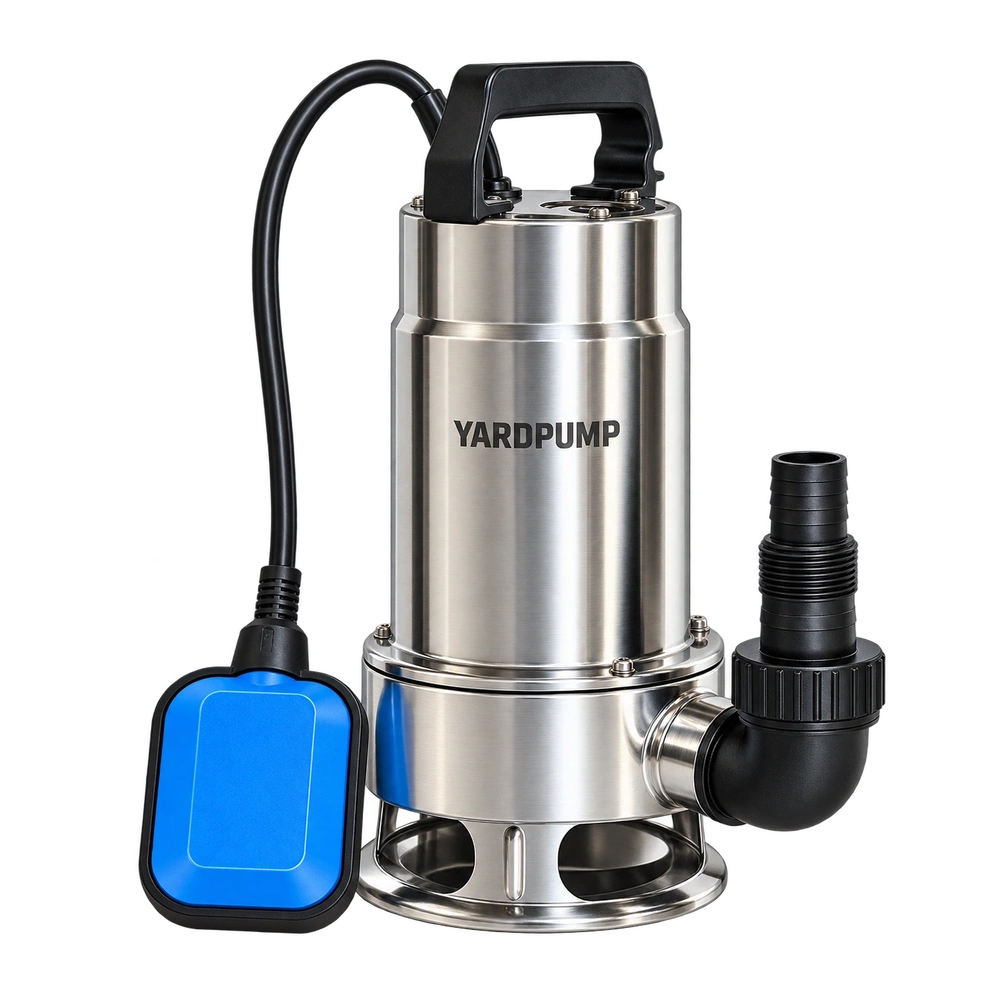
One submersible pump drains a site too slowly. Adding an identical pump to the existing discharge pipe seems an obvious way to double the flow. It may increase flow substantially, but doubling is not automatic. Parallel pump capacities are added at equal head; the actual duty is where their combined curve meets the system curve.
The more restrictive the common discharge pipe becomes, the smaller the useful addition from the second pump may be.
Add flow at the same head
For two identical pumps, select a head and add their individual flows at that head. Repeating this builds the combined curve. Adding the two advertised maximum flows and assuming the original operating head remains unchanged is not a valid system calculation.
Each branch also has losses. Unequal hose lengths, fittings or pump characteristics change the flow sharing. Meanwhile, friction in the common line increases with total flow. A squared-flow relationship is a useful simplified turbulent-flow model, although its coefficient depends on diameter, roughness and other conditions. Starting the second pump therefore changes the head required by the pipework.
A deliberately hypothetical curve example
Assume each pump follows H = 12 − 0.08Q², and the system follows H = 3 + 0.02Q², with Q in cubic metres per hour and H in metres. These are invented curves solely for illustration.
The single-pump intersection gives approximately 9.49 m³/h. With two identical pumps sharing flow equally, the combined pump relationship becomes H = 12 − 0.02Qtotal². Its intersection with the system gives 15.00 m³/h total. The increase is approximately 58%, rather than 100%.
These results are not product performance data. Enlarging the common line could flatten the system curve; changing static lift or branch resistance would change the answer again. Air, solids accumulation and unsteady drainage can also make a simple steady-flow calculation insufficient. Use verified curves and the actual arrangement for a purchasing decision.
Prevent the branches from interfering
A stopped branch can become a reverse-flow path. The designer should establish suitable check-valve and isolation arrangements for each branch. One check valve after the junction does not automatically prevent flow into the stopped pump. Valve selection must address the water’s solids, installation orientation, losses and closing behaviour.
With dissimilar pumps, the weaker unit may deliver very little at the common pressure or may fail to open its check valve properly. Current in both motors does not prove useful output from both pumps. Do not improvise series/parallel conversions or permit uncontrolled reverse driving of a stopped unit.
| Test state | Record | Decision supported |
|---|---|---|
| A alone | Flow, head, current and water level | Individual operating suitability |
| B alone | The same measurements | Pump or branch differences |
| A and B together | Total and obtainable branch flows | Real increment and load sharing |
| One unit stopping | Reverse flow and valve response | Interaction between branches |
Specify controls and hydraulic performance together
Level-based staging can bring in the second pump as demand rises. Starting order, permitted start frequency and alarms must suit the available collection space. The electrical supply must also support the intended simultaneous demand and starting sequence. Adding a pump changes more than the water circuit.
Give the supplier the common pipe diameter, length, elevation change, outlet condition and branch drawing. Request confirmation of both single-pump and dual-pump duties. For redundancy, define the acceptable capacity with one unit unavailable. For peak-flow assistance, state the combined acceptance duty. Describing the same extra pump as both a standby and a simultaneous duty unit without defining the operating states creates an avoidable specification gap.
Commissioning should use consistent water-level conditions when comparing configurations. Otherwise, a reduced lift during the two-pump trial can exaggerate the apparent benefit. Retain individual readings as well as the total result.
If the common line discharges into a river or tank with a changing level, its boundary pressure is not fixed. State the receiving-level range when assessing both operating states. A demonstration at low receiving level cannot promise the same capacity with a submerged outlet during a storm. Review the required protection against reverse flooding as part of that arrangement.
Frequently asked questions
Can pumps with different power ratings operate in parallel?
Possibly, but watts are not the deciding criterion. Compare complete curves, useful flow at common pressure and each pump’s permitted operating range.
Is a larger common pipe always the best investment?
Compare the actual capacity gain, modification cost, drainage task and solids-transport needs. Pump count or pipe diameter alone cannot answer that.
Does higher total flow prove both motors have acceptable loading?
No. Flow sharing may be uneven. Check individual electrical loading, stability and operating limits.